

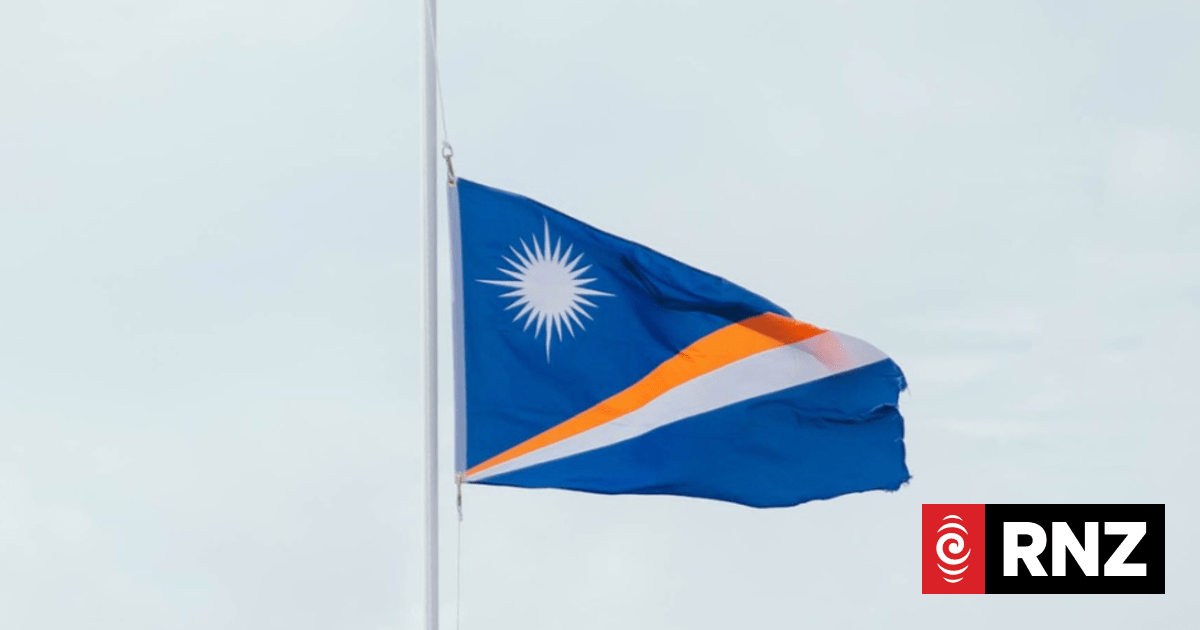
Marshall Islands flag
Photo: Facebook / Office of the President, Republic of the Marshall Islands / Hersol C Canete
Marshall Islands Finance Minister David Paul says he has no guarantee of fuel shipments for the next two months onward.
Paul told RNZ Pacific the country is at the mercy of the market, with no way of predicting future supply due to the conflict in the Middle East between Israel, the United States and Iran.
“Your guess is as good as mine,” he said.
“In order to be realistic, everything is still fluid, and anything can happen. I really cannot predict one way or the other.”
The country, which relies on diesel generators for 90 percent of its electricity, declared a 90-day state of economic emergency at the beginning of the month.
It gives the government broad powers to limit the use of fuel in its public sector.
Read more:
Paul said its last shipment, which will last them about two months, was three times more expensive than normal.
“You tend to find yourself paying higher premiums than what is stipulated in the contract, because it is easier for companies in this particular predicament to declare force majeure because [the Iran war] is something they have no control over,” he said.
“We have a multinational company, ExxonMobil, still operating in the market. But our worry and the uncertainty that we face is [over] the fuel requirements for power generation … before the next load arrives.”

Marshall Islands Finance Minister David Paul
Photo: Supplied
Under the new state of emergency, the Marshallese government and most of its services are shutting down at 3pm every day.
Aiming to reduce energy use by 30 percent over the 90 days, offices are required to shut off air conditioners, lights and any other equipment drawing power.
Public schools and major hospitals are exempt. Paul said he has contemplated a worst-case scenario where supply completely dries up.
“We’ll have to make sure that we insulate ourselves from this kind of exposure in the future, but at this point in time, we really are at the mercy of the availability of supply that the market will be able to offer.”
Speaking from Boston, Paul said he had discussed with the US possible ways it could assist, saying added financial assistance, on top of Compact funding, is on the table.
“We will continue to dialogue with them … making sure that we get the support and the supply needed, whether it’s providing personal assistance … or whether there’s going to be an actual supply [of fuel].”
Tuvalu has also declared a state of emergency, while Solomon Islands, Fiji, Nauru, Vanuatu, the Cook Islands, and the Federated States of Micronesia have introduced measures to limit the usage of their existing fuel stocks.
