


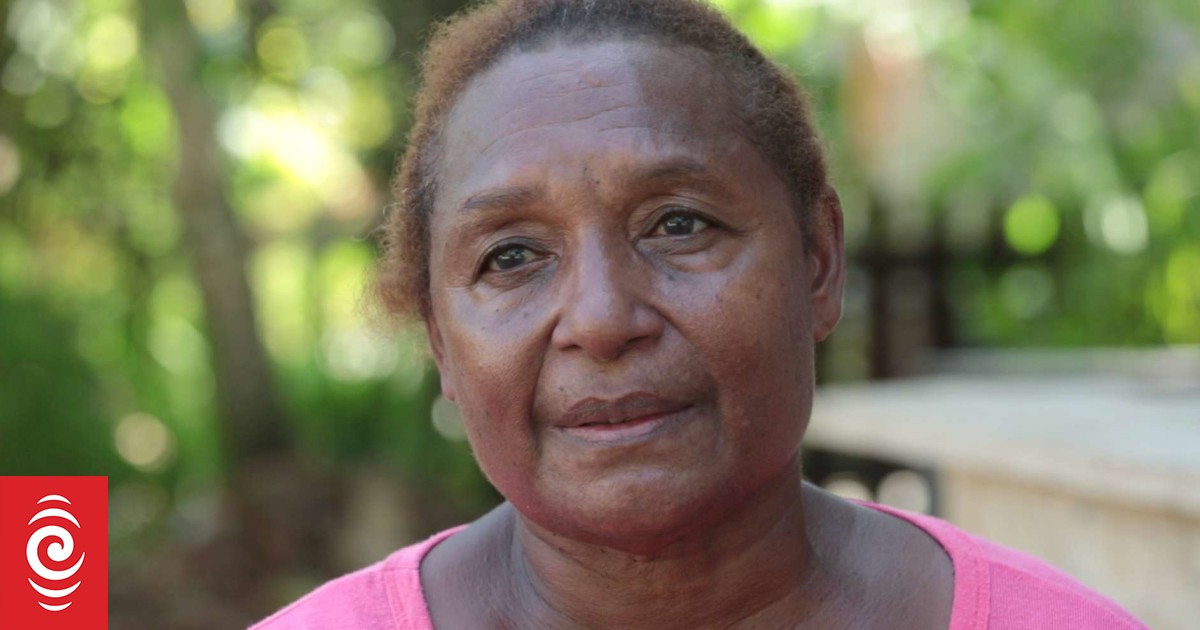
Dorothy Tekwie
Photo: RNZ / Koroi Hawkins
A women’s rights advocate in Papua New Guinea has called for the creation of a Ministry for Women.
According to Dorothy Tekwie, such a ministry is required to address long-running issues of discrimination, abuse, and marginalisation of women in PNG.
In recent years, the Cabinet has expanded to include new ministries for coffee, for oil palm and for livestock among other portfolios. Tekwie said it was telling that there was no ministry to deal with pressing issues holding back half of the population and, by extension, the country.
“We have currently 38 ministries. And I’m not saying that they are not needed, but they could be amalgamated, or they could be more reasonable,” she told RNZ Pacific.
“I am actually calling for a Ministry for Women, and the call is, if it’s not for this government, then hopefully we get it when the new government is formed after next year’s election.”

Woman at election rally, East Sepik, PNG.
Photo: RNZI/Johnny Blades
When PNG gained independence in 1975, the constitution provided for equality and participation of women in political, social and economic development of the country.
But according to Tekwie, implementation of these provisions had rarely been properly resourced, nor had political will behind it.
She said currently, women’s issues were mainly shoehorned into a poorly-funded office within the Community Development Department.
“Women, who are now a little bit more than 50 percent of the population of this country, are pushed into the Community Development Department or a department that is handling everything like Religion, Youth and Sports.”
Tekwie said people should consider that women literally give life to everyone and play a critical role in the health of the population – as such, the challenges facing women are important national issues.
PNG’s Prime Minister James Marape last month said his government wanted to “raise consciousness” about domestic violence faced by women in the country. He said 64 percent of women in PNG had experienced “one form or another” of violence in 2025.
“We are not asking for a big ministry, but something that can coordinate the National Council of Women, that can do all the all the good work that women SMEs (Small to Medium Enterprises) are doing, all the good work that women in the churches are doing, and pull everything together and look at the issue of abuse.
“Women, children, young girls are being abused by men in the community, even in the families. Family-related sexual violence is on the increase. So we want to have a small ministry, and not big, probably the smaller side of all of them, but we want to see it supported.”

Papua New Guinea parliament in session on 15 February 2024.
Photo: Loop PNG / Screencapture
PNG has had very few women elected to its national parliament in its five decades since independence. Tekwie said voters had bought into unhelpful stereotypes.
“They have this notion that the man is the leader and the woman is the servant. Well, it’s time. It’s time this country puts the servants up there so that the servants can produce the goods that this country needs to be fed, to be clothed, to be educated, to be healthy.”
At last week’s Momase Regional Development Forum in Madang, Tekwie presented a petition signed by 41 women leaders calling for a Ministry for Women to Charles Abel, former Deputy Prime MInister and head of the Government Reset @50 Committee, a committee tasked with developing a blueprint to guide policy, planning, and implementation over the next 20 years.
