


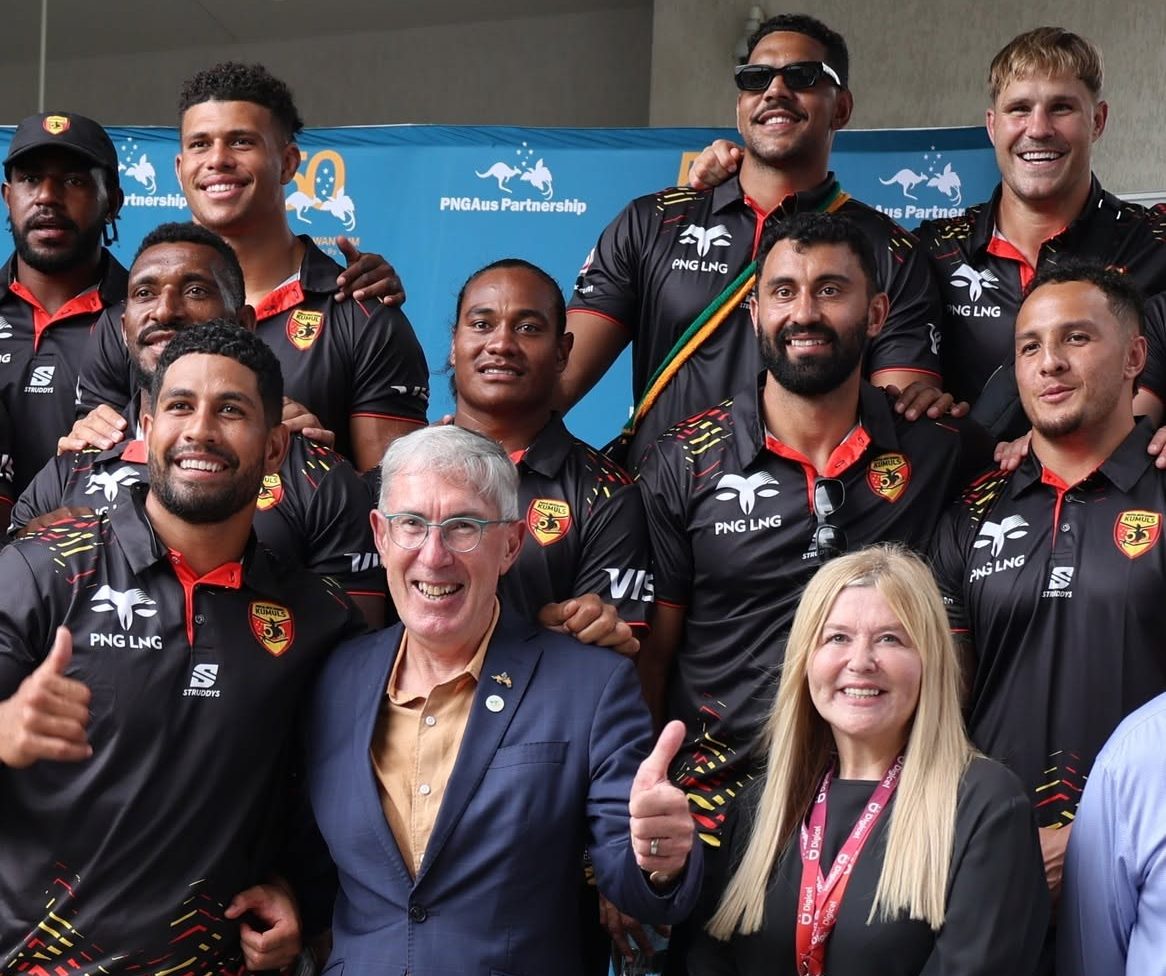
Recent developments surrounding Papua New Guinea’s entry into Australia’s National Rugby League (NRL) through the PNG Chiefs have generated understandable excitement. For many Papua New Guineans, the announcement confirms what has long been obvious: rugby league is not merely a sport in PNG; it is part of the country’s social fabric.
Yet the Chiefs project is about more than sport. The scale of investment, the involvement of both governments and the strategic context in which the deal emerged demonstrate that PNG’s NRL entry should be understood as both a nation-building project and an exercise in regional diplomacy.
Rugby league was first introduced during the gold rush era and later strengthened through Australian military presence during and after World War II. Over time, what began as an imported game evolved into a uniquely Papua New Guinean institution. Domestic competitions expanded throughout the 1960s and 1970s, representative matches drew large crowds, and rugby league became one of the few activities capable of uniting people across Papua New Guinea’s immense cultural and linguistic diversity.
The emergence of players such as Adrian Lam, Marcus Bai, David Mead and Justin Olam demonstrated that Papua New Guinean athletes could compete successfully at the highest levels of the game. The establishment of the PNG Hunters in 2013 further strengthened pathways into professional rugby league and laid important foundations for the Chiefs franchise.
Against that historical backdrop, the December 2024 announcement of a PNG-based NRL team represents the most significant development in the country’s rugby league history. However, the initiative also reflects broader strategic considerations.
Australia has committed approximately $600 million over ten years to support the franchise and related rugby league development activities. Public reporting further indicates that the arrangement is linked to wider strategic objectives in the Pacific and was accompanied by undertakings concerning the ongoing security relationship between Australia and PNG. Reports suggest that Australian support is contingent upon PNG maintaining Australia as its principal security partner and not entering security arrangements that would undermine that relationship.
This places the Chiefs project firmly within the realm of soft power, indeed bordering on the realm of hard power. Unlike conventional aid programs, sports diplomacy seeks to strengthen influence through shared interests, cultural connections and public goodwill. Rugby league provides Australia with a uniquely effective vehicle for engagement because it already enjoys deep legitimacy within PNG. Rather than creating a new institution, the partnership invests in one that already commands widespread public support.
At the same time, the arrangement raises legitimate questions about opportunity cost. Supporters correctly observe that the funding does not come from PNG’s domestic budget and was specifically allocated by Australia for this purpose. In that sense, the Chiefs are not directly competing with PNG government expenditure on hospitals, schools or roads.
However, the broader question remains. Could A$600 million of Australian expenditure have generated greater developmental benefits through investments in health, education, infrastructure or governance reform? Critics have argued that the scale of the commitment invites comparison with other development priorities that continue to face significant resource constraints.
The answer ultimately depends on outcomes. If the initiative creates jobs, stimulates tourism, expands sporting opportunities, develops youth pathways and strengthens bilateral relations, the investment may prove justified. If those benefits fail to materialise, however, opportunity-cost concerns will become increasingly difficult to dismiss.
This is where governance becomes central.
PNG’s challenge has seldom been the absence of plans. More often, the problem has been translating policy commitments into sustained implementation. More often, challenges emerge during implementation. The Chiefs project therefore faces a governance test that extends well beyond sport.
The most immediate governance issue is accountability. Once hundreds of millions of dollars are committed across governments, sporting bodies and commercial partners, questions about who owns the project, who makes decisions and who answers for failures become unavoidable. Large-scale funding arrangements involving multiple governments, sporting organisations and private stakeholders inevitably create complex reporting and oversight challenges. Questions relating to ownership, expenditure, procurement processes and performance measurement will require clear answers throughout the life of the project. Transparency will be particularly important because a significant proportion of the funding originates from Australian taxpayers while the team’s legitimacy ultimately depends on support from Papua New Guineans.
The second risk concerns institutional capacity. Establishing a successful NRL franchise requires sophisticated administration, commercial management, talent development systems, corporate partnerships, player welfare programs and long-term financial planning. Building this capability is a substantially different challenge from organising domestic competitions. The success of the Chiefs will depend not only on athletic performance but also on whether robust institutions can be established and sustained over time.
A third risk arises from public expectations. The symbolism of a national NRL team is powerful. However, heightened expectations can become problematic if immediate results fail to materialise. Professional sporting organisations often require years to become competitive. Expansion clubs in elite competitions frequently experience difficult periods before achieving sustained success. If supporters expect instant success, disappointment may create public frustration and weaken enthusiasm for the project.
This risk has broader diplomatic implications. The Chiefs are being presented as both a sporting and strategic success story. If the team becomes competitive, financially stable and nationally admired, it could strengthen the soft-power objectives underpinning the arrangement. Conversely, if the franchise struggles on the field or encounters governance controversies off it, the initiative could become associated with waste, disappointment or dependency rather than partnership and national achievement.
The political risks should not be ignored either. Because the project is linked to a broader strategic partnership, future changes in regional geopolitics could affect public perceptions of the initiative. What is currently celebrated as a sporting opportunity may, in some circumstances, be criticised as an instrument of external influence. Maintaining public confidence will therefore require consistent evidence that the project serves PNG’s interests first.
None of these risks mean the initiative is misguided. On balance, the Chiefs project is probably a worthwhile investment. Rugby league remains one of the few institutions capable of transcending regional, linguistic and cultural differences within PNG. Few development initiatives possess comparable nation-building potential.
Nevertheless, success is not guaranteed. The long-term value of the project will depend on governance standards, institutional competence, financial accountability and realistic public expectations.
The main question is no longer whether PNG deserves an NRL team. A good number would argue that it clearly does. The more important question is whether the institutions responsible for the Chiefs can convert a historic opportunity into a sustainable national achievement.
