


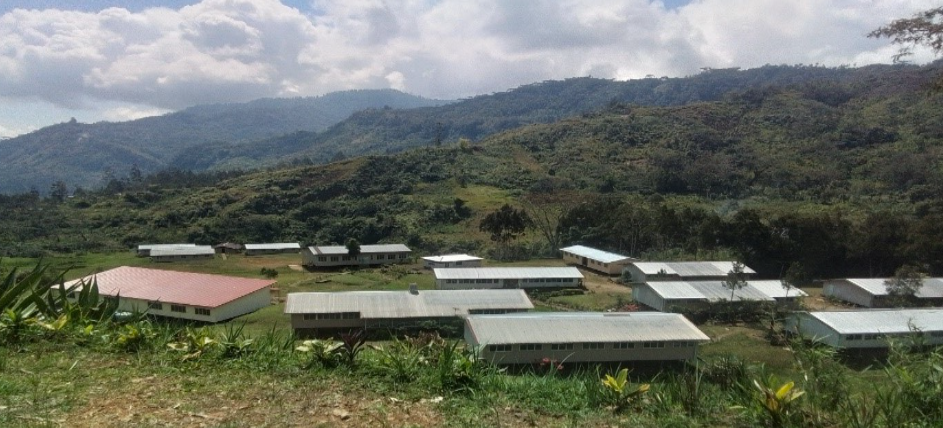
PNG is home to many rural and remote schools. Jiwaka is situated in the central highlands and is itself a relatively remote province. Jimi is the most remote of Jiwaka’s three districts. It is home to the Jimi Valley and is characterised by its mountains, rivers and valleys and by its heavy annual rainfall.
Jimi Secondary School is one of eight and until recently the only boarding secondary school located in the Jimi district of Jiwaka Province. Classified by the Education Department as a level-9 school, it has the capacity to house 600 students, though the actual enrolment is around 350. The vast majority of students board at the school, though there are a few day students.
I visited Jimi Secondary in 2016 and 2024. My new Devpolicy Brief reports on the findings from my 2024 visit. In general, the school’s infrastructure is in disrepair. There are 14 classrooms. Twelve of them are in need of maintenance, and two in need of rehabilitation. None of them has a table and chair for the teacher. None of them has working electricity.
There are two male and two female dormitories. The male dormitories are in a bad state, the female dormitories in a very bad state.
There are ten teacher houses for the 20 teachers at the school. Most teachers have to share a house, even if they have their family with them. Only the Principal and Deputy Principal get houses to themselves. Two teachers are housed at the nearby primary school. The houses have not been maintained since the school opened and are all in poor condition.
The toilet facilities in the school are pit latrines. The mess is extremely basic, with cooking on a wood fire.
The school’s main generator is out of order. A mini, portable generator is used as required to provide power to the school administration and to the computer lab. No electricity goes to the classrooms, the teachers’ houses or the student dormitories. Students are unable to study at night due to a lack of lights.
The school has few textbooks, and there is nowhere secure to store them. There is a computer lab, with about five computers, which is sometimes connected to the portable generator.
There is no sports field at the school and no sporting equipment. The school grounds are large. However, there is no proper fence around the school’s perimeter.
There is no school vehicle.
Despite the urgent need for more spending on operations and maintenance, the emphasis at the school has been on new buildings. Three new buildings have been constructed in recent years, each one funded by a different source: four new classrooms by the Jimi District Development Authority, a science lab by the national government and a school library by the school’s own funds. However, none of these buildings has been completed and none of them is in use.
Expenditure on a road to the school has been more effective because that road has been completed. However, especially because the road is unsealed, it is vulnerable to becoming impassable if it is not maintained.
Other issues that trouble the school are teacher absenteeism, lack of mobile reception, an absence of nearby functioning health facilities and the closed local airstrip. Teacher absenteeism was particularly bad in 2023, the result of political tensions arising from the 2022 general election, and a reminder of the cost of politics in PNG.
School governance entities (the school board and the parents’ committee) exist but rarely meet due to the distances involved in convening a meeting. External inspections are at most annual, with none in 2023, again due to post-election disturbances.
Most students leave after Year 10 to go to other schools. The number of students in Year 12 is only one-fifth of the number in Year 10 at Jimi Secondary.
Running a remote school is no doubt a difficult task, and the commitment of many of the school’s teachers and parents was commendable. Nevertheless, the reality for Jimi Secondary is that is not going to produce well educated students.
Better management and a stronger focus on maintenance and rehabilitation rather than the construction of new buildings is needed. The use of Starlink satellite internet and the purchase of a solar-battery system to provide light for students and teachers in the evening is highly recommended, and should be affordable for the school. A reduction in political tensions would result in less violence and better service delivery.
Download the Devpolicy Brief.
