


On the occasion of Papua New Guinea’s 50th anniversary of independence, the government formulated a 20-year roadmap called Roadmap for Economic Sustainability and Enabling Transformation (RESET)@50 to accelerate inclusive and sustainable progress, and to build a state that serves its people with integrity and gives them opportunity.
The Australian National University–University of PNG Partnership was invited by the government’s Reset team to prepare some policy papers. This article gives an overview of the submission on RESET@50’s “Big Bet 4b: how the government could enable internet access for all”.
Information and communication technology (ICT) development in PNG dates back to 1955, when the sector operated as the Posts and Telegraphs Division; the Post and Telecommunication Corporation was established in October 1982 and split in 1996 to create Telikom PNG Ltd, Post PNG and PANGTEL (now NICTA). Apart from the corporatisation of Telikom in the mid-1990s, the government made very little progress in developing the country’s ICT sector for many decades.
This started to change, albeit slowly, in the early 2000s. Liberalisation of the telecommunication sector in 2005, which introduced mobile competition, set the stage for faster development. Over the last 20 years, competition has increased, more ICT infrastructure has been built and more people have come online. Several policies and laws were also introduced (notably the 2008 National ICT Policy), along with a regulator, the National Information and Communications Technology Authority (NICTA). The government’s business entity in internet services, DataCo, was established in 2014. The government also introduced a Universal Access and Services (UAS) policy.
But 70% of the population is still cut off from the internet, a high share by regional standards (Figure 1). Prices remain high, which makes affordability a concern for many people, and ICT infrastructure does not cover the whole country. Together these make internet access a key development priority.
Internet prices in PNG have fallen, mainly because of the entry of Digicel to the mobile market in 2007 and Vodafone 15 years later. But compared with other countries in the Asia-Pacific region, affordability remains a major challenge (Figure 2). PNG businesses and other consumers spend 3.2% of their average monthly income on internet, 60% more than the benchmark set by the International Telecommunication Union. That is well above the share of average income spent by internet users in Fiji (1.2%), Malaysia (1.1%) and Australia (0.9%).
Figure 2: Cost of internet in PNG and selected countries in the Asia-Pacific region
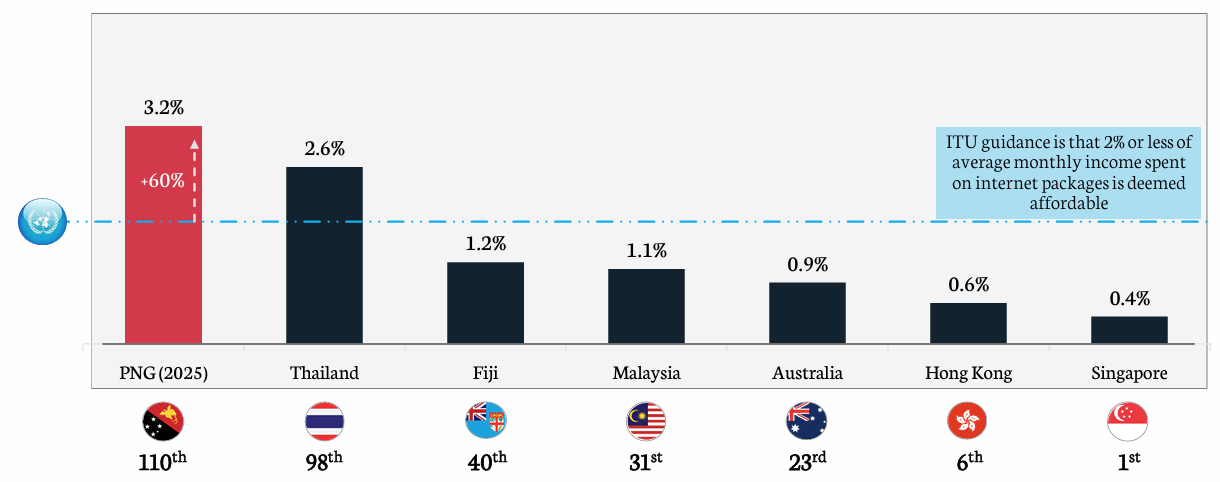
Notes: Based on the average cost of a monthly mobile plan (10 gigabyte basket) against average income in selected countries. PNG’s 2024 ranking was 175th. For 2025, the percentage has been estimated using current monthly mobile plans from different telecommunication providers, including price falls. On this basis, PNG’s ranking is projected to improve to around 110th, assuming other countries’ values remain unchanged. Source: Broadband Genie, Vodafone, Telikom, Digicel, Long Street Advisors analysis via PNG Business Council.
Combined with low incomes and the lack of a nationwide ICT network, high costs put the internet far beyond the reach of many people, especially households in rural and remote areas where formal jobs and incomes are scarce. This holds back human development: more than 70% of the population is cut off from information that can be found online and that matters for education, jobs, entrepreneurship and full participation in modern society.
The UAS policy, overseen by a secretariat within NICTA, deals mainly with how UAS funds will be used. It sets broad targets for improving internet access but says much less about how to reach them.
Digital literacy is also low, which exposes users to significant risks. Digital literacy training and information are needed to protect users and to support proper use of the internet.
How then could the government provide internet access to all?
It should follow the approach it took in 2005 with such success in the mobile phone sector: introduce competition.
Credit is due to the government for liberalising the ICT sector, which has brought significant improvement, even if the sector is not yet up to regional standards. That experience shows the surest path to further gains is private investment and innovation in response to consumer demand, with the government providing the enabling environment rather than intervening directly, including commercially, in the market.
The government should focus on removing market distortions, promoting fair competition and protecting consumers. It should leave the market to determine internet prices and service quality.
There is also a case for using public finances in a targeted and transparent way to support internet access. This should not be taxpayers’ money. Instead, the government should use UAS funds, a levy charged on industry and managed by NICTA, and draw on development partner funding to finance internet access in rural and remote areas, in line with the UAS policy.
The policy submission makes the following recommendations.
First, encourage more competition, especially in the wholesale segment of the ICT market. Institutional barriers to lower wholesale prices should be removed. One example is National Executive Council decision No. 337/2025, which revoked earlier decisions giving DataCo a monopoly over the international gateway and over the national wholesale price of internet. This new policy should apply to all international cables.
Lower wholesale prices would allow the liberalised retail market to pass savings on to consumers. All policy actions by the government should be made public.
Second, unlock satellite connectivity through the entry of geostationary, medium-earth orbit and low-earth orbit satellite providers. Starlink and OneWeb have recently been granted operating licences. Satellite will boost connectivity in rural and remote areas, where most of the population lives and where towers and fibre cables are expensive and difficult to build and operate.
Third, make better use of existing cable capacity. Because it matters so much for wholesale prices, the government should keep exploring ways to use the large, underused capacity of its cables.
Fourth, mandate interoperability among ICT providers and mobile number portability, so that consumers can communicate seamlessly regardless of provider, technology or location. This would improve consumer choice and connectivity.
Fifth, use industry levies and donor funds to widen access. The UAS Fund and external concessional financing should pay for internet services, including satellite, particularly in areas where rolling out fibre cables and building towers would be expensive. Transparency in the use of UAS funds should improve. Given the availability of UAS and donor funds, general tax revenue should not be used to widen internet access.
Sixth, roll out comprehensive digital education for all, in partnership with schools, the private sector and non-government organisation.
Finally, embed these policies in a new Internet for All policy. To maximise the chances of success, the government needs a clear statement of its objectives and chosen policy instruments, especially in sensitive areas such as increased competition.
Read the author’s full report and other Australian National University (ANU)-University of Papua New Guinea (UPNG) contributions on the RESET@50 website.
Read the blog on the family planning report.
