


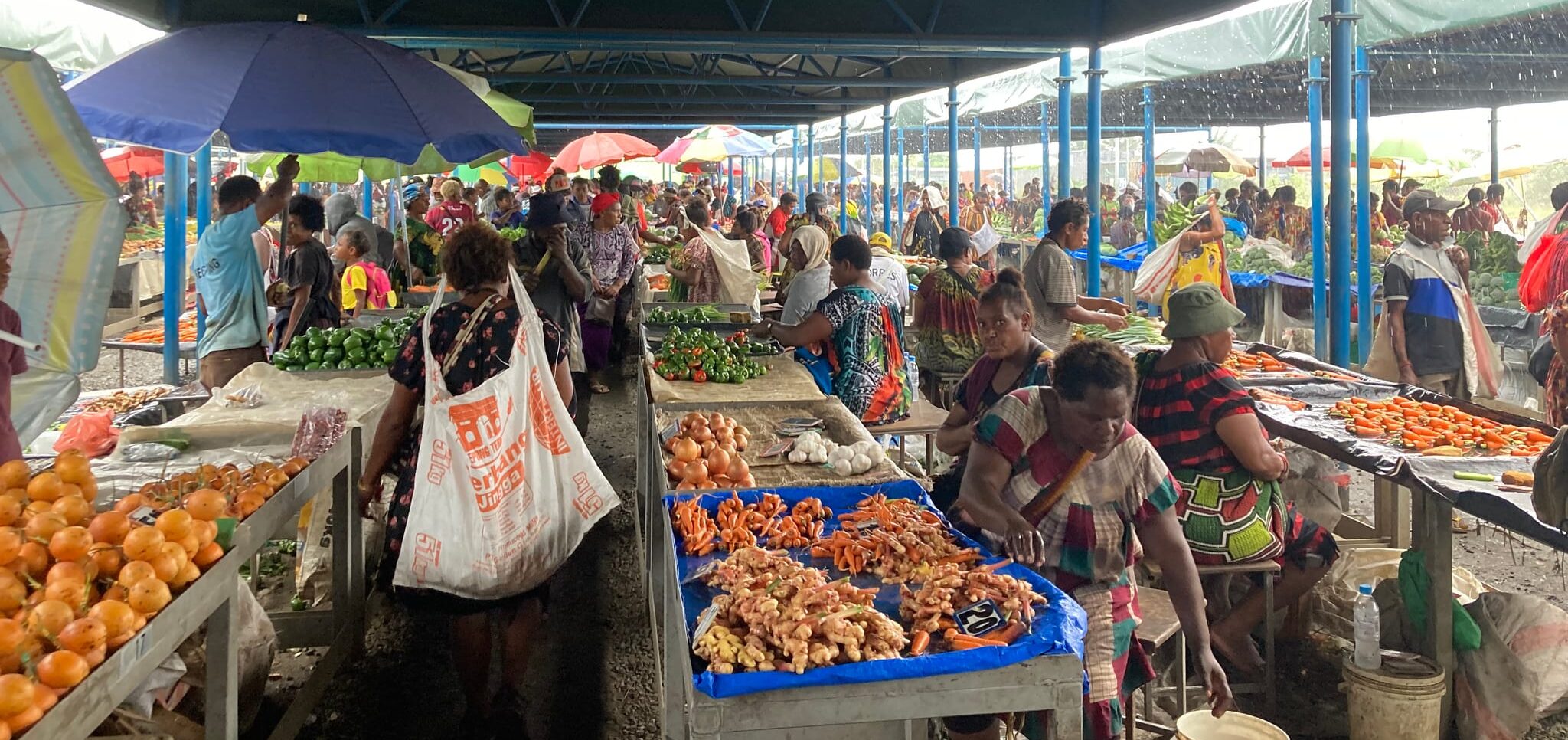
Survey data suggest that in Port Moresby (POM), feeding an entire household a nutritious diet for a single day requires 45% of a low-skill worker’s daily wage. The healthy diet burden eases somewhat outside of the capital: 41% in Kokopo, 38% in Lae and 37% in the Highlands. The reasons behind these regional differences are layered. In Lae, wages are relatively higher while food costs are lower compared to POM. In the Highlands, both wages and food prices are lower, resulting in roughly the same share of earnings needed for a healthy diet as in Lae even though the absolute numbers differ. On the other hand, Port Moresby faces higher healthy food costs and lower wages, particularly for informal wage workers.
From June through November 2025, the International Food Policy Research Institute (IFPRI) conducted telephone interviews with wage workers in low- and low-medium-skill jobs (henceforth low-skill) across seven cities where the Fresh Produce Development Agency (FPDA) is monitoring fresh food prices: Port Moresby, Kokopo, Lae, Mount Hagen, Banz, Goroka and Daru. The survey aimed to inform comparisons of men’s and women’s labour activities and wages to evaluate urban workers’ financial access to a healthy diet.
Survey data reveal that in 2025, low-skill wage workers earned between PGK4.30 and PGK5.80 per hour. Men consistently earned about PGK0.50 more per hour than women; however, skills and greater educational attainment matter, even modest ones. Workers in low- to medium-skill jobs, such as shop assistants or taxi drivers, earn a kina more per hour than those in low-skill positions (PGK5.00 vs PGK4.00 per hour). In addition, over half of respondents reported they would prefer a share of their wages paid in meals at work or food to take home.
Recognising that an important share of low-skill wages is spent on food, we focus our attention on dietary patterns of low-skill wage workers. Diet quality within the PLUWS 2025 survey is measured using the Diet Quality Questionnaire (DQQ) module. We consider four diet-quality indicators: the dietary diversity score (DDS), minimum dietary diversity for women of reproductive age (MDD-W), protection against non-communicable disease (NCD-protect) and dietary risk of NCDs (NCD-risk). Women low-skill wage workers consume more healthy food groups (DDS and NCD-protect) than men low-skill wage workers. However, women also consume more unhealthy food groups than men, largely consisting of instant noodles, sweet beverages and processed meats (NCD-risk).
We compare the PNG dietary quality outcomes with lower-income urban adults across 91 countries reported in the Global Diet Quality Project (GDQP) dataset. In doing so, we categorise the GDQP dataset by the World Bank country income groups and global regions for easier interpretation. The comparisons are not perfect, since the PLUWS sample is more narrowly defined, but they provide useful global context.
Just over half (53%) of the low-skill urban workers in PNG meet the minimum dietary diversity (MDD-W) adequacy indicator. Comparing PNG low-skill urban wage workers with countries across global income groups, the PNG survey sample falls between the low-income country average (39%) and the lower-middle income country average (65%) for meeting minimum dietary diversity recommendations, and is similar to low-income adults in urban areas of lower-middle income countries (LMICs) in South Asia (50%) and Sub-Saharan Africa (44%) (Figure 1).
Figure 1: Global comparison of MDD-W for urban adults
Note: To improve comparability with the PLUWS, global comparisons are limited to individuals in the bottom two income quintiles in each country. Source: Authors’ calculations using IFPRI 2025 PLUWS and DQQ Microdata 2021-2024. Gómez et al. (2024) demonstrate the utility of the MDD-W in also predicting micronutrient adequacy in populations of men.
In addition to dietary diversity, diet quality is associated with the incidence of NCDs such as diabetes, heart disease, stroke and cancer. Low-skill urban wage workers in PNG have a comparatively low average NCD-protect score (3.0) compared to other countries across the globe (Figure 2). Ideally, individuals should aim for a high NCD-protect score by consuming diets rich in micronutrients and fibre to protect against NCDs. These foods include pulses (legumes), whole grains such as brown rice, nuts and seeds, and fruits and vegetables including vitamin-A rich fruits and vegetables such as carrots, dark leafy greens, orange-flesh sweet potato and ripe pawpaw.
Figure 2: Global comparison of NCD-Protect Risk score (0-9) for urban adults
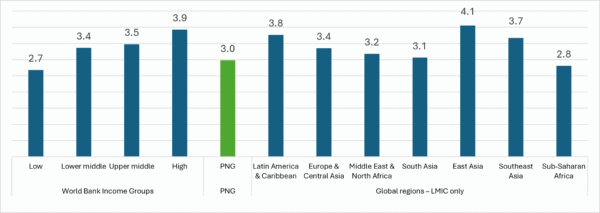
Note: Global comparisons are limited to individuals in the bottom two income quintiles in each country. Source: Authors’ calculations using IFPRI 2025 PLUWS and DQQ Microdata 2021-2024.
Contrary to the NCD-protect score, the NCD-risk score is a metric of dietary risk factors that may increase the likelihood of developing cardiovascular issues, diabetes, hypertension and the like.
Low-skill urban wage workers in PNG have an alarmingly high average NCD-risk score (2.9), similar to high-income countries (3.0) that consume a greater share of ultra-processed foods (Figure 3). The high NCD-risk score in urban PNG is driven by above average consumption of instant noodles (50% vs 12% in sampled urban LMICs), sugary beverages (92% vs 70% in sampled urban LMICs) and processed meat (36% compared to 20% in sampled urban LMICs).
Figure 3: Global comparison of NCD-Risk score (0-9) for urban adults
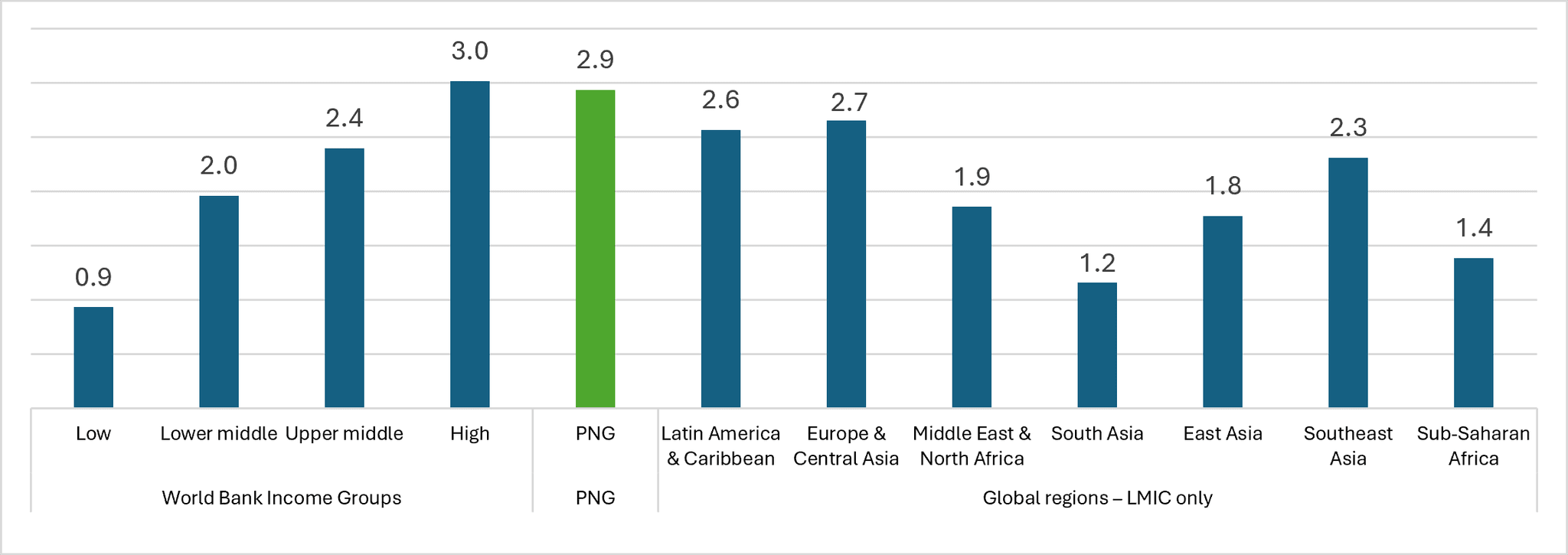
Note: Global comparisons are limited to individuals in the bottom two income quintiles in each country. Source: Authors’ calculations using IFPRI 2025 PLUWS and DQQ Microdata 2021-2024.
The PLUWS 2025 report suggests that healthy diets are financially out of reach for many low-skill urban workers in PNG. This echoes results in rural PNG, as demonstrated by recently published work from the 2023 PNG Rural Household Survey. Simultaneously, PNG’s low-skill urban workforce reports a worrying signal of lower diet quality and high NCD risk scores, potentially setting the stage for a growing burden of chronic disease.
In January 2026, the PNG government increased the minimum wage to PGK5.00 per hour, recognising the high cost of food across PNG’s urban landscape. However, medium- to long-term investments to improve domestic fresh produce value chains are also needed to bring down the costs of healthy foods for PNG families.
