


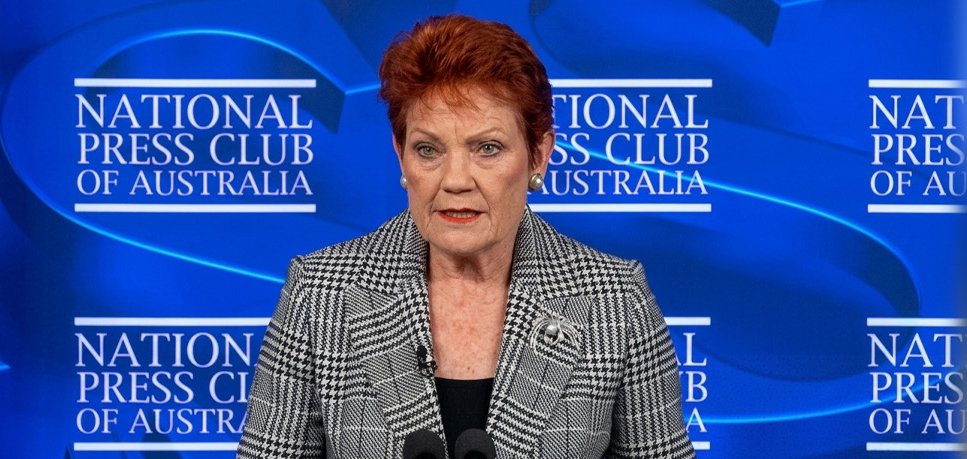
During her widely reported appearance at the National Press Club last week, One Nation leader Pauline Hanson was asked (at 58:06) about her views on Australian foreign aid spending in the context of bipartisan efforts by both Labor and the Coalition governments over the last decade to deploy aid to push back on China’s growing presence in the Pacific. The question and her response were as follows:
Phil Coorey (journalist): Over the past decade or so, as we’ve seen the sort of rise of China in the region and governments here of both persuasions, Coalition and Labor, have increasingly relied on aid as a form of soft diplomacy, especially in the Pacific, to push back at the incursion, if you like, of China. Have you changed your views on foreign aid? Do you see a value in it from a geostrategic position? Or are you still, you know, largely opposed? Are you still of the same views you held for a long time?
Pauline Hanson: Phil, as long as it’s spent well. When I hear — and I just heard recently — from the foreign aid that’s going to Papua New Guinea and I’ve heard this for years and years and years, decades, the corruption that goes on there and the amount that is actually wasted. I’ve got Australians as I said, 130,000 Australians living in poverty who can’t get a roof over their head and we’re giving foreign aid to countries that don’t respect it and corruption that’s happening there, that needs to change. You talk about the Chinese, the amount of money that we’ve helped with our Pacific partners and we’ve given them foreign aid, only still allowed to the Chinese to come in there, their Belt and Road projects, supports that they’re building, it’s like they’ve said to us, up you, we’re going to just take the Chinese and have them here. If you want Australians’ hard-earned taxpayer dollars, well, there has to be, you work with us. And China is a real big concern to me, where we’re headed with that. Foreign aid in the right places, but, Phil, I also believe clean up our own backyard first, and when I can look … Put a roof over the people’s heads, put food on the table for our Australian people and not see the starvation that’s happening with children and people, then we might be able to increase and help others.
Another journalist asked a clarifying question about Chinese aid:
Tom Connell: Are you saying essentially if a country accepts foreign aid from China, we wouldn’t give it as well? That would be a deal-breaker for us?
Hanson: My concern is they are still accepting from China. If China is our biggest concern, I think that we need to really look at the relationship they have with China and how it’s going to impact on us. If we’ve been propping up these countries for many years, Tom, you know, we have to realise the threat. We cannot disregard China. We have to realise the threat that it could be in our vicinity.
The first notable aspect of Hanson’s response is the apparent softening of her position on aid spending. Whereas One Nation’s current party platform calls for a $3 billion (60%) reduction of the annual aid budget, Hanson’s remarks suggest this spending should be judged by “whether it’s spent well” rather than arbitrarily cut. She even opened the door to a possible increase. Aid advocates may well have taken some solace from these comments. However, given Hanson’s subsequent appearance (just a day later) at an event at which Australian mining magnate and One Nation donor and fundraiser Gina Rinehart publicly encouraged her to emulate Elon Musk — the man who oversaw the demolition of USAID — and “take a bulldozer” to federal government regulation and spending, this solace was probably short-lived.
Two other aspects of Hanson’s remarks are worth interrogating. The first is the suggestion that Australia’s aid to the Pacific should be conditional on whether countries are also accepting assistance from China. Here Hanson’s remarks unwittingly illuminate one of the unstated dynamics of what Foreign Minister Penny Wong has called the “permanent contest” in the Pacific — that is, that Pacific governments and elites, rather than just Australia or China, are among the primary players in and beneficiaries of this contest. Alan Tidwell from Georgetown University has recently labelled this dynamic as a form of “strategic arbitrage” wherein “a small state profits from the gap between what two rivals will pay for the same alignment … The gap is the asset, and the leader’s task is to keep both rivals paying”. From the Pacific leaders’ viewpoint therefore, “Asking who is winning the great game is the wrong question. Instead, the question that matters is whether arbitrage itself can last.”
Whether it is accessing funding for state-of-the-art policing equipment, high-profile infrastructure projects or elite sporting franchises, Pacific governments have a direct interest in keeping the contest going as its ending — either in the form of one rival withdrawing or both rivals reaching an agreement to cease competition — would crash the price of alignment. Globally, we have seen this play out with the massive funding cuts to America’s development assistance programs under President Donald Trump, of whom Hanson is an avowed supporter. Beijing has not “filled the gap” in response, as many geopolitics pundits predicted. Instead, China has simply sought to purchase developing countries’ alignment much more cheaply and, in the process, has been able to portray America as fickle and untrustworthy. Of course, none of this has been good for global development and, as a result, we have seen a massive increase in levels of need in areas including the humanitarian and health sectors. Given Australia’s position as the largest regional donor by far, and the very high levels of aid dependence in many Pacific countries, an equally dismal foreign policy and development outcome would result if Australia were to withdraw its funding to the region on the grounds that Hanson suggests.
Hanson’s remarks also included a reflection on the relationship between corruption and aid, suggesting that Australian development assistance is helping fuel corruption in countries like PNG. This is not a new narrative and one in which populist critics of aid, both here and internationally, have often indulged. While it is certainly an issue in the Pacific, there is very little evidence of Australian aid being implicated in corruption. However, the focus on competing with China for Pacific elites’ support has meant that we talk about corruption — and the importance of combatting corruption as part of the promotion of economic development — much less than we used to. In the mid-2000s, the Australian aid program published a stand-alone anti-corruption strategy as part of a wider focus on governance, and anti-corruption featured in both the Coalition government’s 2006 Aid White Paper and the Labor government’s 2011 aid policy.
Today, while Australia’s governance spending remains high, there is very little talk about corruption in the Pacific, its effects and how we might best work with partners to combat it. Corruption gets scant attention in the government’s 2023 International Development Policy. This is not a viable answer to the Hanson critique. Acknowledging the problem, and discussing evidence-based solutions, must be part of the response. Of course, in doing so Australia should be humble and willing to learn given both its own imperfect record on government integrity and the alleged role of some of our non-aid spending in high-profile corruption scandals in countries such as Nauru.
It remains to be seen whether One Nation can sustain its rapid rise in the opinion polls until the next federal election and whether Hanson really has had a change of heart on foreign aid. If there is one point upon which a more constructive consensus might be built between aid advocates, One Nation’s constituencies and those of the major parties, perhaps it should be her initial observation that we should judge the success or otherwise of Australia’s aid by its effectiveness.
