


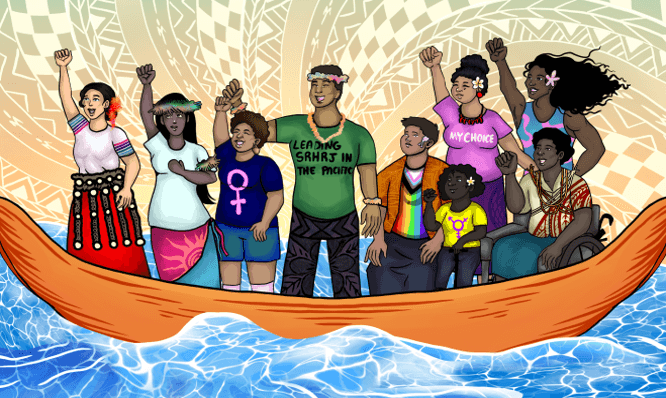
This year, a group of Pacific young people published a guide to talking about pleasure. They called it Pleasurenesia — a play on the colonial labels Polynesia, Micronesia and Melanesia, terms outsiders coined to organise a region that had never asked to be organised. By folding “pleasure” into that geography, Youth OCEANS, the regional youth-led network of the International Planned Parenthood Federation, made a pointed claim: conversations about pleasure, sexuality and wellbeing in the Pacific should be shaped by Pacific people, for Pacific people.
Pleasurenesia is a facilitation resource that deserves attention from development practitioners, donors and policymakers working on Pacific health and rights. Its argument — that comprehensive sexuality education has failed Pacific young people because it was built on the wrong foundations, not just because it left pleasure out — matters for how we design and fund youth SRHR programming in the region.
The numbers are stark. Teenage pregnancy rates in parts of the Pacific run two to three times higher than global averages. In Fiji, 858 teenage pregnancies were recorded in 2024, nearly double the previous year. HIV infections among young people aged 15 to 29 are rising. Gender-based violence rates sit at 60 to 70% in Papua New Guinea, 64% in Fiji and 60% in Vanuatu. Contraceptive access remains unequal, with unmet need in rural and outer island communities at 40 to 60%.
These statistics should drive programming decisions. The Pleasurenesia guide asks why existing interventions have not shifted them.
In co-design sessions and key informant interviews, young people across the Pacific told Youth OCEANS that most SRHR resources felt imported, clinical and disconnected from how they actually understood relationships, bodies and wellbeing. The language was too formal or too explicit. The examples ignored Pacific cultural structures and faith contexts. The focus sat almost entirely on avoiding risk, leaving no room for the conversations young people were already having about feelings, attraction, comfort and connection.
This is a structural problem. When young people say condoms reduce comfort or feeling, and education programs do not acknowledge that, it becomes a real reason condoms are not used consistently. When conversations about relationships focus only on preventing harm, young people are left without the language to recognise healthy dynamics, communicate boundaries or understand consent in relational terms.
Pleasurenesia treats pleasure as the foundation on which adjacent conversations — consent, communication, bodily autonomy, safe relationships — can happen, rather than as a sensitive add-on to risk messaging. The guide’s seven Pleasurenesia Principles (Love Yourself, Embrace Learning, Talk Openly, Be Flexible, Think Universal, Rights First, Be Positive), adapted from IPPF’s regional Talking Pleasure with Ease framework, are arranged visually around a woven mat — a Pacific reference to interconnection and collective meaning. No principle stands alone. None requires a particular entry point.
That non-linearity is one of the guide’s most practical contributions. Co-design participants were explicit that conversations about sexuality in Pacific communities develop gradually and indirectly, through storytelling, humour, shared reference and relational trust rather than a structured curriculum. The guide’s facilitation tools, including a detailed talanoa session outline and a structured conversation guide, work with that reality rather than against it. They provide entry points through familiar values like respect, care and wellbeing, and give facilitators ways to read the room, hold silence and adjust based on group readiness rather than a fixed session plan.
The decolonising argument running through the guide is worth taking seriously as a policy position. The historical chapter documents how Pacific traditions of open, gradual, relationally embedded learning about bodies and relationships were disrupted by colonial governance and Christian missionisation, which introduced shame, silence and risk-framing as the dominant lens on sexuality. That history helps explain why externally developed, prevention-focused, clinically framed materials still land poorly in Pacific communities: they sit in the same lineage as the frameworks that created the silence to begin with.
The guide does not argue that cultural values should be bypassed in the name of rights. It argues something more careful: that the values Pacific communities already hold — care, responsibility, dignity, relational accountability — are compatible with pleasure-centred, rights-based sexuality education, provided those approaches are genuinely adapted to local language, leadership and context rather than translated in from elsewhere.
For practitioners and donors, that distinction matters. Funding Pacific youth SRHR curriculum development without equivalent investment in community consultation, youth co-design and facilitator preparation will not shift the numbers. Pleasurenesia is one model of what that investment can produce. It drew on key informant interviews across ten countries, co-design with Youth OCEANS members and Member Association representatives, and sustained attention to inclusion — engaging young people of diverse sexual orientations and gender identities, those living with disability, and youth from smaller countries and outer island communities.
The result is not a universal curriculum. It is a flexible framework, and the guide is explicit that it should be adapted rather than replicated. That flexibility is a feature, not a hedge. The Pacific is not one context, and effective SRHR programming should not treat it as one.
What the Pleasurenesia guide shows is that Pacific young people have both the analysis and the tools to lead this work. The question for those of us funding and designing the broader system is whether we are investing accordingly.
