



Last year, 2024–25, Australia issued 321,000 backpacker visas — 97,000 more than the previous year, and in fact significantly above the previous record of 258,000 set in 2012–13.
Backpacker visas include the 417 Working Holiday Visa, for rich countries and uncapped, and the 462 Work and Holiday Visa, mainly for poorer countries and mainly capped.
The first boom in backpacker numbers came in the late 2000s. It was the result of both the Global Financial Crisis — which pushed up unemployment in many European countries — and the incentives which the Coalition put in place in 2005 to get backpackers to work on farms by offering them extended stays if they did. After the 2012–13 peak, the number of backpackers started to fall as Europe recovered from its recession and stories of backpacker exploitation exploded in the media. And then during the pandemic most backpackers went home, and very few new visas were issued. By 2022–23, backpacker visa issuance had recovered to its pre-pandemic level. There was little change in 2023–24. But last year, backpacker visa demand took off again, setting a new record.
How to explain this second boom in backpacker visa numbers? There are three main reasons.
First, under the Australia-UK free trade deal, that was signed in December 2021 and entered into force in May 2023, UK citizens can now stay in Australia for up to three years on successive annual backpacker visas without any work requirements. Previously, UK backpackers could, like all other backpackers, only come for one year to Australia, and had to meet regional work requirements in order to stay for a second or third year. This generous treatment has doubled the number of Brits on backpacker visas in Australia. Prior to the pandemic, the number had ranged from 35,000 to 45,000 but in 2023–24 it hit a new record of 47,000 and then skyrocketed to 79,000 last year.
The backpacker boom is not just a UK phenomenon, however. 2024–25 smashed the record for backpacker visa issuance even if UK visa holders are completely excluded. Backpacker visas have generally become less popular among the youth of rich countries. Excluding the UK, the demand for first-year 417 visas fell from 172,000 in the previous peak of 2012–13 to 116,000 last year. However, many more backpacker visas have been made available on a capped basis, mainly to developing countries. The number of 462 first-year backpacker visas issued increased from just 9,000 in 2012–13 to 38,000 last year.
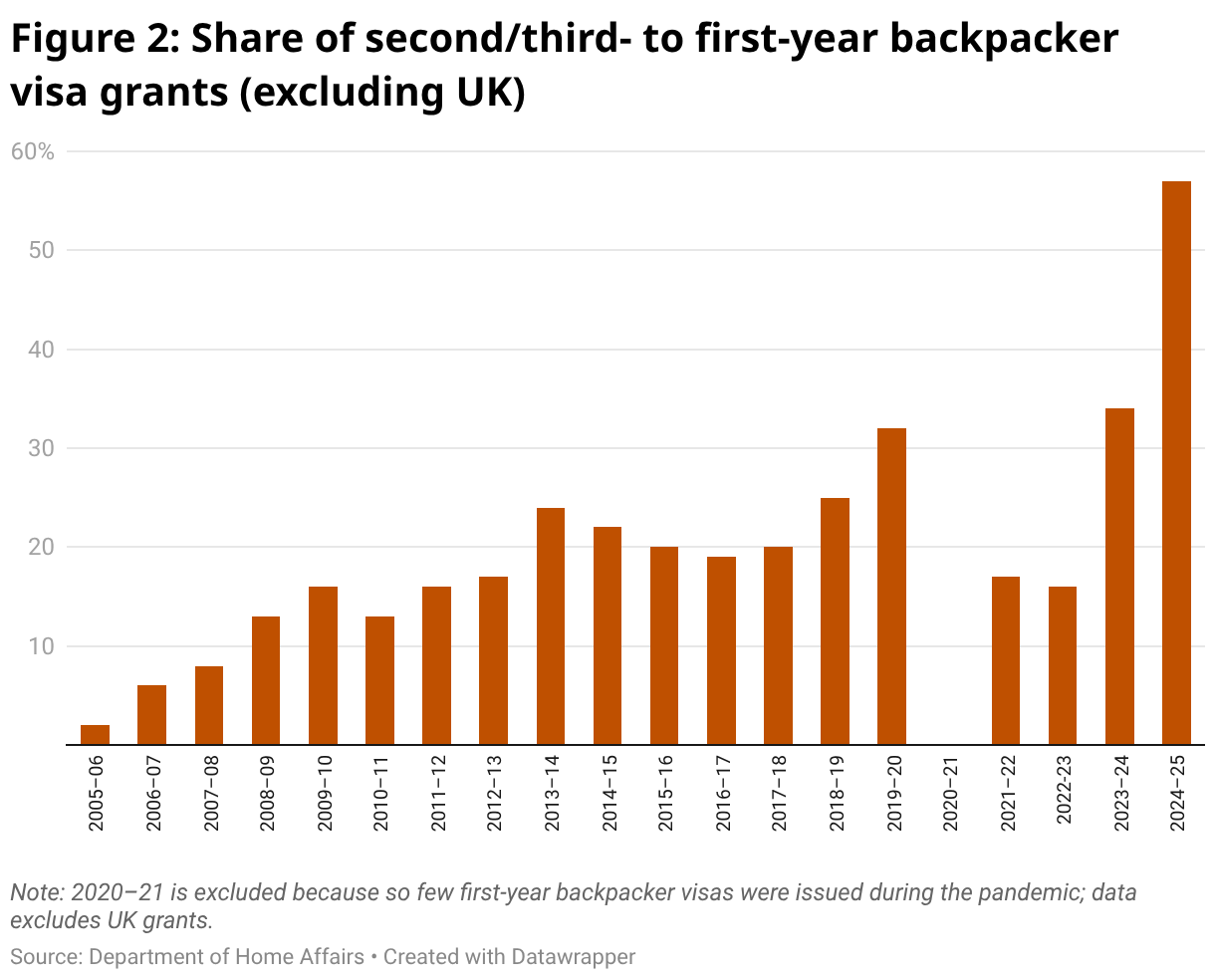
Third, while the number of first-year backpacker visas being issued is still below its 2012–13 peak, many more second- and third-year backpacker visas are now being given in return for work in the first and second year, mainly in agriculture. Taking out the UK, in 2012–13 the ratio of second- and third- to first-year backpacker visas was 17%; now it is 56%. This variable has steadily trended upwards since the second-year visa option was introduced in 2005 (the third-year visa option was added in 2019). The trend was interrupted by the pandemic, as the graph below shows (2020–21 data are excluded because results were so skewed by borders being closed). That upward trend has now resumed however, and with a vengeance. Last year, 62% of those on a second-year visa applied for a third year, confirming that these visas are more about work than holiday.
Reform of the backpacker visa has been long talked about but slow in coming. A decade ago, the Fair Work Ombudsman found, after an inquiry into the employment of backpackers, that the scheme’s “work-for-visa system is broken” and that there was “an environment of unreasonable and unlawful requirements imposed on visa holders by unscrupulous businesses.” A 2017 University of Adelaide study found that backpackers were more likely to be exploited than Pacific seasonal workers.
Labor’s 2023 Review of the Migration System recommended the abolition of the second- and third-year backpacker visas. Labor didn’t follow through on this recommendation. It did in 2024 set up a review on regional visa settings, but that review never finalised, or at least never published, its report.
Perhaps this second boom in backpacker numbers has finally prompted the government to take action. The 2026 budget flagged reforms to the Working Holiday Maker (WHM) visa program to “better control numbers, reduce barriers to work, provide a fairer allocation of WHM visas, and support Australia’s national interests” (p.8). In the second blog in this two-part series, we unpack what these reforms could, and should, entail.
