

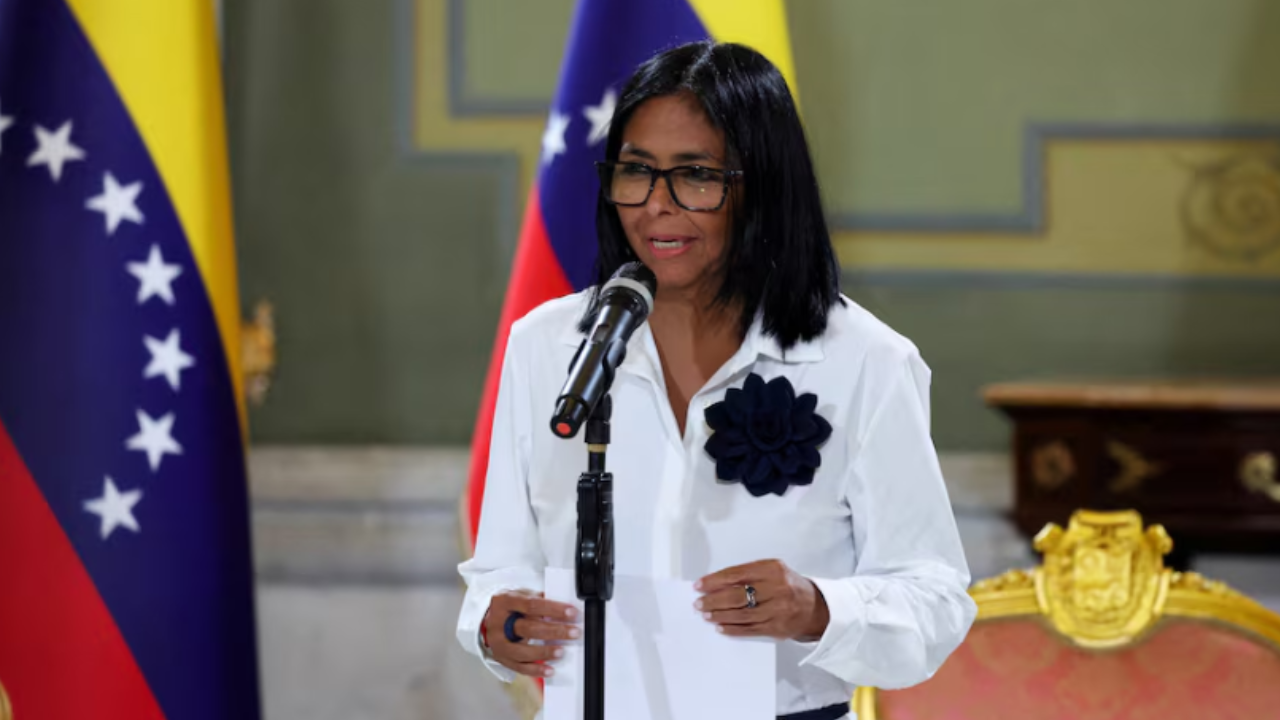
Venezuela’s interim President Delcy Rodriguez addresses the media. [Photo Credit: Reuters]
Venezuela’s strongest earthquake in over a century is the biggest challenge to Delcy Rodriguez’s early leadership but could also allow the interim president to stamp her authority on a fractured government and begin rebuilding a broken country.
After two earthquakes of magnitudes 7.2 and 7.5 struck Venezuela on Wednesday evening, it could take weeks for the full extent of the damage to become clear. U.S. government data models suggested the death toll could ultimately exceed 10,000.
Even so, some things were already clear. Rescuing those trapped, treating the injured and rebuilding homes and infrastructure will require a vast effort.
That project has the potential to define Rodriguez’s political future.
A close ally of U.S. President Donald Trump, she has sought to portray herself as an agent of political change even though she served as vice president to her predecessor, socialist Nicolas Maduro, whom Washington ousted in January.
Even so, some things were already clear. Rescuing those trapped, treating the injured and rebuilding homes and infrastructure will require a vast effort.
That project has the potential to define Rodriguez’s political future.
A close ally of U.S. President Donald Trump, she has sought to portray herself as an agent of political change even though she served as vice president to her predecessor, socialist Nicolas Maduro, whom Washington ousted in January.
Rodriguez is already attempting to do exactly that. “In unity, we will overcome this situation,” she said in the initial aftermath of the disaster.
Major U.S. support could tip the outcome. In 1999, late leader Hugo Chavez rejected U.S. help after deadly landslides killed at least 10,000 people, an early signal of the anti‑U.S. posture that later deepened Venezuela’s isolation.