


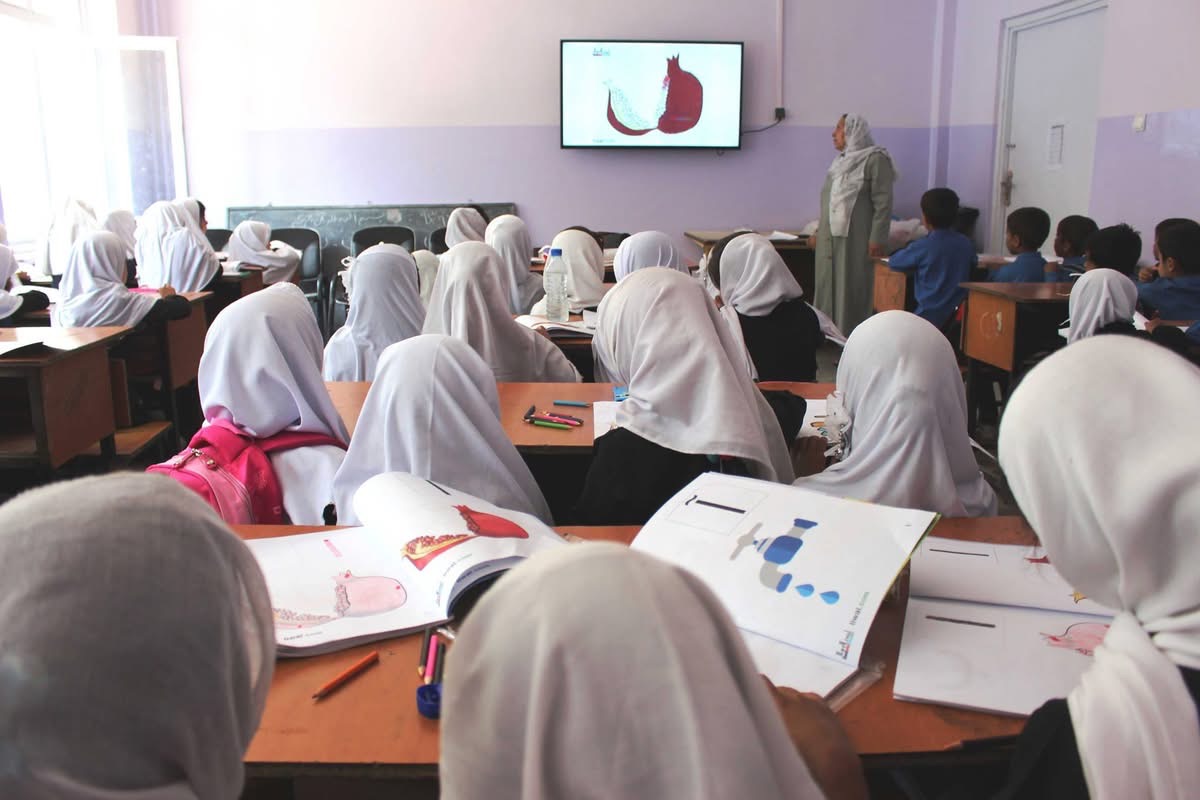
Afghanistan’s restrictions on girls’ secondary and higher education are the immediate barrier to women’s education. But even if these restrictions are eventually removed, access will also depend on attitudes within households and communities. In a new study published in Review of Development Economics, we look at the demand side of women’s education, which has been less prominent in discussions on this issue. We argue that the demand side is as important as the supply side.
Our study adds a household political-economy perspective on women’s education in Afghanistan. Social norms and household bargaining will influence whether restored rights can be exercised in the future. Even if formal bans were lifted tomorrow, entrenched attitudes in households and communities could remain an important constraint on enrolment, which is why the demand side matters for the sustainability of any future policy reversal.
We use nationally representative Asia Foundation surveys covering more than 69,000 respondents across all 34 provinces between 2014 and 2021. Respondents were asked whether women should have equal educational opportunities at primary, secondary and tertiary levels, and whether they should be able to study in another province or abroad.
Men and women answered similarly on primary education, but the gap between them widened at each higher level. After accounting for socioeconomic characteristics of respondents, province-related factors and survey-year shocks, men were 6.2 percentage points less likely than women to support secondary education, 12.6 points less likely to support tertiary education, 14.8 points less likely to support study in another province and 15.3 points less likely to support study abroad. Rural respondents were also less supportive of women’s secondary and tertiary education and of study in another province, though urban men were the most opposed to study abroad. Support rose modestly for both men and women across the 2014 to 2021 period, indicating that attitudes are not static. Ethnic differences were also marked: Hazara respondents were substantially more supportive of higher education and mobility, while Pashtun respondents were the least supportive, patterns the paper links to the Pashtunwali code of honour and seclusion and to the Hazara community’s history of migration and investment in schooling.
These results suggest that acceptance of basic education does not necessarily extend to forms of education that increase women’s mobility, qualifications and potential economic independence.
Men’s attitudes towards higher education for women have cultural, historical, religious and ethnic roots that are difficult for policymakers and international organisations to influence directly, and shifting them is a long-term project. But these attitudes are not fixed. Our analysis shows they are systematically associated with women’s financial contribution and perceptions of insecurity across Afghanistan. Where women contributed to household income, men’s opposition to their education was lower. The estimates imply related reductions in men’s negative attitudes of about four percentage points for secondary education, 5.3 points for tertiary education, 4.7 points for study in another province and 3.1 points for study abroad. The deeper cultural sources of these attitudes may be slow to change, but the attitudes themselves appear to vary with economic circumstances.
This pattern is consistent with an intra-household bargaining mechanism. When women contribute economically, education may be seen as producing tangible household benefits, and women may acquire greater influence over family decisions. Our results also show that women’s income contributions moderated the association between insecurity and restrictive attitudes. Fear of insecurity was linked to lower support for women’s schooling, particularly at primary, secondary and tertiary levels, but this negative association was weaker where women contributed financially. On our reading, a woman’s earnings help legitimise her participation in education and work and raise the household cost of withdrawing her, so families weigh security concerns against a more visible economic loss.
Reading causal relationships into the results is not straightforward. Households that allow women to work may already hold more supportive views on the role of women in society. We controlled for a wide range of individual and household characteristics, but unmeasured factors, such as unobserved progressive household norms, could still drive both women’s earnings and men’s stated attitudes. The association we document is robust, but a causal interpretation would require research designs we cannot implement with these data. Women’s economic participation may help shift household attitudes, but it cannot be treated as a stand-alone solution.
There are lessons for policy. First, women’s right to education is the central objective and does not depend on any economic case for it. Evidence that education also brings large economic and social gains can help build broader support but should not be used to imply that these rights are conditional on women’s earnings. UNESCO has estimated that a prolonged suspension of women’s higher education could impose very large long-run economic losses on Afghanistan. The social costs extend further, including weaker health, education and professional capacity.
Second, international programs should protect the limited economic spaces still available to Afghan women and connect skills to realistic livelihood opportunities. Recent ILO programs show that context-sensitive recruitment, community engagement, adapted worksites and entrepreneurship support can enable women to earn income under severe restrictions and can contribute to gradual changes in community attitudes. UN Women initiatives similarly combine business support, access to finance and markets, and women-only safe spaces.
Third, beyond our own results, the wider evidence base points to the importance of addressing insecurity and mobility directly. Safe transport, locally accessible learning, female teachers, secure accommodation and community-based education can reduce the practical and perceived costs that families associate with women studying away from home. Remote education can preserve learning where access is blocked, but it should remain a bridge to accredited formal education rather than a permanent substitute.
The importance of these measures is borne out by a World Bank study based on interviews with more than 2,000 women and focus groups with women and men, which found that safety, transport and family concerns shaped women’s ability to travel for study and work. In Herat, male participants described security as influencing whether and when women in their households could leave home. One man described the difficulties faced by his sister, a veterinary university student, who needed a mahram to accompany her during fieldwork. In Kabul, participants reported that some girls did not attend school because the available buses were mixed gender.
Finally, engagement with community and religious leaders may be important because they can influence local attitudes. The marked ethnic and regional differences in our results also suggest that a uniform approach is unlikely to work, and engagement will need to be tailored to local institutions such as the Pashtunwali code in the south and southwest. Engagement should aim to reduce resistance and to make the household and community benefits of women’s education visible, while being clear that women’s right to education does not depend on male permission or on a demonstrated economic return.
Read the published paper “Men’s support for women’s education in Afghanistan: the roles of income and insecurity”, in Review of Development Economics.
