


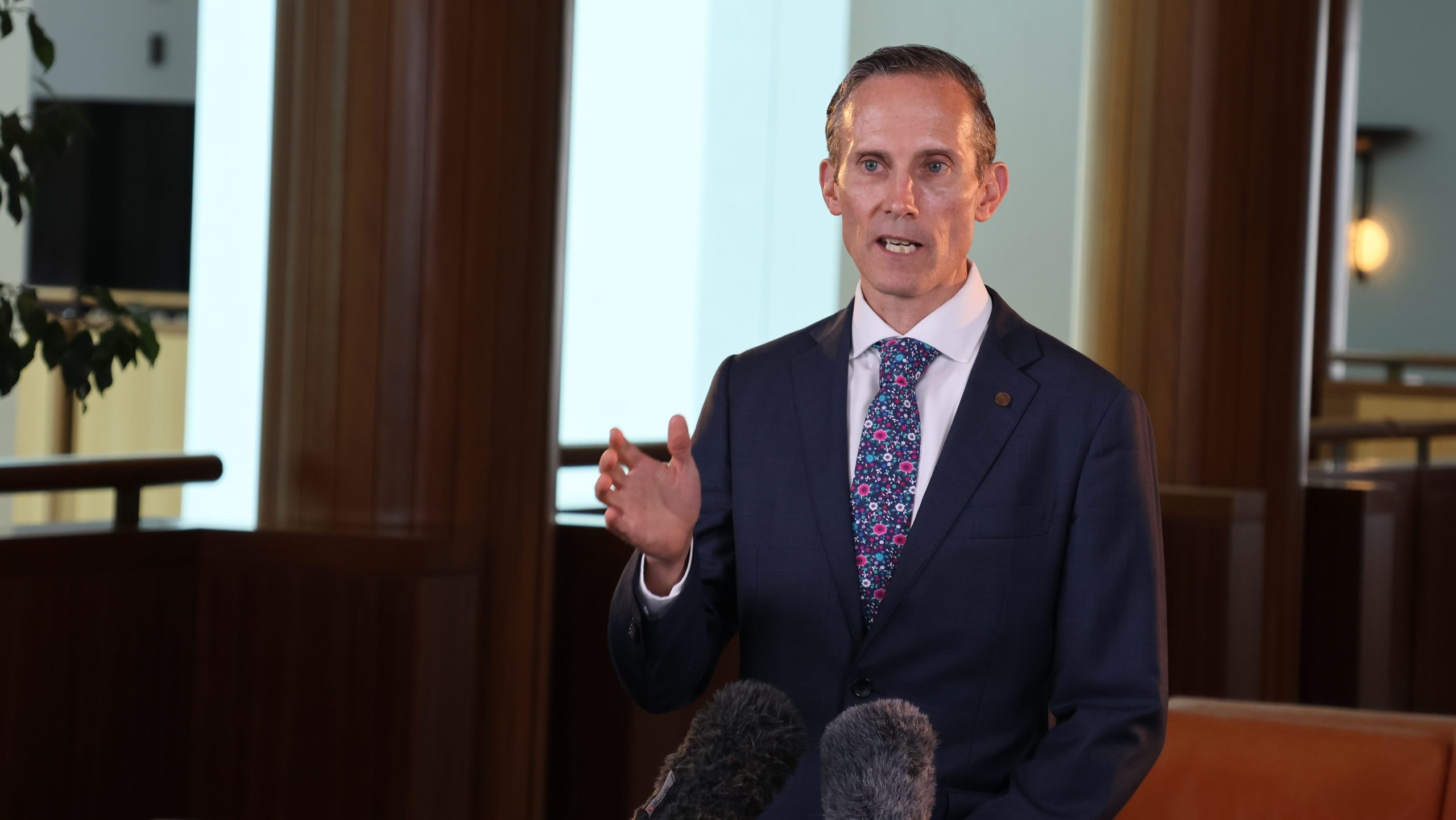
This speech was delivered at the launch of the Australian Council for International Development’s (ACFID) State of the Sector Report 2026 on 6 August 2026.
I acknowledge the Ngunnawal people, the Traditional Custodians of the land on which we meet, and pay my respects to Elders past and present. I extend that respect to all First Nations people here today.
On the cover of this report are Kilu and Oneidah from Boboe Island in Solomon Islands, harvesting sea grapes.
Sea grapes are a traditional food and an important source of livelihood. In Western Province, four communities have launched a women-led enterprise producing body lotion and soap from sustainably harvested sea grapes. The work draws on traditional practices and helps conserve a food source under pressure from a changing climate. It also creates new sources of income.
The project is supported through Climate Resilient by Nature, an Australian Government initiative delivered in partnership with WWF-Australia.
That cover image captures much of what good development looks like. Local knowledge shapes the work. A trusted partnership supplies support. Environmental care and economic opportunity advance together.
The photograph shows people at work. The pages that follow give us the evidence behind that work.
Good sector data helps organisations see changes and lets funders test assumptions. It also gives the public a clearer view of how the sector uses trust and expertise. This report performs each of those functions.
I am delighted to launch the ACFID State of the Sector Report 2026.
Thank you to ACFID and Monash University, and to Karinda Flavell, Raewyn Lans, Aditri Saikia, Emily Moreton, Samanthi Gunawardana and Sara Niner, with support from Terence Wood. Thank you also to the organisations that contributed data and case studies. A report of this scale depends on a sector willing to examine itself closely and share what it finds.
This is the second State of the Sector report, following the first in 2018. Across 36 indicators and 10 characteristics, it provides the most comprehensive comparable picture of Australian development non-government organisations in nearly a decade.
The pressures are plain. Inflation has increased costs. Real public donations are around 20% lower than in 2015. The share of Australian adults donating to ACFID members fell from 8.3% in 2016 to 5.7% in 2023. Across a comparable group of organisations, staffing fell by around one-third between 2017 and 2022.
These figures affect organisational resilience and the capacity to plan for the long term. They also shape how many communities organisations can reach.
Alongside that strain, the report records strong performance across many areas.
ACFID members continue to set a high standard for transparency and accountability. Audited financial reporting is universal. Compliance with ethical standards for emergency appeals is consistently high. Participation in learning remains strong, with 25 active communities of practice and more than three-quarters of members involved in at least one.
The sector is also becoming more representative in important respects. Around 70% of staff are women, and women’s representation among chief executives and board directors has risen since 2016. The report identifies scope for stronger data on broader forms of diversity. Better measurement will help organisations understand who holds influence and where fresh perspectives can be brought in.
There is encouraging progress on climate integration. In 2023, 458 projects included an element of climate action, with most focused on building resilience.
This October, that work will have a global platform in the Pacific. In partnership with Australia, Fiji and Tuvalu will host the official Pacific Pre-COP events from 5 to 8 October 2026. Fiji will host the preparatory meeting, while Tuvalu will host a leaders’ event. The gatherings will bring global leaders to the Pacific to see climate impacts and Pacific-led solutions first-hand. They will also help shape priorities ahead of COP31.
The report’s new baseline for locally led development is another important contribution.
Forty-three per cent of responding members had an internal commitment or policy on locally led action or partnerships. Almost all organisations reported dedicating staff time to partner-led capacity building and institutional strengthening. Among organisations undertaking advocacy, local partners usually had some influence over that work.
These measures give the sector a basis for tracking change over time.
Locally led development means listening early and sharing decisions. It means backing local institutions and recognising where knowledge sits. That approach builds capability close to the people affected and supports solutions grounded in local priorities.
This approach sits at the heart of the Australian Government’s development program. We support solutions shaped by communities themselves across climate adaptation and health, as well as education and governance. Local organisations bring knowledge and legitimacy. Australian organisations contribute expertise and long-term relationships.
Australian non-government organisations are invaluable partners to government. You can mobilise quickly and work in fragile or hard-to-reach places. You reach people who can be overlooked by large systems, and you sustain relationships across political and funding cycles.
Your experience also improves policy. You help government understand regional challenges and shape responses. Through deep people-to-people links, you connect Australians with our region and give local partners a stronger voice in Canberra.
In 2026-27, the Albanese Government will invest $5.2 billion in official development assistance, an increase of $112 million on the previous year. More than three-quarters of that investment will benefit our region, including $2.2 billion for the Pacific and $1.4 billion for Southeast Asia.
At a time when aid budgets are shrinking elsewhere, Australia remains a reliable and responsive partner. Our development program helps shape a region that is more peaceful and prosperous. It strengthens relationships founded on mutual respect for sovereignty.
It supports human rights and social inclusion. That includes gender equality and disability equity, along with LGBTIQ+ rights.
It is also an investment in Australia’s future. Helping a community withstand a cyclone or contain an infectious disease contributes to a safer region. Supporting children to learn and protecting humanitarian workers strengthens the resilience on which shared prosperity depends.
Government works with a range of partners because different organisations bring different strengths. We choose delivery partners according to capability and context. The proportion of funding delivered through contractors varies from year to year.
Funding delivered through non-government organisations has remained broadly stable at around 10 to 11% of official development assistance over the past decade. Non-government organisations can also compete for departmental procurements.
The distinctive contribution of this sector deserves clear recognition within that mix. Non-government organisations bring public trust and specialist expertise. They also bring local partnerships and the patience required for work whose results unfold over years.
The report’s findings on public engagement deserve close attention. In 2023-24, ACFID members raised $750 million from more than 793,000 Australians. That is a formidable constituency for international development. The decline in donor participation also shows the work ahead.
The strongest case for aid often begins with a truthful account of what cooperation achieves.
It is harvesting sea grapes from a better-managed reef. It is a health worker reaching a remote community. It is a local organisation leading through the next emergency. It is an Australian donor seeing how a modest contribution becomes a larger act of solidarity.
The sector has an opportunity to tell more of these stories while keeping the rigour that this report exemplifies. Evidence gives stories weight. Stories give evidence reach. Together, they can build durable public support.
The operating environment will remain demanding. Humanitarian need is rising and climate pressure is intensifying. Civic space is narrowing in many places, while resources remain tight.
This report shows a sector learning how to work in that changed world.
Its strengths are substantial: professional standards and deep partnerships, alongside a culture of reflection and a broad community of Australian supporters. Its challenges are stated with candour, which gives the sector a solid base for action.
The task now is to use this evidence. Strengthen organisations before strain becomes fragility. Widen the circle of Australians who see themselves as participants in development. Move from local consultation towards local authority. Keep testing which partnerships produce lasting benefit.
The cover returns us to the heart of the work. Kilu and Oneidah are drawing on knowledge rooted in their community and place. Their hands are harvesting food and supporting livelihoods. Their work also cares for an ecosystem that will sustain future generations.
Good development gives people greater power to shape their own future, supported by partners who respect their knowledge and back their ambition.
Congratulations to ACFID, Monash University and everyone who contributed.
