


The Pacific Engagement Visa (PEV) is now in its third year. With June 2026 data now available, we can assess PEV success over its first two years.
To get a PEV visa, applicants and their families have to register for a ballot, be selected through that ballot to apply for a visa, and then meet the visa requirements, including an Australian job offer.
In the first two years, 4,006 PEV visas out of an available 6,000 visas were granted. The shortfall reflects a slow start, but the pace has picked up. From January to May 2026, more than 400 PEV visas a month were issued, over double earlier monthly rates. Indeed, the program has become so successful that visa processing was drastically slowed in June so as to comply with Australia’s decision not to issue more than 3,000 PEV visas in a single fiscal year.
The pick-up in the second year is also clear from cohort analysis. After two years, the success rate for the 2024–25 cohort (visas granted divided by visas available) is 74%. For the 2025–26 cohort, the success rate was 59% after just five months, before the brakes were put on. It took the 2024–25 cohort twelve months to reach the 59% mark.
Why is the second-year cohort so much more successful? The main reason is that while only 3,000 visa applications were lodged by winners of the 2024–25 ballot, 4,422 were lodged by 2025–26 winners. This suggests that many more people were selected out of the 2025–26 ballot and invited to apply than the 3,000 quota for that year. (Those successful in the ballot are likely to submit a visa lodgement even if they don’t yet have a job offer, in the hope that the job offer will come. A visa lodgement is a sign of ballot success, but by no means a guarantee of a visa grant.)
This “over-selection” is something we recommended back in August last year. Its importance is shown by the next graph, which compares 2024–25 and 2025–26 visa success rates. The graph shows the ratio of grants per cohort to the total annual visa quota (3,000 for both cohorts), as well as, for the 2025–26 cohort, the ratio of grants to applications. The data is presented by counting months from the January of the year after the ballot was held.
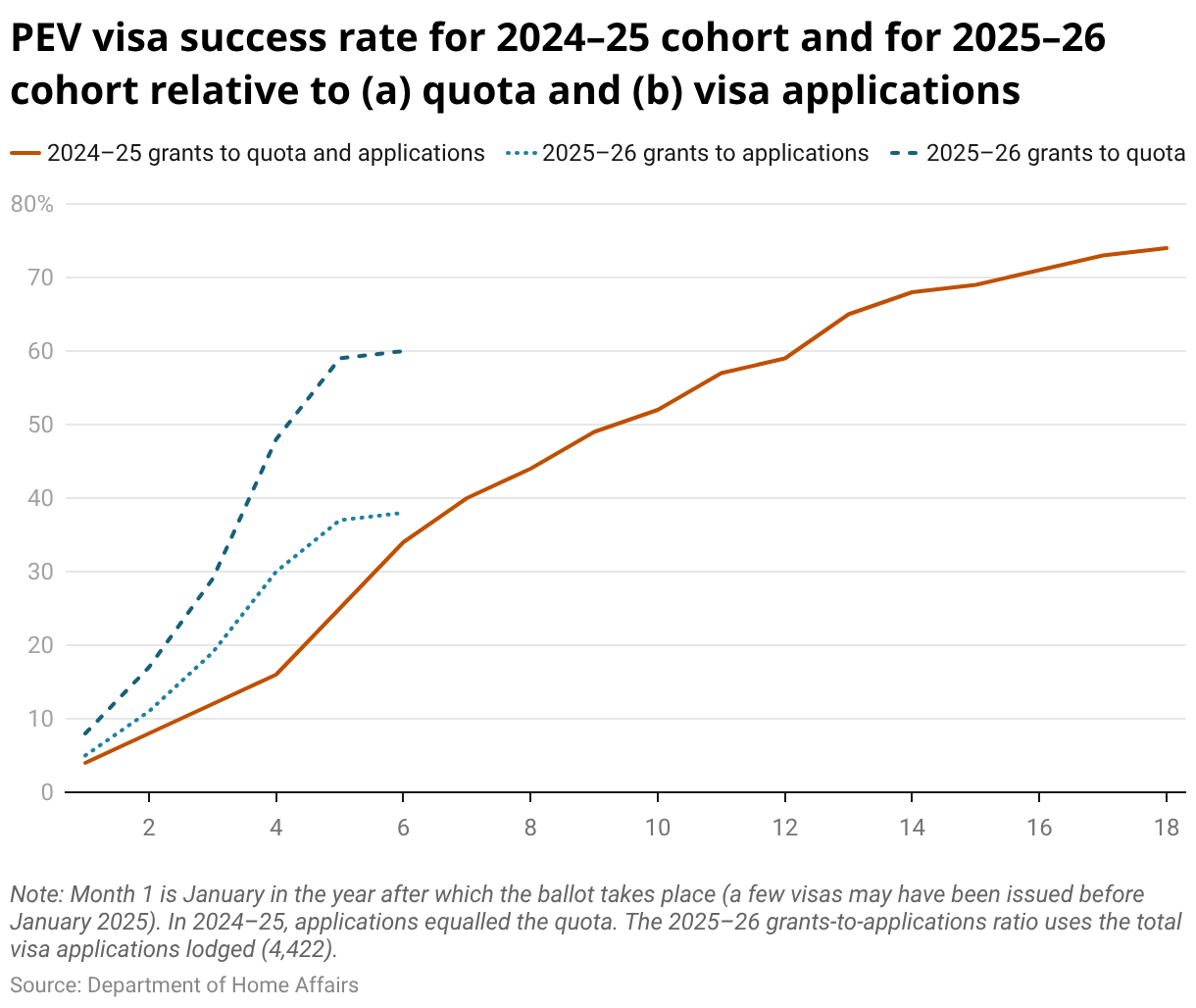
There is only one line for 2024–25 because in that year both the total visa quota and the number of visa applications were the same (3,000). But these two lines are different in 2025–26, when the total quota (3,000) was far exceeded by the total number of applications (4,422).
There is improvement in the grants to application ratio, meaning that newer applicants are finding it easier to get a job, but there is significantly more improvement in the grants to quota ratio, which indicates that receiving more applications is what is really driving the increase in PEV grants. Indeed, as of June only 20% of the growth in the aggregate success rate between cohorts is due to more visa grants relative to applications, with the remainder being due to more applications.
Overall, this is a good news story. If another 3,000 PEV visas are granted this year (2026–27), then the cumulative PEV success rate (visas granted to total quota) will climb from 67% as of June this year to 78% as of June next.
However, there are certainly some issues to be addressed. The two decisions — (a) not to issue more than 3,000 PEV visas in a fiscal year and (b) to select more than 3,000 applicants from the ballot — mean that some selected in the ballot will never get a visa.
There will also be problems for those who were informed in August of this year that they were successful in this year’s (2026–27) ballot. Say that one such applicant finds a job at the end of December. If 3,000 visas have already been offered since July because of visas still being granted to the 2025–26 cohort, and no more visas are issued till the end of the fiscal year, then that person will not get a visa until the following July at the earliest. Will the employer hold the job offer until then?
An alternative that would reduce these problems would be for Australia to recognise that it only issued 1,006 PEV visas in 2024–25, and to increase the limit on PEV visa issuance in a single year above 3,000 for the next few years, or to remove it altogether.
