


Papua New Guinea, the largest Pacific Island country, celebrated 50 years of national independence on 16 September 2025. There is much to celebrate. PNG’s peaceful transition to independence and its democratic record are real achievements: governments have changed through elections and parliamentary processes rather than military coups, and hundreds of distinct communities, languages and cultures have been held together within a single constitutional state.
An anniversary is also a time for honest reflection. PNG continues to face political instability and weak accountability, law and order problems, gaps in health and education, gender inequality and violence against women. Fifty years should give Papua New Guineans the confidence to acknowledge these problems and work on them together.
To find out how young Papua New Guineans see the milestone, I asked 80 university students from across the country five open questions online: what reaching 50 years of independence meant to them, what they saw as the country’s main challenges, which values matter most for its future, what young people should focus on now, and how university students could contribute to development today. Respondents volunteered, so the sample is not representative of PNG students as a whole. Their views still matter. They are not observers of the country’s future so much as the generation that will inherit it, and they bring perspectives shaped by different provinces, cultures, socio-economic backgrounds and political experiences.
Asked what the milestone meant, students most often described it as “a call for change” (32.7%) and “a time for reflection” (26.4%). They wanted greater attention to leadership, development, equality, essential services and livelihoods, and leadership that is people-centred, accountable and responsive to basic needs. Some felt political leaders are spending time and money on matters of limited importance, with one student citing the focus on rugby and the new PNG Chiefs team.
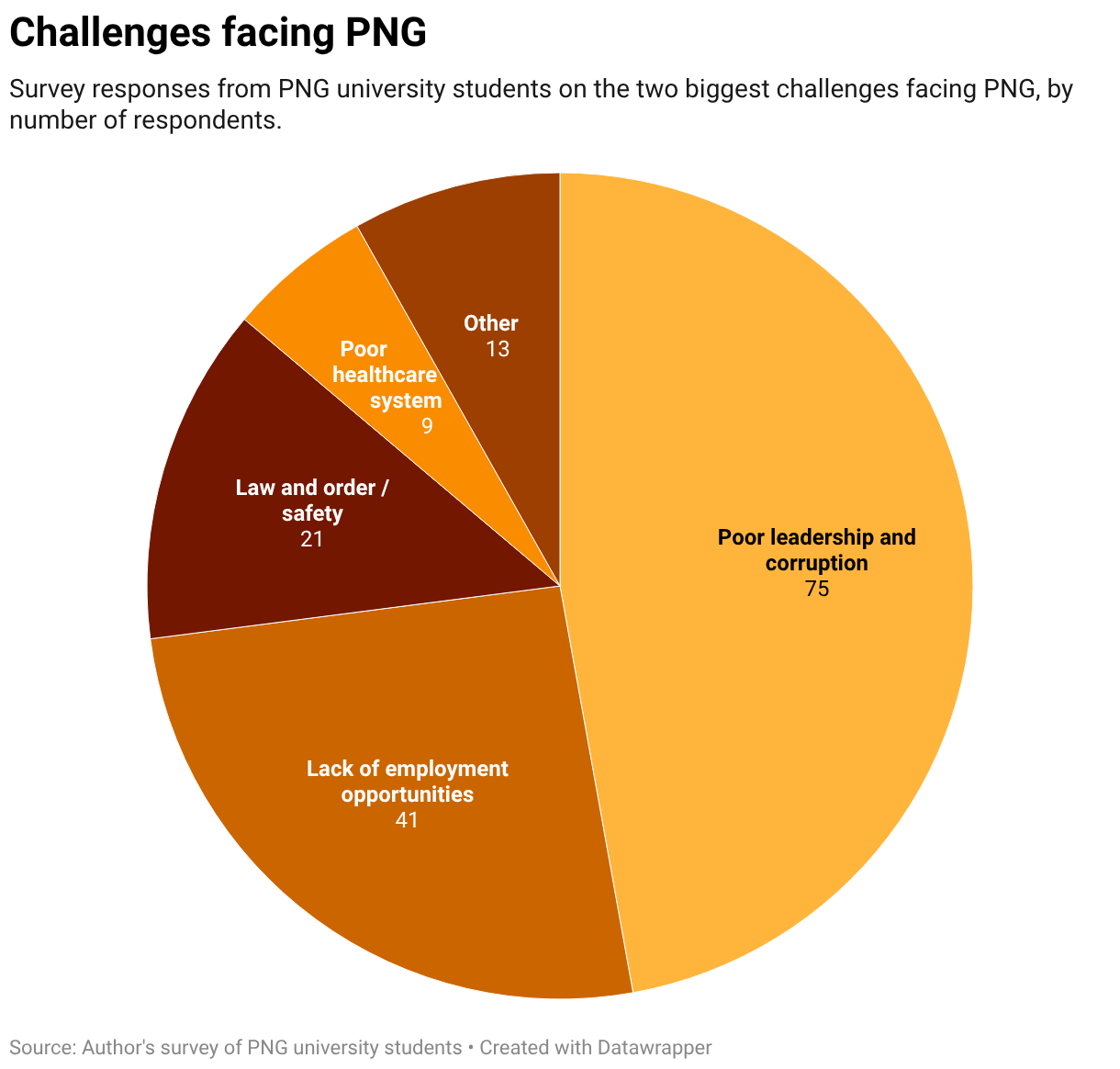
Asked what is holding the country back, students named “poor leadership and corruption” and “lack of employment opportunities” most often. Corruption here meant mismanagement of public funds, grand corruption, bribery and payoffs, nepotism and favouritism.
Education and health came next, with students pointing to shortages of teachers, inadequate learning materials, poor school buildings and too few health workers and medical supplies. Strengthening these services, they argued, is critical if PNG is to achieve its Vision 2050 goals. Students from outside Port Moresby added that development and infrastructure remain concentrated in the capital while many provinces and villages struggle.
A third set of concerns was equality and inclusion. Students welcomed efforts to support women but said people with disabilities are still left out; one described the difficulty wheelchair and crutch users face with public transport in Port Moresby and elsewhere. Others said the national general elections are an opportunity to vote in qualified women to work alongside good men. As one respondent put it:
“It is time to give women a chance to make some changes. For so long men have been voted in and progress has been slow.”
One theme connects these answers. Students see PNG’s development problems as linked to the quality of leadership and governance. Poor leadership and corruption are not isolated failings but the source of unemployment, weak public services, inequality and slow development, and most respondents expected the other problems to ease once visionary and service-minded leaders are in place.
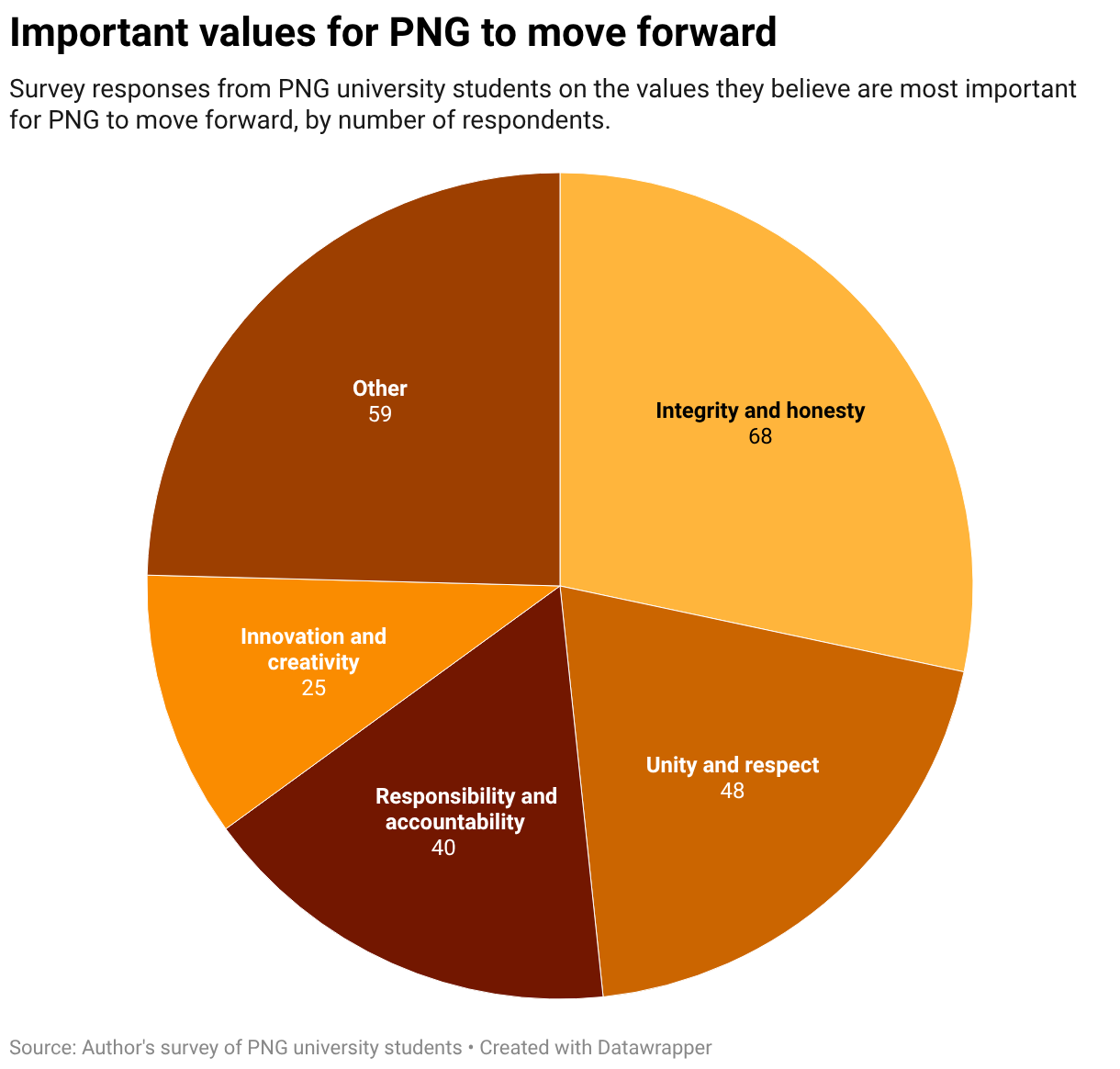
Asked which values PNG needs, students named “integrity and honesty” and “unity and respect” as the qualities both leaders and citizens must uphold. On integrity, studies here and here show how corrupt and dishonest practices have become normalised in PNG, from political leadership to everyday dealings in communities. One student referred to paying police officers or other public servants to get work done, while noting that many public servants remain dedicated and hardworking. Honesty, students said, must show in conduct and not only in words. That matters in a predominantly Christian country, where the normalisation of dishonest practice raises questions about the gap between professed values and everyday behaviour.
On unity, students identified division along regional and provincial lines as a cause of ethnic conflict and of wider problems in law and order, safety, business and public services. It can also fuel secessionist sentiment. Those in positions of power and those in communities and on the streets, students said, need to work towards the same goal: the wellbeing of all Papua New Guineans. Nation-building, on this view, is a shared moral and social responsibility, to be practised by families and ordinary citizens as well as by political leaders.
The last two questions asked what young people, and university students in particular, should be doing now. Rather than looking to the government to solve the country’s problems, respondents emphasised personal responsibility. Young people should make deliberate choices about their lives, learn about government policy and their rights as citizens, use the internet to inform themselves, and act on problems in their own communities, whether by intervening safely in a domestic dispute or reporting it to police. Several worried that respect for the rule of law remains weak after almost 50 years, and said young people can change that by upholding it themselves. On livelihoods, students stressed finishing school and attaining qualifications, but also acquiring practical skills: trades, entrepreneurship, saving and financial management. With formal employment scarce, these offer other paths to earning a living and contributing to the economy.
Asked about their own role, students described themselves as present-day actors rather than leaders in waiting. They pointed to supporting neighbourhood watch groups, promoting cleaner communities and setting an example for younger relatives. As one explained, “Since our families spend a lot of money on our education, they feel a sense of pride when they know that we are Uni students. Our younger siblings and the young kids look up to us and follow what we do.” Most universities have student association groups organised by academic program or by province, and during semester breaks these groups run awareness activities in schools and communities in Port Moresby and in their home provinces, on gender-based violence, peer pressure, national legislation and other local concerns. One female student said: “Every end of the semester, I hold a book drive donation, and then donate these books to a school back in my village.” When disasters or law and order crises occur, students also collect cash, clothing and food for affected communities.
Students have little money or formal influence, and they know it. What they claim instead is knowledge, energy and community networks, and student associations give them the organisational means to connect universities with villages and provinces. The sharper message for PNG’s leaders is the one running through every answer: this generation reads the country’s problems as a failure of governance, and it will be voting on that basis.
