


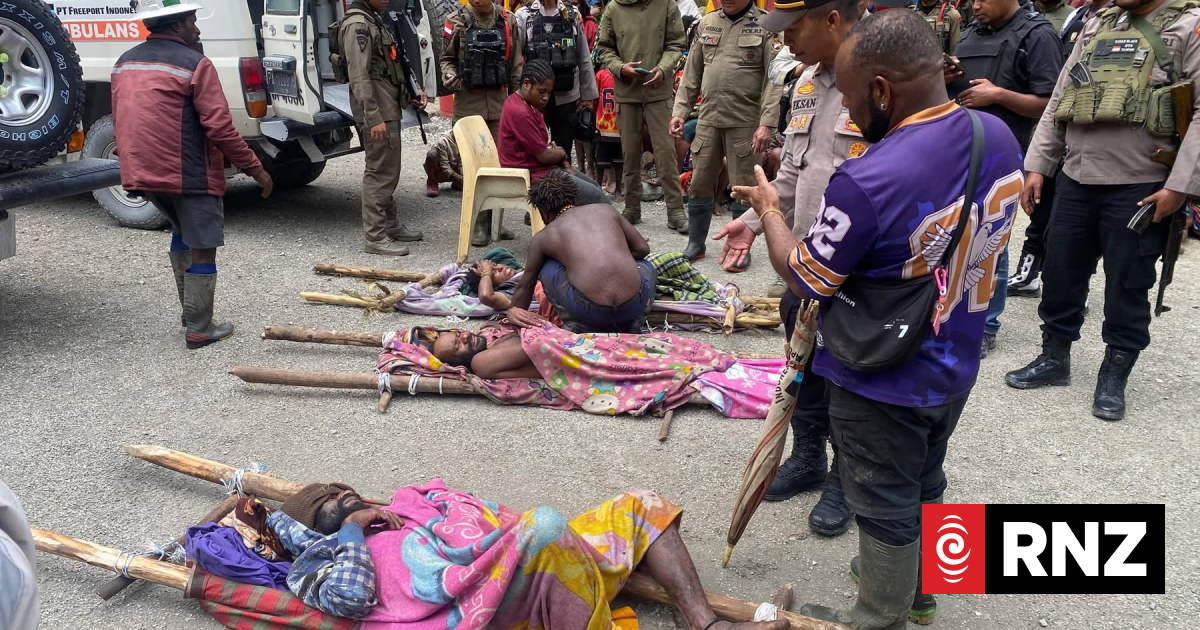
A photo of Indigenous West Papuan civilians in Distrik Tembagapura, Mimika, Central Papua, allegedly injured by use of excessive force by non-organic Indonesian military forces (TNI Satgas Habema). This image, alongside several more graphic ones, was shared on Facebook by the United Liberation Movement for West Papua leader Benny Wenda on 9 May 2026. RNZ Pacific has been unable to independently verify the picture.
Photo: Facebook / Benny Wenda
A West Papuan church leader has warned that ongoing killings of young Papuans allegedly by Indonesian security forces have the hallmark of genocide.
Since the start of the year there’s been no stop to violent incidents in Indonesian-ruled Papua region – known internationally as West Papua.
Indonesia’s government blames recent violence on armed, pro-independence West Papuan fighters.
However, human rights defenders say the violence is escalating violence, and the young, indigenous people of West Papua are in the firing line.
Escalation
Last week a 17-year old Papuan girl was killed as a result of a military operation reportedly targeting civilian mining camps in Tembagapura.
Also last week, several Papuan high school students were shot when tensions flared at a graduation parade through the town of Kobakma in Papua’s central highlands. Police had objected to them wearing the Papuan Morning Star Flag a symbol of the Independence Movement.
Last month, Indonesia’s National Commission on Human Rights (Komnas HAM) said it was investigating a shooting incident that left up to twelve Papuan civilians dead as the result of an Indonesian military operation in Kembru district. According to human rights researchers, a 5-year old girl and a 77-year old woman were among the dead.
Komnas HAM’s commissioner for monitoring and investigation Saurlin Siagian said it was difficult to ascertain the exact ages of each victim in the Kembru incident, but he told RNZ Pacific that two pregnant women were among those killed.
Earlier in April, five people, including a 12-year old boy, were shot dead in Dogiyai regency in an alleged retaliatory attack by police after a policeman was killed.
The list goes on, stretching back to January – dozens of people reported dead, dozens more people injured and many more people displaced from their villages.

Pastor Jimi Koirewa, the head of the human rights and justice department of the GIDI Evangelical Church of Indonesia in Papua.
Photo: Supplied
Pattern
The head of the human rights and justice department of the GIDI Evangelical Church of Indonesia in Papua, Pastor Jimi Koirewa, said there was a disturbing pattern to these attacks.
“The children are being killed, the women are being killed. That is a part of genocide, because the women will give birth to babies, the kids, the children, the youth, they are the future of Papua, and killing them is part of a genocide. They’re wiping us out. There will be no more people there standing in Papua. The old people will die gradually,” Koirewa told RNZ Pacific.
Indonesia’s Foreign Affairs Ministry declined to comment on the pastor’s claim. It said it could not discuss recent incidents while investigations are underway. However, the Human Rights Minister in Jakarta, Natalius Pigai, has admitted the situation is a serious concern.
After a violent year in 2025, when Komnas HAM which recorded 97 violent incidents and armed conflicts in Papua, the situation has deteriorated further this year.
Pigai noted that the country’s independent human rights body has identified 26 cases of violence in Papua from January to April 2026.
“Based on records from both domestic and international sources, there is an escalation. In just under a month, no fewer than 20 people died in 5 incidents in Dogiyai, Yahukimo, Puncak Papua, Timika, and Tembagapura,” Pigai said in a statement on Sunday.

Natalius Pigai, a former chair of Indonesia’s National Human Rights Commission (Komnas HAM), a West Papuan who has been the target of racial slurs.
Photo: Tekdeeps
Pigai claimed the government was continuing to seek a peaceful solution that can address the root causes of the conflict.
For the past several years Indonesian security forces in Papua have been engaged in conflict with ‘armed criminal groups’, their label for Papuan pro-independence fighters within the wider OPM Free West Papua Movement.
Lack of justice: ‘Shooting the people’
Pastor Koirewa said the Indonesian military forces had been amassing in large numbers in recent months.
“There’s so much military deployment coming into Papua and the reason, they said, is they want to get rid of the rebels, OPM, that’s what they call rebels. They said that they want to get rid of the OPM so that development can happen, the government can come and build the land,” Koirewa said.
“But when they come in, they are not shooting the combatant, the OPM, but they are shooting the people. So I see that the it’s escalating.”
Koirewa said police rarely investigated the violent incidents thoroughly, leaving Papuan communities mistrustful of the justice system. The GIDI church has raised its concern with the upsurge in violence.
“Our church, we have no influence in Jakarta at all. We already made some communications through the formal way to Jakarta, yeah, through the our parliament, let them know what is happening, but Jakarta is not responding. They don’t care.
“They just come in with their programme, and they don’t care at all. That’s why the church now is looking for aid outside of our country,” Koirewa said, adding that the aid they sought is for internally displaced people and Papuan schools.
Displacement
Jakarta has been promoting major agri-business projects in Papua provinces – including oil palm, rice and sugarcane – as well as large scale mining and forestry projects in the interior.
The government argues that increasing development and economic activity raises the standard of living for everyone in Papua.
“Which part of Papua are they developing? Why are the Papuans still the poorest among the whole Indonesian population. They have been for with us about more than 60 years. And why are the Papuans still the Papuans still in poverty?” Koirewa said.
“We see that there has been no output at all. They will only bring more non-Papuans in to take over our land.”

A camp of displaced West Papuans in Papua’s highlands.
Photo: Supplied
Koirewa said changing demographics due to Indonesian transmigration added to the sense that Papuans were being out numbered in their homeland and facing a bleak future.
“There’s no hope,” he said.
The displacement of Papuan villagers is also a factor, with the latest Internally Displaced Persons update from Human Rights Monitor group saying over 107,000 West Papuans remain displaced by armed conflict.
