

Overview:
Guam’s growing role as a strategic U.S. military hub is fueling debate across the island, where economic reliance, environmental concerns and questions of self-determination are colliding. As military expansion accelerates, Indigenous Chamorro voices are increasingly challenging its long-term impact on land, culture and daily life.
By Sean Mantesso
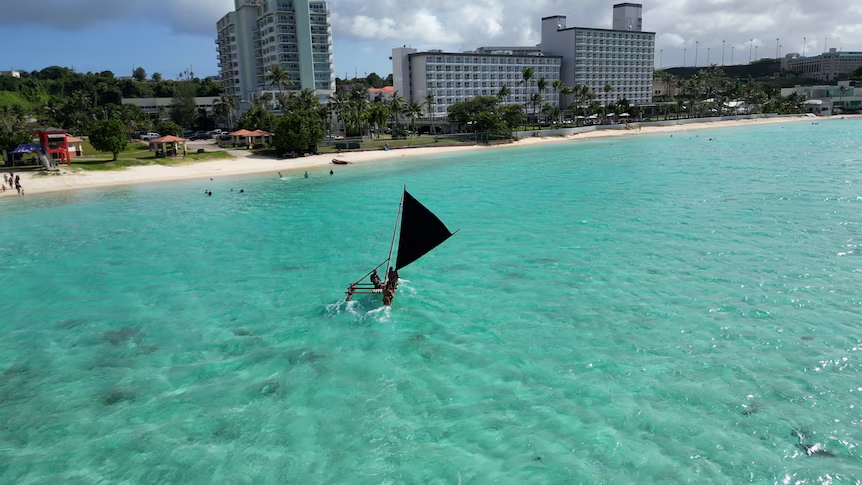
CANBERRA, 06 APRIL 2026 (ABC) — In the glistening waters of Tumon Bay, a traditional canoe catches the wind.
At its helm is boat builder Ron Acfalle, who has sailing in his blood.
“We came from the ocean,” he says. “We didn’t sprout from the ground.”
Ron is an Indigenous Chamorro from Guam, a 50-kilometre-long island in the Western Pacific and an unincorporated territory of the United States.
He is reviving the lost art of canoe-building and sailing, practices once banned under colonial rule.
But today Guam sits at the centre of a new struggle. It is caught between the world’s most powerful military and the right of its people to determine their own future.
Guam is already one of the world’s most militarised islands — nearly a third of it is controlled by the U.S military and the people here enlist at extraordinary rates.
And yet Guam’s people cannot vote for the U.S president and do not have a voting member of Congress.
Now, as the island undergoes another major military build-up, life is being reshaped.
Lack of job alternatives
Up at his workshop overlooking the bay, Ron says the military is a tempting career on an island with few other opportunities.
“When we graduated from high school, there was no place for us to go,” he says.
Ron was a marine for four years, but he hopes his culture can offer an alternative.
“I came home and I took that knowledge and I took the discipline and I’m teaching it to the younger generation,” he says.
“They don’t have to join the military.”
But many still do. The people here enlist at a higher rate than any U.S state.
That loyalty is tied, in part, to history.
During World War II, Guam was captured and occupied by Japan for nearly three years.
When U.S forces retook the island in 1944, liberation came, but so did lasting consequences.
Indigenous land was later forcibly acquired, and the military’s presence became deeply embedded in island life.
Ron is among a growing number of Chamorros, who make up about half of Guam’s 170,000 people, questioning a widely-held view that what is good for the military is good for Guam.
“There’s a growing concern now that they’re disrespecting our land … our burial sites,” he says.
“I view [the military] as coming here not for the culture, not for anything other than for themselves.”
Strategic value in conflict with China
But real change won’t come easily.
An unincorporated territory of the United States, the people of Guam have little say over how the military uses the island.
Pacific Center for Island Security director Leland Bettis said Guam represented a “treasure” in terms of military value.
“The military does not need permission from the government in Guam to project force,” he said.
“It does in Japan. It does in Korea. It does in the Philippines.”
Guam being the closest American territory to flashpoints such as Taiwan make it vital in any future conflict with China, Leland says.
The ABC was given rare access to a handful of military sites to get a glimpse of how the U.S is investing.
At one site we spoke with personnel working on the US$11.5-billion dollar Guam missile defence system.
Captain Alexander Manville said Guam was the first location for this type of system to be deployed.
It’s described as a “360-degree missile defence shield” which, unlike the already deployed Terminal High Altitude Area Defense (THAAD) missile system, can defend against low and short range projectiles.
“I’d say it is a full commitment to the people of Guam and to the defence structure that we have here, that it is being fielded here first,” Captain Manville said.
Guam local Captain Alejo Luhan, from the National Guard, told us he welcomed the military’s continued investment.
“It’s provided a lot of opportunities for young adults, young kids and people who aspire to serve a higher calling,” he said.
Build-up’s environmental impact
But on Guam’s northern edge, the impact of the build-up is harder to ignore.
Near Camp Blaz, a stretch of coastline known as Ritidian borders a protected wildlife refuge, home to endangered species and an area that’s culturally significant for the Chamorro people.
On the road at the refuge’s entrance, demolition work echoes from a new live-fire training range.
“It can be very loud, all the clearing and grading,” said Monaeka Flores, the executive director of Prutehi Guåhan, an environmental and Chamorro rights group.
According to U.S military estimates, roughly 10 per cent of Guam’s remaining limestone forest has been cleared to make way for the range.
The site also sits above an aquifer that supplies around 80 per cent of the island’s drinking water, raising concerns about potential contamination.
The U.S Navy, which oversees the construction of these facilities, told the ABC in a statement that it was “committed to protecting Guam’s environment and is in full compliance with all legal requirements”.
It said “stormwater management systems minimise the risk of lead contamination … and are operating as intended” since their completion in April 2025.
But Monaeka said Guam already has a long history of contamination related to military activity, and the range and other works here risked “generational harm”.
“We have a high incidence of cancer, heart disease, diabetes … essentially the military build-up here guarantees ecological destruction, affecting our food security, the safety of our drinking water, the health of our people,” she said.
‘You come home with demons’
For the many Chamorros who enlist, serving in the U.S military can raise difficult questions.
Like so many other patriotic Americans, Roy Gamboa enlisted in the aftermath of 9/11 and served two tours in Iraq as a marine.
“It’s nothing like the movies, it changes you … you come home with demons,” he said.
Roy’s experiences led him to found the veteran’s support group Got Your 671, a combination of the military term “got your six” and Guam’s calling code of 671.
As much as 14 per cent of Guam’s population are veterans, yet studies show they have, on average, access to less than half the services available to veterans in the U.S.
Roy said many veterans travel to Hawaii just to receive basic care.
“My question, of course, is always, do we not bleed the same? Have we not died for our country enough?” he said.
Being a patriot does not stop Roy questioning the military’s role on Guam.
He took us to a lookout above the U.S naval base and pointed down toward where he said his grandfather’s land was forcibly acquired after the second world war.
“I feel more hurt knowing that … his belief was some day we will get this land back, [but] he died,” Roy said.
Despite their service, Roy said many veterans feel caught between competing loyalties.
“Where does a veteran belong on the island of Guam, where do you side? In many cases veterans can feel conflicted … I’m torn, I’m stuck between the two worlds,” he said.
Pricing civilians out of housing
That tension is also visible in everyday life.
While military personnel often live in well-serviced housing, many locals are struggling.
The cost of living on Guam is among the highest in the United States.
Jessica Lizama said even with two full-time incomes, her family cannot afford to rent a home.
She, her husband and their four children have been living with her parents for the past six years.
“An apartment, or a condo, that’s about almost US$3,000 [$4,342 in rent] a month and that does not include utilities like power, water,” Jessica said.
Guam’s military personnel can receive rental allowances of $3,000 per month and about half live in civilian housing.
Jessica said the situation “just feels helpless … it’s very frustrating, heartbreaking”.
Military addressing issues
On Nimitz Hill, named for the famed World War II Admiral Chester W Nimitz, Commander of Joint Forces Micronesia Joshua Lasky said the military was working hard to secure more off-base housing.
He also said the military was complying with environmental regulations as well as conducting remediation works such as replanting forests to compensate for areas where land has been cleared.
“Is everybody always happy? Of course not,” Rear Admiral Lasky said.
“But I don’t think that’s necessarily a signal of a flaw in the system — that’s a healthy system.”
On questions about Guam’s future, its political status, and whether the island should have more autonomy, Rear Admiral Lasky had no clear answer.
“I think that is really a matter for the government of Guam and the United States government. What I can tell you is we are committed to being part of the community here,” he said.
An economic lifeline
For many on Guam the military presence is not just strategic, it’s essential.
By some estimates, military activity now underpins as many as one in five jobs.
Few understand that dependence better than Lee Webber.
A Vietnam War veteran who was evacuated to Guam for medical attention, he married a local and never left.
After decades working in publishing, he now runs a dive shop.
“If there was no military this island economy would be down now. It would be shut off,” Lee said.
“After COVID everything fell apart, but our military business held … we’re probably 95 per cent military.
“In spite of what any politician will tell you … the islands really, really, are actually in dire straits … without the military … we wouldn’t be floating.”
That reliance shapes how many people view Guam’s future.
“If we were a state, we’d be in a mess,” Lee said.
“And if we were independent, we’d be so vulnerable it would be unbelievable.”
A revival underway
But for many Chamorros autonomy is about more than politics.
The Hurao Academy in the capital Hagåtña is Guam’s first Chamorro immersion school, and this year is the first it has been fully publicly funded.
The school’s founder and long time Chamorro language proponent Anna Marie Blas-Arceo has spent decades working to bring it to life.
“It has been a dream of mine for many, many years — 20 years in the making,” she said.
For the parents and kids, Hurao is more than just a school.
For decades the U.S suppressed the Chamorro language and banned it in schools, a policy only fully lifted in the 1970s.
The damage from that and many other repressive policies is still being felt today.
Anna Marie said many Chamorros of her generation, born in the postwar period and discouraged from speaking their native language, “have this hole in them”.
Parent of two Sågue Salas agreed, saying having his kids learn Chamorro meant they would not “struggle with their identity like I have”.
“I still see my parents struggling to actually know who they truly are and know how grounded they are to our land and to the culture,” he said.
Guam and the Chamorro people have endured a great deal and much remains unresolved.
But across the island a revival is underway, not led by politicians or military power, but by ordinary people.
Anna Marie believes that even the U.S military does not have the power to stop the revival that is now underway.
“No matter what our political status is, no matter whether there’s military influence or not,” she said.
“No matter what happens around us, if we protect our families and the teaching of our language and culture within our families, then nobody can take that away from us,” she said…. PACNEWS
