

Overview:
After an eight-year absence, the Peace Corps is back in Palau — and nine newly sworn-in volunteers are ready to bring English literacy instruction to elementary schools nationwide. From Germany to Iowa, meet the volunteers embarking on a two-year mission rooted in cultural exchange and community.
By: Summer Kennard
KOROR, Palau (July 9, 2026) — “I love working with kids, and seeing them grow is really something that makes me happy” — with those words, Peace Corps volunteer Ole “Sochai” captured the spirit of a new chapter in the decades-long partnership between Palau and the United States.
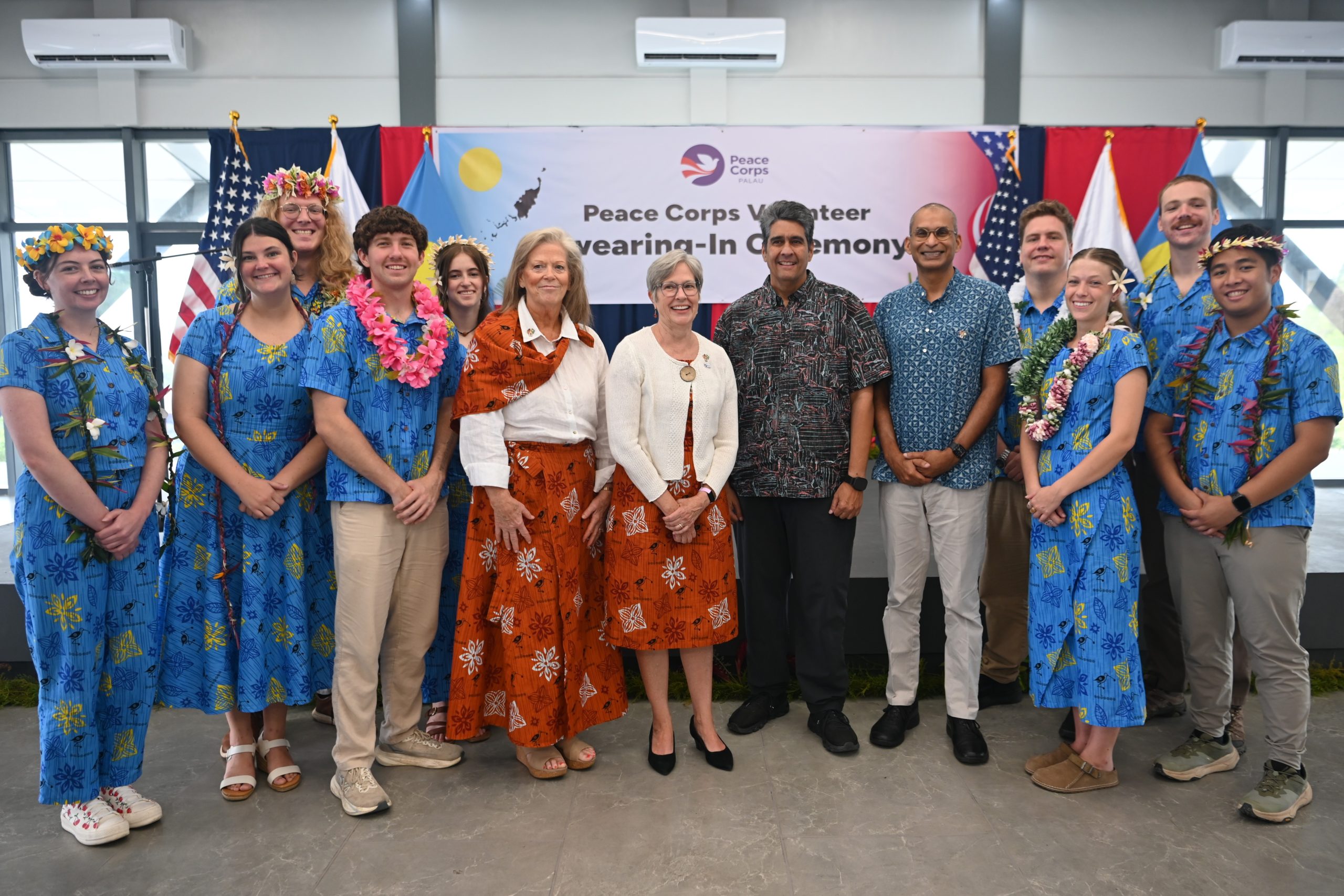
The Peace Corps officially returned to Palau on Tuesday, swearing in its first group of volunteers since 2018. Nine volunteers, who completed 10 weeks of language, cultural and technical training, took the oath of service and will spend the next two years teaching English literacy in elementary schools across Airai, Aimeliik, Koror, Melekeok, Ngaraard, Ngardmau, Ngaremlengui and Ngatpang.
Volunteers reflect on new chapter of service
For many of the incoming volunteers, the assignment marks the start of a deeply personal journey. Sochai, who is originally from Germany but has lived in Philadelphia for the past nine years, said his love of new cultures and people drew him to the program.
“Once I graduated from college, I knew I wanted to get out there, go somewhere I’ve never been before,” he said. Having previously served in Cameroon, he said he was drawn to Palau by an open position teaching English literacy. “I love working with kids, and so I chose to come here to Palau.”

Volunteer Tyson “Ngiramelngoes,” of North Liberty, Iowa, said he was inspired to join the Peace Corps by a family friend who served in Madagascar in the 1990s. Though he had never heard of Palau before finding it listed on the Peace Corps website, further research changed that.
“After researching Palau, how gorgeous of a country it is, the history of both Peace Corps and Palau … made me really excited to serve,” he said. “I’m really proud that I chose this country.” Ngiramelngoes said he is looking forward to teaching upper-grade reading and writing fluency at Melekeok Elementary School. “I’m very passionate about teaching. The kids there are fantastic,” he said.
A new operational model
Peace Corps Deputy Chief Executive Officer Chris Besch said the program’s revival was made possible by sustained requests from Palau’s government and a redesigned support structure. “I think it really helped that President Whipps was persistent in requesting that we return,” Besch said. “We’re returning with a different structure that will make our operations better.”
Unlike earlier iterations of the program, when Palau was administered jointly with the Federated States of Micronesia without local staff, the new model includes one permanent American staff member and five local employees based in-country. “We think that’s going to be a much more successful model,” Besch said.
Associate Director for Global Operations Nancy Herbolsheimer said the swearing-in ceremony reflected the strength of the bilateral relationship. “This underscores our strong relationship between the country of Palau and the United States and our ongoing partnership,” she said.
Selection process and outlook
Peace Corps officials said host communities are chosen based on school readiness, community support and the availability of host families, with staff typically starting at the school level to identify need and a potential in-country counterpart for volunteers.
While only nine volunteers arrived this year, officials said demand exceeded supply, and recruitment is already underway for a second group expected to arrive in April 2027. Besch said success is measured not just by classroom outcomes but by integration. “Success is really having a Peace Corps volunteer become a true member of a host family, a community and a school staff,” he said. “They’re not here as outsiders but as people who truly belong.”
Embassy: Return signals ‘grassroots’ bond
U.S. Embassy Chargé d’Affaires Shankar Rao called the swearing-in a personal and diplomatic highlight of his posting in Palau. “It really signifies the deep bonds between Palau and the United States,” Rao said. “It’s the grassroots level of engagement that makes this relationship so special.”
Rao said he hopes the program’s return marks the start of an ongoing cycle of exchange. “I hope this is a cycle that we can continue, with mutual benefits for both Palau and the United States,” he said.
President Surangel S. Whipps Jr., addressing the newly sworn-in volunteers, framed the moment as a continuation of a long-standing relationship rather than a fresh start. “Today is not just about starting a new chapter; it’s about honoring a deep-rooted, lifelong bond,” Whipps said. “For generations, Peace Corps volunteers have worked hand in hand with our local communities — in our education sector, helping protect our environment, and supporting the development of sustainable tourism.”
