

This year’s Kiribati Language Week’s English translation means to “strive diligently to fulfil our responsibilities and uphold our Kiribati identity.”
But for Roi Burnett (Beru, Onotoa, I-Matang) that English translation doesn’t quite capture that phrase’s true essence.
“I think ‘Karina te ang’ has such a deeper meaning behind it,” Burnett explained.
“It literally means to take a breath, and ‘ang’ can be translated as the wind, the breath or the spirit. So to me, ‘karina te ang’ means to just always, in whatever you do … always take a breath and take in the spirit.”
Burnett, who is of i-Kiribati and European heritage, was born in Australia, lived in Fiji, but primarily grew up in Aotearoa.
“I didn’t grow up understanding my language,” she said.
“I was born in Australia and we grew up away from Kiribati, but it wasn’t until I was a bit older and I actually went back to Kiribati, and I was living and working there for two years, that I actually learned the language and I was able to understand it.”
“So it’s been a journey for me, and one that’s still ongoing at the moment too.”
Roi and family in Tarawa, Kiribati
Roi Burnett
Following her undergraduate degree, Burnett spent two years in Kiribati through Volunteer Service Abroad, working alongside two women’s organisations.
“Just being completely immersed in your language, hearing it every day, hearing people speak to you in the language, just really helped me to grow with my understanding,” Burnett said.
“It also just forced me to speak because most i-Kiribati that grow up away from home, we can understand the language, but we don’t have the opportunities to speak it as much,” she added.
She now works alongside a growing movement of i-Kiribati based in New Zealand, Ara Maneaba, who organise online language classes for others who want to stay speaking and learning the te tatate ni Kiribati.
“I think the first sessions we were all a little bit to speak in front of each other,” Burnett said.
“But our tutor just does such a good job at really bringing that shyness away from us…now everyone has grown in their confidence, so even if we make a little mistake, it’s okay. That’s how you learn,” she said.
Burnett added that overcoming embarrassment is something every learner eventually has to face.
“Kiribati people, we love to laugh,” she said.
“So if you make a mistake, everyone will just crack up. That’s part of overcoming that fear of being laughed at, I think, is how you really grow on your journey.”
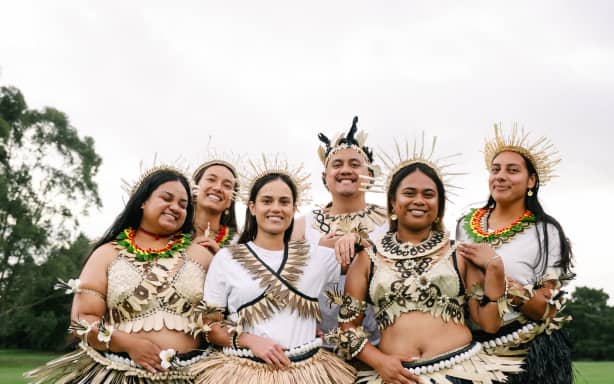
Ara Maneaba, a collective young i-Kiribati in Aotearoa
Roi Burnett
Reframing perceptions of Kiribati
Burnett said that reconnecting with her language has also sharpened her own perception of Kiribati as a nation, and how they are often spoken about.
“There’s a common perception that we are a vulnerable island,” she said.
“Obviously we’re experiencing the impacts of climate change, so that’s not to deny the reality, but it’s the way that we’re always being talked about that can kind of, frame us in deficit ways,” Burnett explained.
“We’re always sort of talked about in terms of our smallness or our vulnerability to the impacts of climate change.”
Those narratives, Burnett said, often overlook thousands of years of Kiribati knowledge and resilience.
“For me, I think it’s about also recognising that we’ve been there for a very long time.”
“Kiribati people have been there for thousands of years. We’ve always been able to navigate environmental change, social change … it’s important when we walk about our places, that we also remember that we have those strengths.”
A lot of this thinking underpins Burnett’s PhD research, which explores menstrual experiences and reproductive health through an i-Kiribati lens.
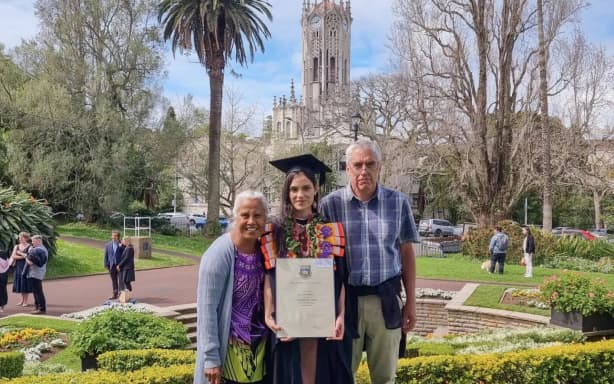
Roi with her parents, Takeua and Greg, at graduation
Roi Burnett
“It was my time in Kiribati where I was working…in the area of, I guess, women empowerment and sort of gender spaces in Kiribati, that I really saw the importance of bringing in our own kinds of i-Kiribati knowledge and expertise,” Burnett said.
“Especially amongst our women … one area that I was really interested in was menstruation and reproductive health. We see these deficit narratives around our health and our bodies,” she said.
Burnett explained that there are ongoing issues around water insecurity, and access to health and sanitation, so she became interested in traditional practices and perceptions around menstruation.
“We say that menstruation is something that’s a bit taboo, but in our culture we celebrate a girl’s first period. So I was interested in … what do those kinds of practices help teach us about our bodies, and how we relate to our bodies?”
Burnett added that indigenous knowledge is too often overlooked. Recognising community knowledge is a way of decolonising research, valuing the expertise of locals and communities that exist beyond a university.
“I think sometimes in mainstream research we kind of sideline those other types of knowledge,” she said.
“But for me, I think it’s really about embracing our practices and seeing that as legitimate knowledge as well, and what we could learn from that.”
Kiribati Language Week ends on Saturday, with celebrations ongoing across the country.
