


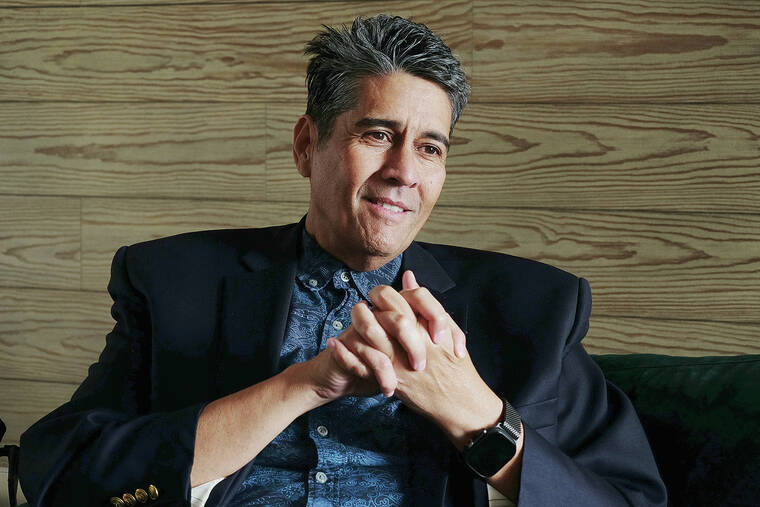
The island nation of Palau, home to just under 18,000 people living on 500 small islands, has become an out sized player on the global stage as the U.S. and China compete for influence across the Pacific islands.
The U.S. military has been building up infrastructure in Palau while Chinese investors have been buying up and leasing land in the islands. President Surangel Whipps Jr. said that “when I got into office, one of the things I was told was there was a lot of this Chinese organized crime operating in Palau, and that we needed to stomp it out.”
Whipps first came into office in 2021 and was re-elected in 2024 in a race against his brother-in-law, former Palauan President Tommy Remengesau Jr.
His time in office has been defined in many ways by his staunch alignment with the United States and his defiant stance toward China. But during a visit to Oahu this month for the Honolulu Defense Forum, he said “I want Washington to understand that we also have challenges.”
This year, Palau will host the 55th Pacific Islands Forum Leaders Meeting. Whipps said that during a recent trip to the U.S. that he extended an invitation to Vice President J.D. Vance to attend the event.
“I think it’s important that Washington shows up,” said Whipps. “They need to be present and part of these activities if they say the Pacific is important.”
Don’t miss out on what’s happening!
Stay in touch with breaking news, as it happens, conveniently in your email inbox. It’s FREE!
He said he hopes Vance, or even President Donald Trump himself, will take him up on his invitation to visit the region as he notes that no sitting American President has ever visited one of the smaller Pacific island nations.
Whipps said that if Trump came to Palau “I’d like to come and take him snorkeling and expose him to coral bleaching and other things.”
The Palauan leader has been vocal about threats his and other island nations face from climate change, which the Trump Administration calls a “hoax.” But Palau has also been deepening ties with the U.S. since Trump’s first presidency as tensions have ratcheted up with China.
Palau is one of a handful of countries to maintain direct relations with Taiwan, which China’s leadership regards as a rogue province. Chinese investment also runs deep in Palau, and tourists from China once came in droves to see Palau’s famously pristine reefs and beaches. It was a major boon for the islands’ small economy.
But in 2017, the Chinese government ordered tour operators to stop selling package tours to Palau, with reports that doing so could lead to fines. Chinese diplomats have since told Palauan officials that unless they cut off ties with Taiwan, they will continue to apply pressure. Whipps calls the tactics “economic coercion by the weaponization of tourism.”
Since then, Palau has also found itself dealing with increased illegal fishing from China’s fishing fleet in and around its waters and has seen an increase in activity by uninvited Chinese research vessels in its waters. As tensions in the Pacific have ratcheted up around Taiwan and in the South China Sea, the U.S. military has also renewed its interest in Palau.
Partner of choice
After World War II, Palau became a “trust territory” governed by the U.S. until it declared independence in 1981.
Along with the Marshall Islands and the Federated States of Micronesia, it has a Compact of Free Association with the United States. Under the agreement the U.S. government provides aid and services to the islands while in return the U.S. military gets access to their waters and airspace to support its operations.
The U.S, military is currently working on upgrades to Palau’s largest harbor, new radar stations to watch China and “pre-positioned” equipment stockpiles in the event of a conflict. China for its part has turned up the pressure on Palau, with American and Palauan authorities accusing Chinese hackers of launching several cyber attacks on both private businesses and government agencies.
Most other Pacific Island nations have direct relations with China rather than Taiwan, and many have joined the Belt and Road Initiative — a series of Chinese-funded infrastructure projects aimed at promoting closer trade ties.
While no sitting American President has ever visited these countries, Chinese leader Xi Jinping has visited both Fiji and Papua New Guinea.
Whipps said that when it comes to many Pacific leaders “their view is Washington is not the partner of choice (and) China is the better partner, because they want to help in renewable energy, they want to build ports, to help with economic development, they care about climate change. You know, that’s what China is at least saying to the Pacific.”
Whipps also noted that he has brought up to American officials that when a new leader takes office in a Pacific Island nation with diplomatic ties to China, they are invited to Beijing for a state visit and one-on-one meetings across the entire government. He said “that has never happened for any Pacific island with the U.S., so that’s the difference.”
Palau has maintained close trade ties to Taiwan and receives aid from the Taipei, but Whipps said Chinese diplomats have explictly told him and other Palauan officials that they will pay for it if China were to seize Taiwan.
“(They say) we’ll give you more now, and if you wait until later, you’re going to get nothing,” said Whipps. “So if you’re a Pacific leader that’s depending on that assistance, how do you think your thought process is? You’re like ‘do I really want to be on the wrong side of history.’”
‘ … The middle of it’
But Whipps is adamant about his insistence on staying aligned with the U.S. and Taiwan, arguing that Beijing has brought corruption and eroded democratic institutions in island nations where its influence has grown.
Both the Solomon Islands and Kiribati have signed secretive agreements with China that allow Chinese police officers to operate in those countries and authorities have at times investigated and harassed journalists investigating Chinese activities in several island countries.
Many Pacific island nations, including Palau, were once bloody battlefields during the “island hopping” campaigns of World War II. The fighting devastated communities caught in the crossfire and many still have thousands of unexploded ordnance spread across their islands that still kill people to this day.
Now, as the U.S. and China compete for influence across the islands and develop new missiles and other weapons for a potential Pacific conflict, many islanders fear a repeat of that history.
Whipps has accused China of attempting to thwart his reelection and alleged the Beijing has in some cases worked directly with Palauan politicians critical of the U.S. military’s increasing involvement in Palau.
Among the most vehement critics has been Palau’s Senate President Hokkons Baules, who has vocally advocated for Palau to sever ties with Taiwan and seek closer cooperation with China.
Whipps said “the narrative is, ‘well, if you keep (the U.S. military) out, then you’re safe.’ But the reality is, we are in the middle of it, and as we know from World War II, whether the United States is there or not, somebody else will be there. And the reality is, that’s why we need to be working together on all fronts: diplomatically, defensively and economically.”
The entire Pacific
In December, Whipps’ government signed a controversial “memo of understanding” with the Trump administration to take up to 75 “third country nationals” from the U.S. under Trump’s massive immigration crackdown who cannot be returned to their home nations.
It would allow deportees never charged with a crime to live and work in Palau, which Whipps’ office said would help “address local labor shortages in needed occupations.” In return, Palau would receive increased U.S. funding and cooperation on health care, pensions, disaster preparedness, law enforcement and security.
Whipps said he saw it as an opportunity serve the interests of both Palau and the United States.
“The United States believes that a lot of these people are economic migrants, they’re not really asylum seekers. We’re saying that doesn’t matter to us,” said Whipps. “We welcome them, they can come, they can live in Palau, and they can work … they’ll give us a list, and then we get to select … we want them to partner with us, to come and be contributing members to our our society and and have a good life.”
The proposal divided the Council of Chiefs, a board of 16 traditional leaders who advise Whipps, as well as Palau’s elected lawmakers. In particular, some raised concerns that language in the agreement indicates deportees wouldn’t be told they are going to Palau until after boarding flights from the United States and that Palauan officials are permitted to accompany them only after boarding.
Last week, the Palauan Senate moved to block the agreement with a bill that that would prohibit entry, residence, employment or long-term stay in Palau of any individuals who have been ordered removed by foreign governments. Paluan Sen. Siegfried Nakamura called the agreement “very inhumane” and said that “nowhere in the MOU does it say these people freely choose to work in Palau.”
But some lawmakers said they see it as a temporary move, with Palauan Sen. Brian Melairei saying “this bill only intends to stop the agreement while leadership fully reviews the pact with the U.S.”
Whipps said that he’s been looking at many ways to jump start Palau’s economy, including rebuilding Palau’s tourism sector.
“When we talk about diversifying our economy, one of the things that we’ve been working on is we can’t be dependent on Chinese tourism,” he said. “So how do we diversify? … instead of having 70% of our tourism come to China, it’s down to 30%, but we have tourists from Japan, Taiwan, Europe and the United States and Australia to fill in that gap.”
But he said he’s looking beyond tourism. He pitches Palau — centrally located between Japan and Australia — as a place that could host tech offices, financial firms and other ventures. He also added “don’t just look at Palau, look at the entire Pacific, because there are opportunities for shared prosperity.”
During a stop in Honolulu in September before the 2025 PIF Leaders Meeting in the Solomon Islands, he called for “an Indo-Pacific investment initiative to attract sustained private-sector investment into our islands,” and said “China cannot remain the No. 1 investor in our private sector. That must change.”
Next month, the East-West Center in Manoa will be hosting an inaugural summit “focused on mobilizing private capital to support critical infrastructure, energy, health systems, and business development” that is set to bring Pacific Island leaders, senior U.S. officials and business leaders to Honolulu.
Whipps said that he would like to see Hawaii play a larger, more direct role in Pacific Island issues, including potential participation in PIF, arguing “if French Polynesia and New Caledonia are part of the Forum, why not Hawaii?”
