


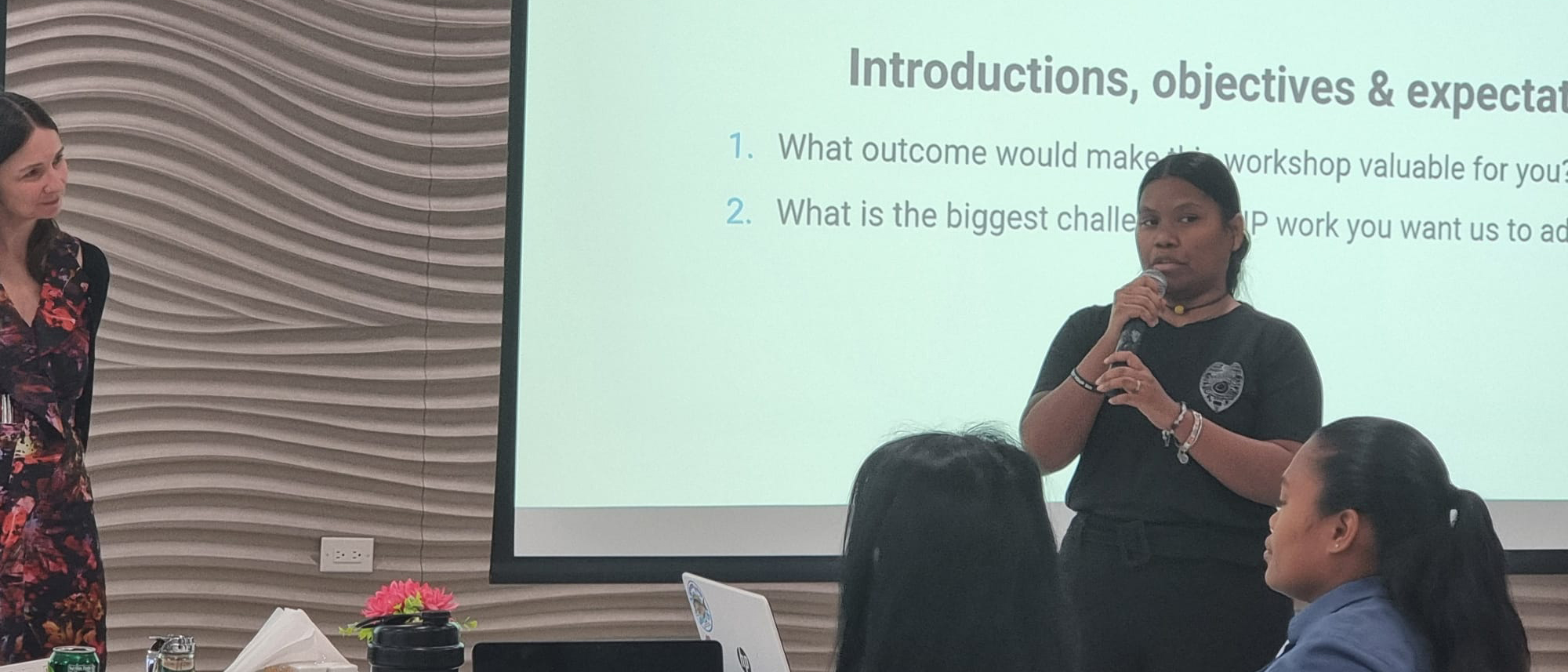
Ngerulmud (Palau), 20 April 2026 – From 20 to 24 April 2026, the Republic of Palau hosted an intensive five-day capacity-building week focused on combatting transnational organized crime, co-organized by Palau Office of the Attorney General and UNODC, with support from the Australian Department of Foreign Affairs and Trade (DFAT) and the Government of Japan.
The week was opened by Minister of Justice Jennifer S. Olegeriil, who set an unambiguous tone. She pointed to the growing poly-criminality of organized crime as one of the defining challenges of the current moment — scam center-linked operations, she noted, does not operate around a single type of offence. Drug trafficking, human trafficking, money laundering, and cyber-enabled fraud are increasingly bundled within the same criminal enterprise, demanding an equally integrated response from law enforcement and prosecutors. “Right now, the criminals are ten steps ahead of us,” she told participants. “We do not just need to catch up — we need to advance twenty steps to get ahead of them.”

Palau is seeing a distinct and troubling pattern of human trafficking that reflects the sophistication of these networks. Investigators have documented the use of drugs to groom victims, creating dependency that traps individuals and complicates both escape, detection and investigation, as well as testimony. Debt bondage is being used as a control mechanism, binding victims through financial obligation before exploitation begins. And a relatively new category of trafficking has clearly emerged: trafficking for forced criminality, in which victims being forced to participate in criminal operations, compelled to carry out cyber-enabled crimes on behalf of the networks that control them.
At the same time, the criminal operations driving these trends are adapting. Scam center-linked networks are shifting away from the large, identifiable compounds that characterized their earlier model, moving instead toward a decentralized approach — dispersing operations into ordinary residential areas to reduce visibility and evade detection. This evolution makes the work of investigators harder, and it demands new tools and new skills to match.

It was against this backdrop that the two workshops were designed and delivered. The first, Building Stronger TIP Investigations and Prosecutions, ran from 20 to 21 April and gave investigators and prosecutors a rigorous grounding in case-building, evidentiary standards, and victim-centred approaches to trafficking in persons. The second, Introduction to OSINT Framework Training, ran from 22 to 24 April and introduced participants to open-source intelligence tools and frameworks, equipping investigators with practical methods to trace criminal networks through digital footprints and publicly available data, closing the visibility gap that decentralization is designed to create.
The week brought together an inter-agency group of participants spanning multiple divisions of the Palauan National Police, prosecutors, immigration officials, and officials from the Office of the Special Prosecutor — reflecting a whole-of-government commitment to confronting these threats. By bringing together these agencies in a shared learning environment, the week reinforced something that practitioners across the region have long understood: that transnational organized crime cannot be addressed by any single agency working alone. The response must be as coordinated as the crime.
This week reflects a deliberate investment by Palau in the institutional capacity needed to meet these threats, and a clear signal that Palau is committed to getting ahead of them.

