


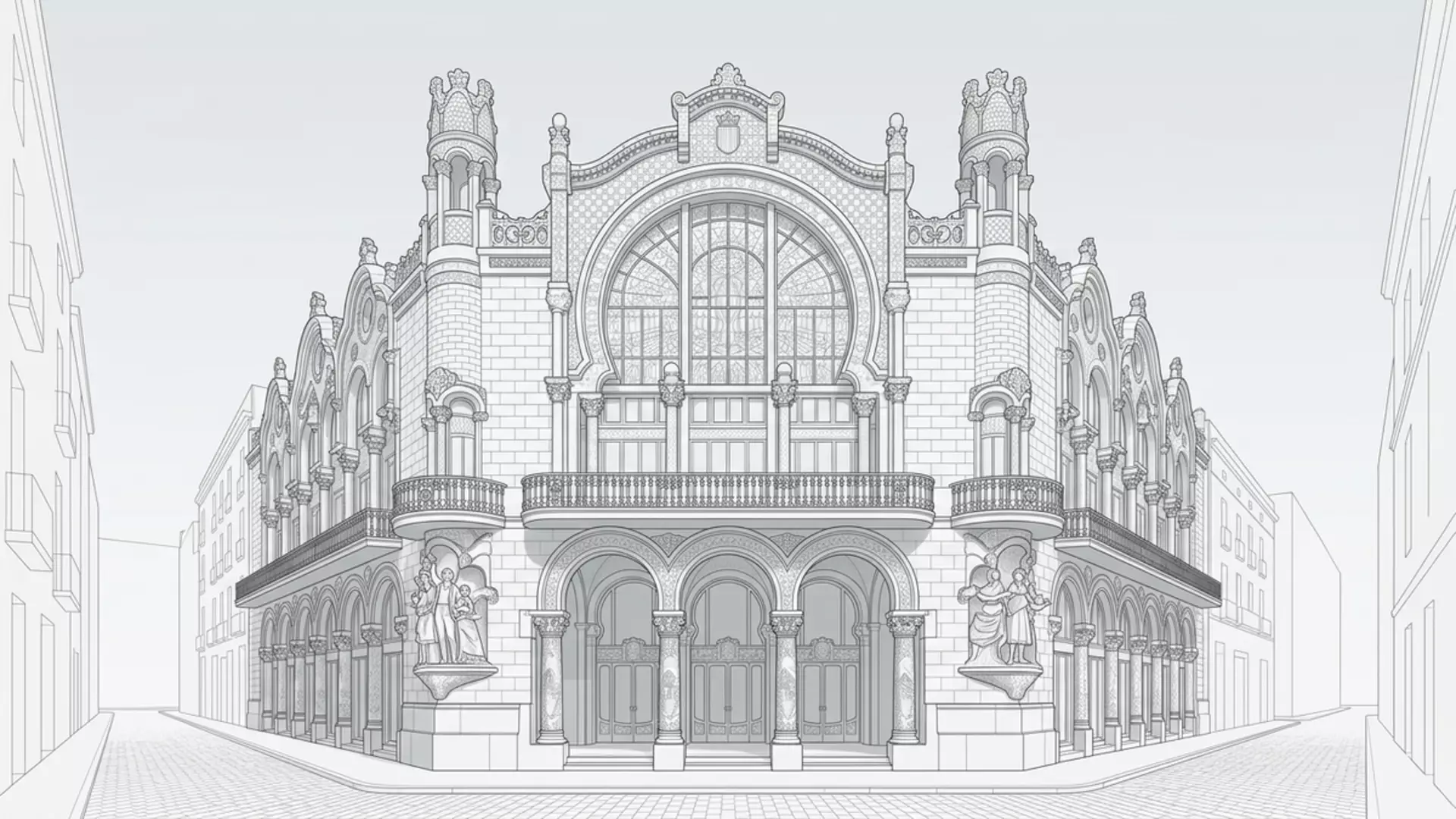
Palau de la Musica Catalana in Barcelona is a concert hall where architecture, sculpture, stained glass and mosaic are woven into a single theatrical setting for music. Designed by Lluís Domènech i Montaner in the Catalan modernisme style and completed between 1905 and 1908, it became the headquarters of the Orfeó Català choral society and later gained UNESCO World Heritage status in the late twentieth century. Inside, the light?filled auditorium makes the experience of a performance inseparable from the building that surrounds it.
A modernisme palace built for Orfeó Català
Palau de la Musica Catalana stands in the historic Sant Pere area of Barcelona, close to the medieval fabric of the old city. It was commissioned as a permanent home for Orfeó Català, a choral society founded in 1891 that played a central role in the cultural movement known as the Renaixença, or Catalan Rebirth. Lluís Domènech i Montaner, born in Barcelona in 1850, received the commission and created a work that became one of the key buildings of Catalan modernisme, the local branch of Art Nouveau.
Construction of the concert hall took place in the first decade of the twentieth century, with the main phase running from 1905 to 1908. The building brought together specialists in sculpture, glass, ceramics and ironwork, reflecting the modernisme enthusiasm for craftsmanship and applied arts. Its importance was later recognised at national level when it was declared a monument in the early 1970s, and internationally when UNESCO inscribed it on the World Heritage List in 1997 as a representative work of Catalan Art Nouveau.
Façades of brick, mosaic and sculpture
From the street, Palau de la Musica Catalana presents a vertical façade of brick punctuated by large openings and layered decoration. Columns clad in mosaic rise from the ground level, supporting overhanging elements and marking the entrance area. Sculptural groups project from the upper parts of the façade, including figures associated with music and Catalan culture, set against ceramic ornament and elaborate ironwork on balconies and railings.
The corner of the building is treated as a display piece, with brickwork, mosaics and statuary wrapped around it to emphasise the presence of the concert hall in the dense urban fabric. Above, the roofline carries further sculptural detail and decorative elements that continue the modernisme vocabulary seen elsewhere in Barcelona. While many works of the movement use stone or roughcast render, Palau de la Musica Catalana relies heavily on exposed brick combined with polychrome ceramic and glass, giving the exterior an intricate, almost textile quality.
A luminous concert hall under a glass canopy
Inside, the main auditorium is arranged as an elongated space with seating on the ground floor and galleries rising along the sides. The focal point is the stage at one end, backed by elaborate sculptural reliefs and framed by decorative columns and arches. Ornament runs across virtually every surface, from the balustrades of the galleries to the ceiling above, but the composition is carefully ordered around the central performance space.
High above the audience, a large stained glass feature in the ceiling acts as a source of daylight, bringing coloured light into the hall and emphasising the sense of a space open to the sky. Around it, further stained glass panels, ceramic decoration and painted surfaces contribute to a rich interior that is characteristic of modernisme, with floral and organic motifs used extensively. The concert organ is integrated into the stage architecture, and the auditorium’s form supports a clear relationship between performers and listeners without relying on a strict classical symmetry.
Visiting Palau de la Musica Catalana: what travellers from Western Europe should know
- Palau de la Musica Catalana stands in the Sant Pere area of central Barcelona, a short walk inland from Via Laietana and the edge of the Ribera district.
- The building rises within a compact urban block, with access from narrow streets and interior routes that include staircases leading to the auditorium level.
- Barcelona is served by an international airport and long?distance rail services; from the main railway stations the concert hall can be reached by city public transport or on foot.
- The official language is Catalan alongside Spanish, and the currency is the euro.
Searching for Palau de la Musica Catalana on social platforms
These links open searches for Palau de la Musica Catalana on each platform.
Frequently asked questions about Palau de la Musica Catalana
Where is Palau de la Musica Catalana located in Barcelona?
Palau de la Musica Catalana is situated in the Sant Pere area of central Barcelona, within the historic Ciutat Vella district near the Ribera neighbourhood.
What can visitors expect inside the building?
Visitors encounter a modernisme concert hall with a richly decorated interior, including stained glass in the ceiling, mosaic?clad columns, sculptural reliefs around the stage and tiered seating.
What makes Palau de la Musica Catalana distinctive among concert halls?
Its combination of Catalan modernisme architecture, integration of multiple decorative arts, early twentieth?century origins and recognition as a UNESCO World Heritage Site make it a distinctive venue for music.
Disclaimer…
