


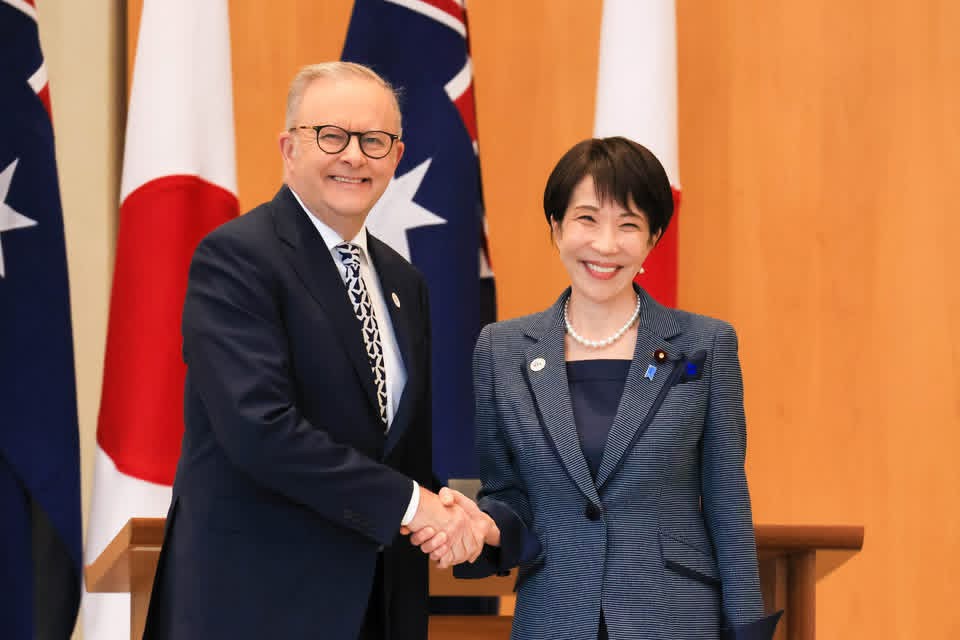
In their meeting on 4 May in Canberra, Australian Prime Minister Anthony Albanese and his Japanese counterpart, Prime Minister Sanae Takaichi, agreed to prioritise a range of issues including supply chains, energy, critical minerals, trade and security.
Under the framework of the Joint Declaration on Economic Security Cooperation, the leaders also pledged to support Pacific Island countries (PICs) to combat money laundering through capacity-building initiatives. This should be seen by PICs as a positive development, as the crime remains one of the key challenges in the region.
However, climate change, which is recognised by the Pacific’s small island states as their single largest security threat, was not on the agenda. The implicit identification of China as a threat to regional stability will displease some Pacific Island nations and perhaps encourage others. In all, however, strengthening Australia-Japan ties is overwhelmingly positive for a disparate region.
Multilateralism is central to the diplomatic and economic functioning of the island nations. In light of the US’s repudiation of international institutions and China’s increasingly aggressive acts, its decline is cause for alarm. North Korean missiles flying over Japan and Chinese aircraft buzzing foreign planes may feel far from, say, Port Moresby. But Pacific island governments notice, register and are planning for this more disputatious era.
Chinese influence in the Pacific Island countries is well documented; its economic and security cooperation initiatives in the region have surged in recent decades. Solomon Islands is closely aligned with China. Kiribati has welcomed Chinese funding for airstrip upgrades, seen by some analysts as evidence of grey-zone military tactics. Luganville Wharf on Vanuatu may soon serve a similar “dual-use” purpose — for Chinese commercial and military vessels alike.
The Australian government is well aware of these investments (or encroachments, depending on who you ask). For its part, Japan’s Takaichi government is pushing itself to step up across the islands, adding hard capabilities to its energetic diplomatic efforts.
In February this year, Defence Minister Shinjiro Koizumi welcomed 28 countries to Tokyo for the third Japan-Pacific Islands Defense Dialogue. Agreements were made with Papua New Guinea, Tonga and Fiji covering maritime security and disaster relief. Koizumi has been clear that the global and regional security environment is deteriorating and that Japan is sharpening its military capabilities and partnerships in response.
Under Koizumi, Japan’s defence budget will now exceed 9 trillion yen (around A$90 billion), closing in on the 2% of GDP target well ahead of schedule. Self-defence is the priority, but self-defence will come, in part, in the form of stronger alliances across the Indo-Pacific.
Koizumi’s call for the “autonomy” of the Pacific island countries aligns with this approach and serves as a clear rebuke to China. Japan’s alternative pitch is the preservation of national sovereignty with Tokyo serving as a long-term security partner. This is the Free and Open Indo-Pacific (FOIP) way, as it were. Now in its tenth year but updated for the current circumstances, Japan’s FOIP vision is based on freedom of navigation and trade, and the preservation of national sovereignty.
The Albanese government has faced diplomatic setbacks in the Pacific islands, not least the failure of a security and climate pact with Vanuatu in 2025. (A revised version of the Nakamal Agreement was approved by Vanuatu’s cabinet in May 2026, but only after explicit language limiting China’s security and investment role in the country was stripped out.) Australia is sometimes seen as “other” on the islands or too close a partner of the United States. Japan’s renewed focus on the islands, therefore, will be welcome.
As Japan-Australia collaboration on global challenges intensifies, this will have positive knock-on effects on Pacific security.
For example, on 18 April, Australia signed contracts for eleven of Japan’s Mogami-class frigates in a deal worth A$10 billion (US$7 billion). This acquisition will bolster the Royal Australian Navy. The frigates, to be built by Mitsubishi Heavy Industries, will have a range of up to 10,000 nautical miles — a gamechanger for Australia’s efforts to protect the Pacific islands’ maritime sovereignty.
The deal was followed by Prime Minister Takaichi’s overhauling of defence export regulations. Now, Japan’s firms will be able to sell lethal weaponry to countries with which it holds Defense Equipment and Technology Transfer Agreements, including Australia and New Zealand. Increased exports and improved interoperability with Japan’s Self-Defense Forces will be a plus for regional security and stability.
In tandem with defence export reform, Japan’s Official Security Assistance (OSA) budget for 2026 has been doubled to 18.1 billion yen (A$175 million). PNG and Tonga were named priority recipients for the 2025-2026 period. Dual-use assets for disaster response and maritime infrastructure building have already been provided to PNG.
Australian policy in the Pacific island countries has tended to focus on economic support. A record A$2.2 billion worth of Official Development Assistance (ODA) was committed to the Pacific in the 2026-2027 budget. Climate funding has been generous for some island nations. But tools to preserve national sovereignty have been constabulary and maritime policing-oriented. For example, Australia’s Pacific Maritime Security Program, under which 12 Pacific island countries plus Timor-Leste have been gifted Guardian-class patrol boats, is a notable success. In terms of hardware, Japan is now well placed to add lethal weapons to the foundations of regional security.
Pacific island countries are too small — economically, militarily and diplomatically, with very limited resources and capacity — to explicitly take sides in the superpower rivalry. They should be cautious about middle power alignment too. That said, external interests that act in good faith to preserve, not erode, national sovereignty should be welcomed. To that end, Australian economic aid and Japan’s more defence-edged approach are opportunities to be exploited.
The concept of rowing between the reefs — finding a path through choppy geopolitical waters without cleaving to one side of a conflict — has become somewhat of a cliché in international affairs. But it is surely the best way for Pacific island countries to preserve national sovereignty and secure prosperity in an era of escalating confrontation.
