

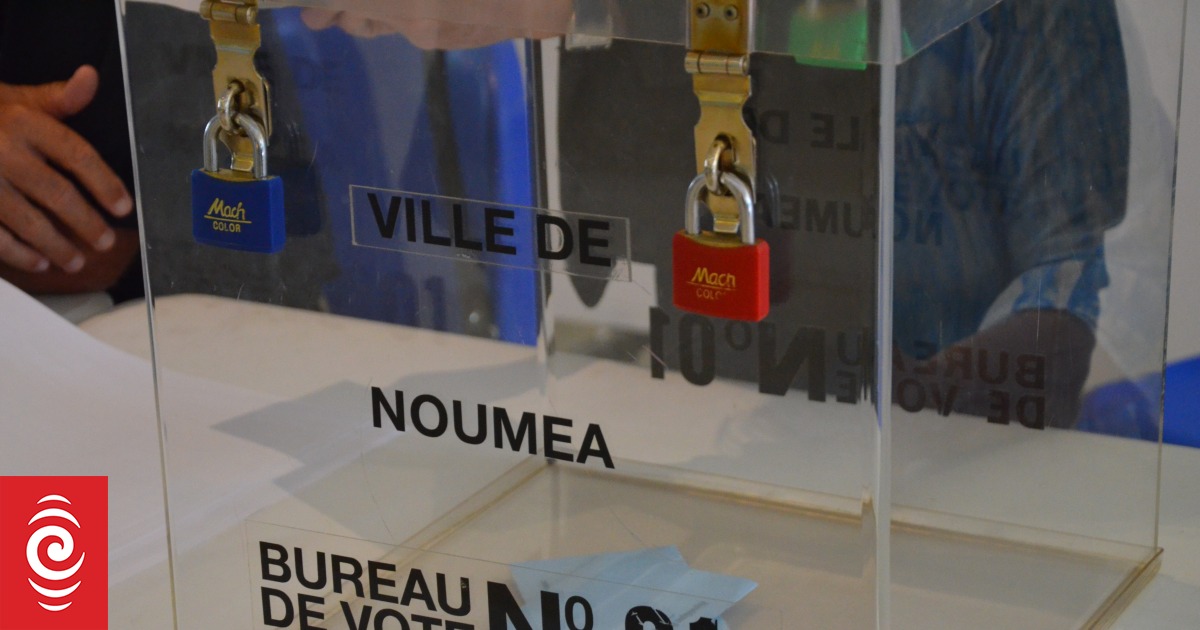
The last time provincial elections were held in New Caledonia was in 2019.
Photo: RNZ Walter Zweifel
New Caledonia’s political landscape is already changing in preparation for the French Pacific territory’s looming provincial elections, set to be held no later than 28 June.
The date seems to be the most likely choice for the crucial elections, which will determine not only the members of New Caledonia’s three provincial assemblies (North, South and the Loyalty Islands), but also, by way of trickle-down effect, the members of the Congress (New Caledonia’s Parliament), the members of its “collegial” government and its future president.
The last time provincial elections were held in New Caledonia was in 2019.
They were supposed to have been held in 2024.
Since then, the poll has been postponed three times.
The last time it was re-scheduled to be held no later than Sunday 28 June 2026, France’s Constitutional Council warned it would no longer tolerate more postponements.
The French government’s latest bid to have a constitutional amendment related to New Caledonia endorsed was flatly rejected on 2 April by the French Lower House, the National Assembly.
Following the rejection, the underlying documents described as the result of talks held in July 2025 and January 2026, which included a proposed new “Bougival-Elysée-Oudinot” pathway proposing the creation of a “State of New Caledonia” within the French realm and an associated New Caledonian “nationality”, also came to a standstill.
Since then, French Prime minister Sébastien Lecornu has launched a fresh series of talks with New Caledonia’s political stakeholders, during hours-long video sessions hosted in Nouméa at the French High Commission.
But so far, no tangible result has emerged.
The latest meeting took place on Tuesday between Lecornu in Paris and New Caledonia’s representatives from Nouméa via video conference.
This was the first time that all political stakeholders (including those for New Caledonia’s independence and those who want the French Pacific territory to remain part of France) sat at the same table since the so-called “Bougival” talks in the outskirts of Paris in July 2025.
But it emerged, even though participants were asked not to communicate, that the two most sensitive items on the agenda remained unanswered.
These were the exact date of the elections and whether there was an agreement on how restrictions would be modified and possibly eased regarding voters eligibility.
As part of the implementation of the Nouméa Accord (1998), and as a temporary measure, it was decided that only voters born in New Caledonia and those residing before 1998 would be allowed to cast their vote for these local elections.
This was originally designed to avert any risk of a possible “dilution” of the indigenous Kanak votes.
During the latest talks, the difficult question of the “frozen” electoral roll and a possible easing of conditions to open the vote to people born or residing at least for the past fifteen years was once again brought up.
The “native” category concerned over 10,000 people (out of a total of about 37,000 people who do not qualify to vote on the provincial elections “special list”).
This represents about 17 percent of the “general” list of 218,000 registered voters in New Caledonia.
If no agreement was found before the elections, then they would be held under the current configuration, that is with a still restricted (“frozen”) electoral roll.
Lecornu said the talks were intended to continue, either in plenary (all parties at the same time) or in “bilateral” (party-to-government) mode.

New Caledonia’s Congress latest modification as at 28 April 2026.
Photo: Congrès de la Nouvelle-Calédonie
Information and awareness already ongoing
As the long-awaited provincial elections are getting closer and more real, authorities are not waiting for the official announcements: they have already launched a proactive information campaign to ensure voters are up to date in their respective documentations.
This can concern the establishment of proxies, for those who already anticipate they will not be able to cast their vote in person.
“You have to registered under the proper ‘provincial (polls) special list’, but you also have to ensure that the person you are giving your proxy to is also registered on this special list”, Nouméa city Citizenship Life department head Mathieu Galléa told Nouvelle-Calédonie la Première on Wednesday.
A bus called “proxibus” – a reference to “proximity” – is also travelling the capital with its agents tasked to provide advice to voters.
Others just turn up at the Nouméa City Hall to check what their eligibility status is.
“Not everyone is familiar with this procedure, so they just turn up and enquire”, Nouméa deputy mayor in charge of elections Raphaël Romano said.
The exact date of the poll
Regarding the exact date of the poll, which has not been made official yet, there seems to be a growing consensus for Sunday 28 June.
According to the most realistic projections, the official announcement and call for writs is expected to come from the French cabinet sometime by the end of May 2026.
The deadline to submit lists of candidates from political parties would be 9 June and the official campaign is expected to start on 15 June.
The provincial elections would then be followed by the election of each of the provincial assembly’s president (speaker).
In July, it would be the turn of the territory’s Congress to elect among its members (representing each province proportionally) its bureau and the members of what will be New Caledonia’s 19th government.
Then the president of the government would be elected.
Another date option was recently mulled by Lecornu: on Sunday 31 May. This was because Paris wanted to have more security forces at hand and available during the scheduled G7 Heads of States summit to be held in Evian from 15 to 17 June.
Serious re-shaping of the political chessboard
Well ahead of the provincial elections, recent political developments in New Caledonia have already started to re-shape the French territory’s landscape.
Last week, Philippe Dunoyer (moderate pro-France) triggered a first shockwave, announcing that he resigned from the Calédonie Ensemble party and that he now intended to set up his own movement in the coming days.
As Avenir Ensemble was part of a Congress caucus with Eveil Océanien party (EO), its three representatives, including Congress Speaker Veylma Falaeo, announced they were now leaving the group and were now sitting as independent.
The caucus, formed in December 2025 (following the conviction of Calédonie Ensemble founder Philippe Gomès), has therefore been dissolved.
The four remaining caucuses in New Caledonia’s Congress are Les Loyalistes (13 seats, pro-France), UC-FLNKS and Nationalists (13 pro-independence), Union nationale pour l’indépendance -UNI- (12 pro-independence) and le Rassemblement (6 pro-France).
The remaining 10 (including former Eveil Océanien and Calédonie Ensemble members) are now classified as independents.
With the pro-France camp, the President of the Rassemblement party, Alcide Ponga, who is also New Caledonia’s government President, also created ructions last week when he pleaded for all pro-France parties to rally behind candidates from Génération NC, the local party headed by New Caledonia’s MP at the French National Assembly, Nicolas Metzdorf.
“Our movement wishes that a unified dynamic in the Southern Province should be carried by a personality capable to assemble”, Ponga wrote.
More divided than ever
In reaction to the suggested rapprochement, based on “lesson learnt” from the recent municipal elections, two major figures of Rassemblement have already resigned while reaffirming their support for Les Loyalistes leader, outspoken Southern Province president Sonia Backès.
Ponga nuanced later, saying “there are those who favour unity and those who want a go-it-alone approach. It all has to settle down”, Ponga said, announcing more debate on the issue within the party.
On the pro-independence side, two former pillars of the FLNKS, PALIKA (Kanak Liberation Party) and UPM (Union Progressiste en Mélanésie) have since 2024 split and set up their own distinct alliance called “UNI” (Union Nationale pour l’Indépendance) which now forms a distinct group at New Caledonia’s Congress.
