


Koror, Palau
A neon-pink blob appears in my line of vision.
Even though I’m wearing a snorkel mask, I’m holding my breath. Slowly, the blob floats closer and closer before suddenly puffing up like a balloon. The water is swirling in its tiny wake and the sun glowing above us.
It is the most relaxed I have ever felt in my adult life, and I only had to travel halfway across the world to make it happen.
The blob, despite looking pink to my underwater eyes, is a golden jellyfish. If this were another snorkeling trip in another part of the world, the sight of a jellyfish would be a warning, with a guide steering us away to prevent anybody from getting stung. But this little guy is special. Not only does it not sting, it’s a member of a rare and beautiful species that only exists here, in this one place, a lake in the remote Micronesian island nation of Palau.
Before I knew that Palau existed or that I wanted to go there, my journey began with a photograph.
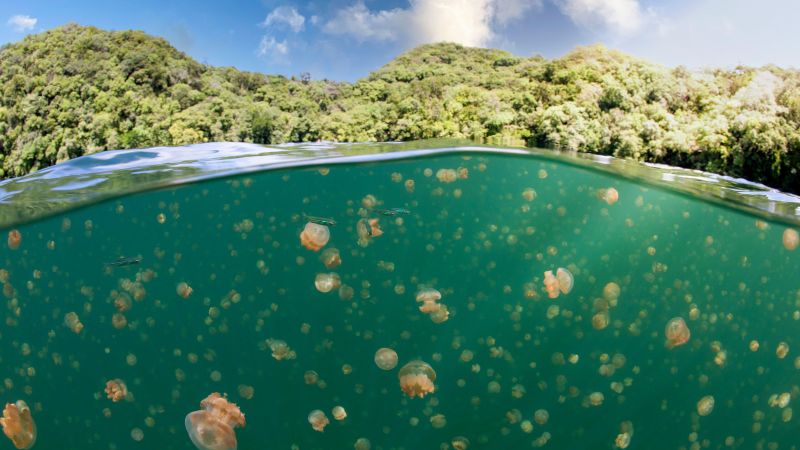
A photo of a lake full of tiny golden organisms peacefully bobbing along en masse has long been used as one of the standard background images for Apple computers and iPhones.
Although I had no context for where the photo was taken or what it depicted, it felt mesmerizing. It was my first screensaver on my first laptop.
In a time where almost anyone in the world can order the same dresser from Ikea and the same coffee from Starbucks, it feels miraculous that there are still living creatures who can only be found in one very small, specific point on Earth.
Officially, it’s named Ongeim’l Tketau, but everybody just calls it Jellyfish Lake. While there are many species of jellyfish all over the world, the unique conditions here have enabled golden jellies to thrive.
Measuring at 400 meters long and 30 meters deep, the lake is “completely stratified,” explains marine biologist Elspeth Strike. That means it has three distinct, separate layers of water, each with very different conditions. Only the top level has oxygen and thus can support life.
“In the world, there’s only 11 marine lakes that are stratified in this way, so it’s pretty special,” says Strike.
It’s not just the water conditions that make such a favorable environment for these organisms. The lake is in the middle of a limestone rock island, which created a sort of sinkhole shape. Over thousands of years, acidic rainfall filled up the sinkhole and made a lake. Tiny fissures in the limestone allow some ocean water to mix with the lake water, creating the only-in-this-spot conditions.
And while the golden jellies are the star attraction here, another species also calls this lake home: moon jellyfish, which are an opaque white hue. Some people refer to the two species as moon jellies and sun jellies.
Moon jellyfish are flatter, shaped like saucers with a flower or star-shaped center. I saw one or two moon jellyfish for every 10 golden ones, but it’s also possible they were more difficult to notice.
Getting to Jellyfish Lake is no simple weekend trip.
Palau’s tiny airport only accommodates a few flights a day. The easiest and most affordable option for me was via Taipei. Palau is one of a handful of countries with formal diplomatic relations with Taiwan so the two have established strong air connectivity and even set up a travel bubble during the pandemic.
After landing in Koror and signing the island’s “Palau Pledge” to behave in an ecologically and culturally sensitive way, it’s an hour boat ride out to Eil Malk Island, then another 10 or 15 minutes’ steep hike to reach the lake.
Upon arriving, guests are asked to remove clothes and shoes, shake out their pockets, and leave behind anything that might interfere with the water — even if it’s just a bit of dust.
Eil Malk is one of Palau’s UNESCO-listed Rock Islands, which are also home to the world’s first-ever shark sanctuary. Palau takes conservation so seriously that travelers must follow strict rules, including only using approved reef-safe sunscreen, and single-use plastics are banned across the whole country. Lake visiting permits are required and cost up to $100 per person, which is often included in the fee for hiring a boat for the day.
But the trek to get there is part of what makes Jellyfish Lake feel so utterly otherworldly. My group of eight snorkelers and two guides were the only humans at the lake on a breezy afternoon in January. It felt like we were the last people left on Earth.
Though Palau is one of the world’s greatest destinations for scuba diving, the activity is banned at Jellyfish Lake.
This delicate ecosystem requires special care. Snorkeling is fine, as it keeps people safely in the top layer. Below that is a middle layer of purple bacteria, and below that a “dead zone” where absolutely nothing can survive due to high levels of hydrogen sulfide.
The good news is that these little golden creatures are just inches below the water’s surface. The trick to finding them is to stay close to the light – the jellyfish migrate through the day, following the sun that they need to sustain them, so simply head to the brightest sections of the lake.

Strike, the marine biologist, works with the Four Seasons Explorer Palau, a liveaboard resort, and guides many of its guests to Jellyfish Lake.
Unsurprisingly, many travelers want to get their own version of the famous jellyfish lake picture. The picture was taken when the jellyfish population was much higher than it is now, so it’s unlikely that any erstwhile photographer can capture so many in a single shot.
On average, the jellyfish measure about five inches across. But when they “inflate,” they can stretch to the size of a person’s face, like a golden elastic underwater balloon. Some people will try to “ruffle” or blow on the jellies to make them expand, which Strike cautions against due to the potential harm they could cause the delicate, 95%-water organisms.
Although I had brought an underwater camera with me, photography became the last thing on my mind. Simply floating along, at one with the water and with these special creatures who seem to glide along to unheard music, is an experience of true Zen. They glowed against the cloudy, greenish-blue water.

Palau’s jellyfish are even more revered now, as there was a period when it seemed like they might disappear entirely. The El Niño weather phenomenon, which affects wind directions and water temperatures in the Pacific, hit Palau hard in 2006.
Rainfall decreased, upping the lake’s salinity and throwing off the delicate ecosystem the organisms need to survive. For several years, the golden jellyfish population declined so significantly that some experts worried the species would be gone forever.
Thanks to careful work from scientists and Palauan locals, that didn’t happen.
The lake reopened to tourists in 2019. These days, the golden jellyfish are as much a symbol of national pride in Palau as the flag.
In fact, the creatures’ scientific name is mastigias papua etpisoni in honor of Ngiratkel Etpison, who was Palau’s president from 1989 to 1993.
