

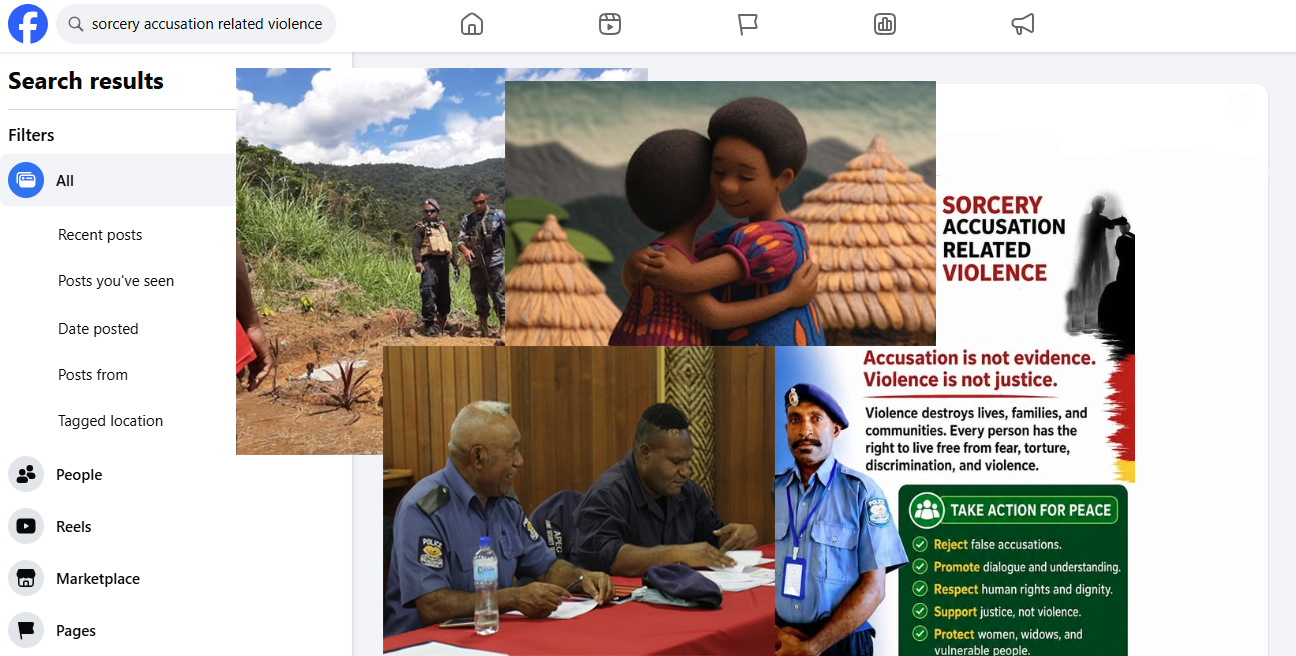
A video appears on Facebook showing a person accused of sorcery being tortured. Sharing it may alert police and help secure the person’s rescue, as well as raising awareness about this terrible form of human rights abuse. But sharing can also circulate the victim’s face and location to new audiences, potentially exposing them to further harm and turning their suffering into a public spectacle.
What should someone who sees such a post do?
This dilemma captures the central finding of our new Development Policy Centre discussion paper. Facebook overwhelmingly dominates the digital landscape in PNG today, acting as a critical medium for the spread of local and national news. It therefore has the potential to both facilitate and prevent sorcery accusation-related violence (SARV) — and indeed we found it plays a very multi-faceted role. Facebook is a place where SARV is witnessed and condemned, but also debated, normalised and sometimes encouraged.
We analysed 507 posts addressing SARV from 24 public Facebook pages and groups between 2013 and 2024. We combined statistical and topic analysis with a close reading of selected comment threads and interviews with people working against SARV.
At first glance, the findings appear encouraging. More than 83% of posts opposed SARV, while only 2% supported it. Yet this does not mean that 83% of Papua New Guinean Facebook users oppose SARV. It tells us, above all, who is producing the visible public discourse. Government, NGO and advocacy pages generated 83% of all posts in our dataset and 87% of the oppositional posts. A relatively small group of committed institutional actors has succeeded in establishing a strong public narrative condemning SARV.
This is a significant achievement. Over the decade covered by our data, Facebook evolved from a space used mainly to report incidents and debate religious dimensions of sorcery accusations into a more developed advocacy infrastructure. More recent posts promote legal reform, promote support for survivors, document parliamentary action, build coalitions and seek to hold political leaders to account. In a context where formal reporting channels are often inaccessible, slow or distrusted, Facebook also allows witnesses and victims to make cases public and difficult to ignore.
But the apparent consensus against SARV weakens when we move from examining institutional posts to individual comments. Here we found a much more varied range of perspectives expressed, including incitements to violence against those accused. We suspect that much more such content circulates in private pages to which we did not have access owing to ethics limitations. This is an area ripe for further investigation.
One real point of contestation in the comments was whether SARV is constitutive of PNG or Melanesian cultural identity. On the one hand, many rejected SARV as an element of cultural identity, labelling it a “primitive” or “stone age” mentality incompatible with modern PNG citizenship. On the other hand, many argued that sorcery belief is intrinsic to Melanesian lifeworlds, contesting the idea that it could be regulated by law or external human rights advocacy.
A common position we found in the comments was “sorcery is real, but violence is wrong”. This is consistent with recent national survey data from the Melanesian Institute showing that many Papua New Guineans simultaneously believe in sorcery and reject violence against those accused. It also reflects the worldview pluralism we have written about previously: biomedical, Christian and magical belief systems can be held at the same time. People may believe that sorcery causes harm while also insisting that torture and killing are morally unacceptable.
This matters for advocacy. Campaigns built only around secular human rights language, criminal penalties or the assertion that sorcery does not exist may fail to engage a substantial part of their intended audience. Effective messages need to meet people within the moral and spiritual worlds they inhabit, while remaining unequivocal that accusation never justifies violence. This could mean emphasising that violence does not resolve misfortune or make communities safer, drawing on Christian as well as legal frameworks and using trusted local voices to frame non-violence as a responsibility to the whole community.
Here the relative digital absence of churches is striking. The church pages in our dataset were among the least likely to post explicit opposition to SARV, despite the strong anti-SARV work of many church leaders offline. We found no Pentecostal or Evangelical institutional pages posting on the issue. Churches are among PNG’s most trusted and far-reaching institutions, and many church leaders already speak in a register that acknowledges spiritual concerns while rejecting violence. Supporting them to translate this work into accessible digital content could extend anti-SARV messaging into communities that secular advocacy struggles to reach.
Our findings point to several practical steps. Governments and donors should treat digital communication as part of core anti-SARV work, not as an optional addition to “real” offline programs. Advocacy organisations need funding for content production, moderation and strategy. Survivors and survivor organisations should help develop shared protocols for reporting incidents without revealing identities, locations or images that create new risks. Churches and other trusted community leaders should be supported to produce locally grounded messages. Online campaigns should also connect to offline dialogue, where fears, grievances and competing explanations can be talked through rather than merely contradicted.
In addition, while 2022’s glasman legislation significantly strengthened criminal penalties for making accusations of sorcery, it does not contain provisions addressing the use of technology or social media to incite violence or distribute SARV-related content. This should be a priority for law reform.
Facebook’s most valuable role may be its capacity to make SARV visible and create pressure to act. However, the danger is that the same visibility can magnify accusations, intensify humiliation and cause harm, as well as acting as a contagion mechanism by spreading and normalising the violence. The challenge is to build a safer and more effective anti-SARV digital ecosystem that capitalises on the reach of Facebook to spread effective messages and support coalitions of support for survivors.
Read the discussion paper.
