


Ana Ma’ileli Savio believes kai is about more than just feeding people – and her growing business is now showing the way for other Pasifika interested in the catering industry.
Her Tāmaki Makaurau-based business, Gia’s Grab and Go, serves allergy-friendly kai with Pacific flavours.
The business began in her mum’s kitchen in 2019, inspired by her daughter Gia, who has severe food allergies.
And while Savio has been driven by a desire to support and foster kai-inclusion for Gia, she soon realised the issue extended beyond her own whānau.
While serving on the Allergy New Zealand board, she learned that Māori and Pasifika have some of the highest rates of food allergies.
Now, her food is not only helping people with allergies but it can also be held up as an example for other Pasifika businesses to follow.
“It’s natural to want to be included as a minority, and in a lot of underrepresented spaces,” Savio said.
Amotai founders, Tania Pouwhare and Anna-Jane Edwards.
Amotai
Savio credits Auckland Council’s supplier diversity network, Amotai, as a key factor in their growing success. Gia’s Grab and Go is one of thousands of Māori and Pasifika-owned businesses connected to this network, which matches businesses with organisations looking to purchase goods and services.
The Māori economy was valued at $32 billion in 2023, almost double its value in 2018, while Tāmaki Makaurau is home to around half of the country’s Pasifika-owned businesses.
Despite this, Auckland Council sources roughly five percent of its suppliers from Māori and Pasifika businesses, with a target of reaching 10 percent by 2034.
Amotai was established through Auckland Council in 2018 to help bridge that gap, and this week, ran their first Suplier Diversity Week.
Council’s economic development general manager, Pam Ford, said supplier diversity is an investment in the region’s long-term prosperity.
“Supplier diversity is about recognising the capability and contribution Māori and Pasifika businesses already bring to Auckland’s economy and ensuring they have fair access to opportunities,” she said.
It now works nationally with thousands of Māori and Pasifika businesses and more than 170 buyer organisations.
And in 2025, more than $400 million worth of contracts were awarded to Māori and Pasifika businesses through the network.
One of its founders, Anna-Jane Edwards, who is Māori and Cook Islands descent, said the kaupapa grew from her public health work and a desire to improve the health and wellbeing of Māori and Pacific communities.
Edwards said one way of doing that was by growing businesses, creating jobs and getting more money flowing into Māori and Pacific households.
“What is the biggest lever that we can pull that will enable our people at scale to live healthy and well lives, and how do we accelerate the growth of money into our homes?”
She added that there is no shortage of capable businesses, but many had struggled to access the organisations awarding those major contracts.
“The demand side door, the one that the procurers, the buyers use, that door has been shut for a really long time,” Edwards said.
But Edwards said Amotai’s role was to open that door, rather than guarantee businesses work – it’s all merit-based, she said, and as a result plenty of the involved businesses thrive.
“The fact of the matter is that they win contracts off their own bat. They’re good, good quality businesses that can do the work.”
Savio added that being given the opportunity to get through that door is also about greater representation for Māori and Pasifika businesses, in a space where they have traditionally been under-represented.
“We never had these platforms, and I feel for the generation before us. There was nothing like that.”
She said greater visibility allowed Pacific business owners to bring their culture and perspectives into spaces where they had historically been underrepresented.
“Be proud of what you’re bringing as a Pasifika,” Savio said.
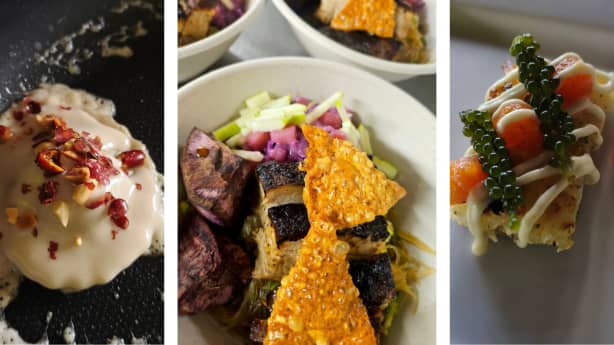
‘Ana Ma’ilei Savio creates meals and catering that are grounded in culture and wellbeing.
With the additional awareness Amotai brings, Savio has been able to connect with various Pasifika communities who have felt their needs were seen from a Pacific perspective.
“I collaborate with a lot of other Pasifika, Māori chefs, and we make sure that the six courses are allergy friendly and and are Pasifika,” she said.
“It’s very unique thing to be doing in space, and and that just gives people confidence, you know, in our communities to be aware, to be able to to feel our culture.”
Pacific businesses could also create more opportunities for rangatahi, and help make the path easier for the generation coming behind them, Savio said.
“It’s our opportunity now to give that to our generation, and our future generations, so that they’re able to not work as hard… and not go through what we had to go through.”
