


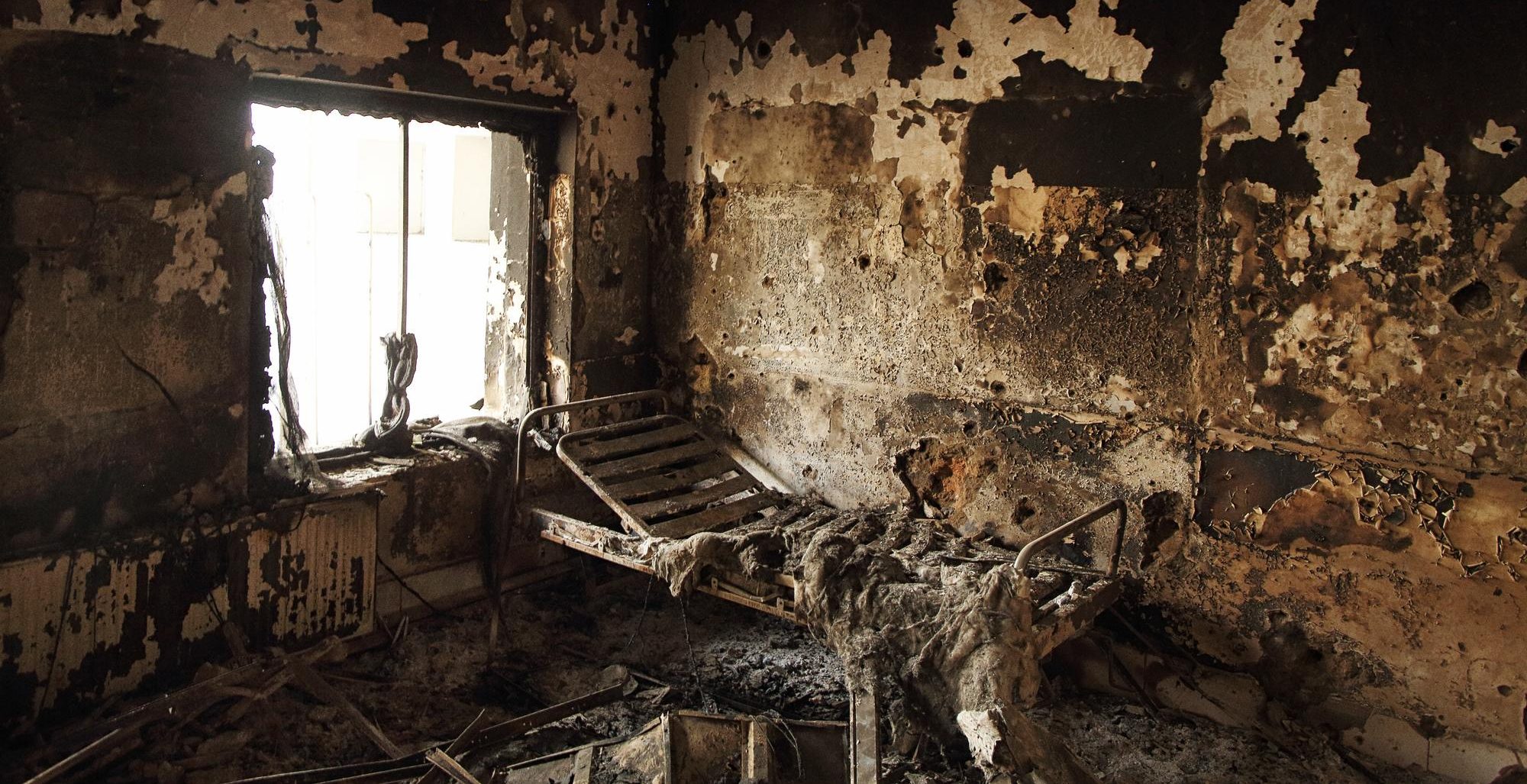
On 3 October 2015, a US gunship repeatedly fired upon the Médecins Sans Frontières / Doctors Without Borders (MSF) trauma centre in Kunduz, Afghanistan. The attack — which occurred during a Taliban attack on other parts of the city — killed 42 people, including patients, medical staff and caretakers, and destroyed the only major trauma hospital serving northeastern Afghanistan.
This infamous attack demonstrated a dangerous erosion of respect for the protected status of hospitals under international humanitarian law (IHL) and, together with widespread attacks on health facilities in Syria and Yemen, it became a major catalyst for United Nations Security Council action. The Security Council unanimously adopted Resolution 2286 on 3 May 2016 — a strong political reaffirmation that medical care must be protected in war.
A decade after this resolution was adopted, attacks on healthcare have not decreased. Instead, every year there have been thousands of attacks on hospitals, clinics, ambulances, patients and health workers. Thousands of healthcare workers have been killed, injured, detained or abducted during this ten-year period. Violence reached record levels in 2023 with 2,562 documented incidents across 30 conflict-affected countries and territories. More humanitarian workers were killed in 2024 than in any previous year, with 383 killed in total.
During conflicts, attacks on healthcare are no longer exceptional events. Hospitals are bombed, ambulances are purposefully delayed or attacked, health workers are treated with suspicion, and patients are denied the care they need. The issue is that the immediate horror of each attack is further compounded by the long-term collapse of access to lifesaving care.
MSF has seen this pattern in many places where we work, including Gaza, Sudan, South Sudan, Ukraine, Myanmar and Lebanon. In the last decade, 21 MSF staff have been killed while carrying out their duties, 15 of which occurred during the current genocide in Gaza, serving as a reminder of the specific targeting of aid workers during crimes against humanity. In 2025 alone, the World Health Organization (WHO) recorded 1,348 attacks on healthcare, resulting in 1,981 deaths of healthcare workers and patients.
This is not a failure of awareness. Governments and modern militaries know the rules. They know the protections that international humanitarian law affords to medical personnel, patients, facilities, transport and equipment. They know this is a war crime.
The evidence suggests that parties to conflict are increasingly brazen in their attacks on healthcare facilities and personnel for two reasons. First, as a military strategy, to forcibly displace populations to punish, demoralise and subjugate, as an end in itself. Second, the absence of independent investigations and meaningful accountability mechanisms means that parties to a conflict can attack healthcare facilities and personnel with relative impunity. It is no coincidence that attacks against journalists follow a starkly similar pattern to attacks against healthcare workers.
The same erosion in respect for IHL is visible in the way humanitarian assistance itself is being treated in war zones by warring parties. It is contempt for IHL and a rejection of humanitarian principles. It is the increasingly common restrictions on access for UN agencies and international non-governmental organisations (INGOs) like MSF. It is a rejection of the role these organisations play in witnessing and speaking out on violations of IHL.
The most visible example of this erosion was in Gaza and the West Bank, where Israel’s ongoing threat to withhold registration from 37 INGOs, including MSF, was presented as an administrative measure. However, its practical impact would be to strip people of healthcare in one of the most medically devastated places on earth. In 2025, MSF teams in Gaza provided hundreds of thousands of consultations, treated mass trauma injuries, supported hospitals and delivered water at scale. While our work and independent witnessing continues through the dedication of our locally hired Palestinian staff, we are working in an increasingly constrained environment. This is a prime example of how the support international aid organisations bring can be dismantled through politically motivated barriers to registration, unnecessary bureaucracy, exclusion and the quiet removal of those still able to treat and testify.
So, in the decade ahead, how do we stop the trend and make real progress on preventing attacks on healthcare? And what role can an influential “middle power” country like Australia play?
First, Australia has consistently presented itself as a supporter of international law and the protection of civilians. That position carries responsibilities. It is not enough to express concern after each attack on a hospital, aid convoy or distribution point. Australia should be more willing to use its diplomatic relationships, public voice and policy tools to defend the rules it says matter.
Australia can ensure that its engagement with parties to conflict explicitly opposes restrictions on medical and humanitarian organisations and seeks concrete guarantees for the movement and safety of ambulances, patients, health workers and humanitarian staff.
Australia can support independent investigations and accountability for attacks on healthcare and for aid models that have caused foreseeable civilian harm.
Australia can use its diplomatic voice to defend the independence of humanitarian assistance and reject militarised distribution systems that expose civilians to harm.
Second, Australia is committed to the global Declaration for the Protection of Humanitarian Personnel. While that initiative is welcome, we must ensure it does not become another statement of principle without consequence like UNSC Resolution 2286. The test is whether it leads to practical protection, timely accountability and political pressure when humanitarian workers, health workers and civilians are attacked.
Australia’s welcomed leadership on the Declaration must include practical follow-through: clearer reporting, stronger diplomatic consequences and specific attention to local staff, who carry the greatest share of risk.
Third, Australia is a humanitarian donor. Donor governments have a direct interest in ensuring that their humanitarian assistance can be delivered safely, independently and according to need. If aid is blocked, manipulated or militarised, donor policy is not simply being undermined, civilian lives are being placed at further risk.
Finally, Australia must be a convenor for other like-minded middle power countries to act, in our region and globally.
The defence of international humanitarian law cannot be left only to legal statements after the fact. It needs coordinated political action while violations are happening.
When hospitals are attacked, when ambulances cannot move, when patients are denied care, and when people are shot at while trying to access food or healthcare, the issue is not only a failure of assistance. It is a failure of law, policy and political will.
Medical staff, patients and humanitarian aid workers deserve more than words. Denying or restricting humanitarian assistance must not be turned into another weapon of war. Australia should help ensure that the commitments made ten years ago are finally treated as obligations, not aspirations.
This is ultimately a test of whether Australia is willing to resist the normalisation of brutality and treat the protection of medical care as an obligation rather than an aspiration.
