


A little over a decade ago, the UK was regarded as both a financial and intellectual powerhouse in global aid and development. That status is set to be fully relinquished if cuts announced by the former Keir Starmer government last week go ahead. The decline in the UK’s leadership on development began with the self-inflicted political and economic trauma that followed the Brexit referendum in 2016, the abolition of the Department for International Development in 2020 and the budget chaos and spending cuts wrought by successive Conservative governments. In 2026, what has since become a bipartisan project would appear to be complete with the publication of detailed plans for slashing Official Development Assistance (ODA) delivered through the Foreign, Commonwealth and Development Office (FCDO).
The cuts envisage a reduction in FCDO’s real (inflation-adjusted) ODA spending by one third over the next three years (Figure 1). They come on top of a 7% real cut in FCDO aid spending in 2025 and against the backdrop of now former Prime Minister Keir Starmer’s announcement early last year that the UK will reduce total ODA spending as a share of Gross National Income (GNI) from 0.5% to 0.3% by 2027 in order to fund additional defence spending.
Detail on the cuts — framed in distinctly Orwellian terms as “modernising our development assistance” — is set out in the FCDO’s 2025-26 Annual Report and Accounts. In one of the last official acts of the Starmer government, the document was tabled in the House of Commons on the final day before the chamber rose for its summer recess. As noted in the document, while FCDO constitutes the largest share of the UK’s aid spend, the figures do not cover spending and projections for aid delivered through other government agencies. For example, they exclude ongoing ODA-eligible spending by the Home Office to accommodate refugees during their first year of stay in the UK, spending which totalled some £2.3 billion in 2024-25.
In terms of bilateral and regional spending, UK aid to sub-Saharan Africa will see the biggest cut, falling by over £800 million by 2028-29 (-56%). This is despite this region containing the world’s highest concentrations of extreme poverty and bearing the brunt of massive US cuts in areas such as health and humanitarian assistance over the last year (Figure 2). Several countries (Kenya, Malawi, Mozambique and Tanzania) will have their bilateral aid cut by over 90%.
Aid to the Middle East and North Africa is spared somewhat by Labour’s commitment to continue to support the Occupied Palestinian Territories and conflict-affected and fragile countries, although the latter commitment has not averted large cuts in bilateral aid to Yemen, Syria and Lebanon. Aid to Ukraine (which accounts for virtually all the Eastern Europe and Central Asia allocation) will be maintained in nominal terms at just under a quarter of a billion pounds a year, maintaining the country’s position as the UK’s largest bilateral ODA recipient.
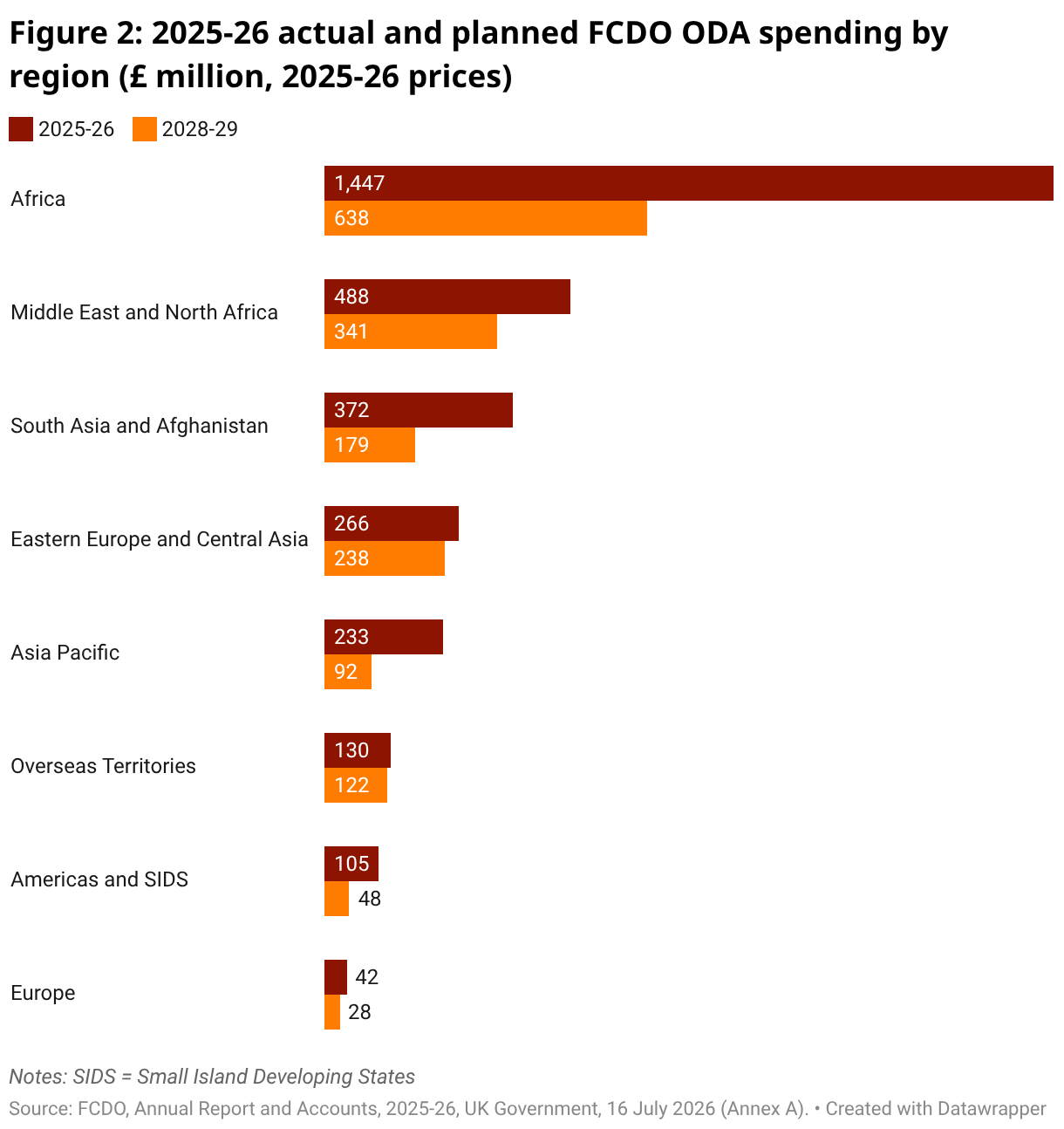
In the “Indo-Pacific” (South Asia plus East Asia and the Pacific), annual UK aid will fall by some £333 million by 2028-29, representing a combined 55% cut. Excluding additional humanitarian assistance provided by the UK in 2025-26 for earthquake recovery, this includes a 21% reduction in aid to war-torn Myanmar. Bilateral aid to Indonesia (which totalled £24 million in 2025-26) has no allocation for 2028-29, while aid provided through ASEAN and to other Southeast Asian countries will drop slightly in real terms. Allocations for Pacific Island countries have yet to be published. In South Asia, there will be very large cuts to bilateral programs in Bangladesh (-59%), Nepal (-92%), Pakistan (-53%) and Afghanistan (-37%). These are all countries where UK aid has traditionally played a prominent role and where the ongoing shocks emanating from the Iran war are exerting mounting pressure on economies, budgets and food security.
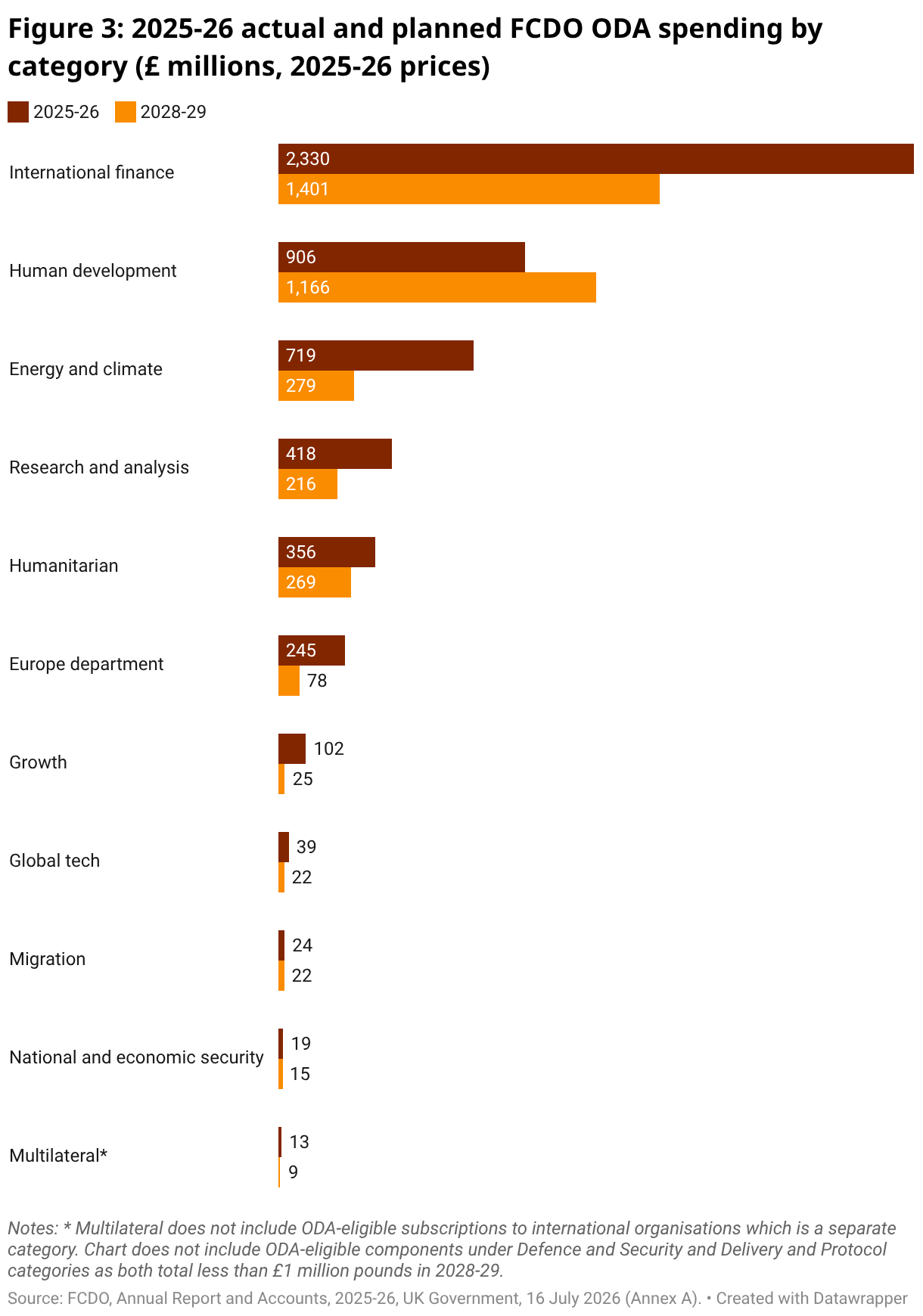
In terms of thematic cuts, growth-related programs (-75%), energy and climate (-61%) and FCDO’s Europe Department (-68%) suffer the biggest proportional hits, while international finance programs face the largest cut in volume terms (-£929 million; Figure 3). The latter suggests significant reductions in the UK’s future contributions to the multilateral development banks. What remains of the UK’s position as a global development “thought leader” will be further diminished by an almost halving of spending on the ODA-eligible components of FCDO research programs. Human development (governance, education, health, gender) is the only thematic category where spending is not being cut.
Aid advocates have been scathing in their criticisms of the cuts. The UK’s NGO peak body has accused the Labour government of “abandoning communities on the frontlines of conflict and the climate crisis and risks plunging these countries’ populations into poverty and instability”. Labour’s own chair of the Commons International Development Committee, Sarah Champion, has described the cuts as “brutal” and “deeply concerning”.
There are hopes that incoming Prime Minister Andy Burnham, dubbed by his supporters as the “King in the North” due to his success as a former mayor of Manchester, might reverse course. In particular, Burnham’s selection of Ed Miliband, widely viewed as a strong supporter of a larger UK role on global development and climate change, as the new Foreign Secretary has led to reports that the cuts will be at least partially walked back and a plan for restoring UK aid developed. Predictably, Reform leader Nigel Farage has been quick to launch a pre-emptive political attack on such a move. Miliband and other pro-aid members of Labour’s caucus may be encouraged, however, by new polling published by the British Foreign Policy Group which suggests that public hostility to aid spending in the UK isn’t particularly high (30%) and that a slim majority of younger voters (53%) believe that the UK should spend more than 0.3% of GNI on ODA. Some have already fleshed out what an international version of Burnham’s governing philosophy of “Manchesterism” might look like.
Whichever way they go, these latest ructions in UK aid will likely be met with little more than a shrug in Australia, where both Labor and the Coalition are much more preoccupied with the travails of the AUKUS arrangement.
