


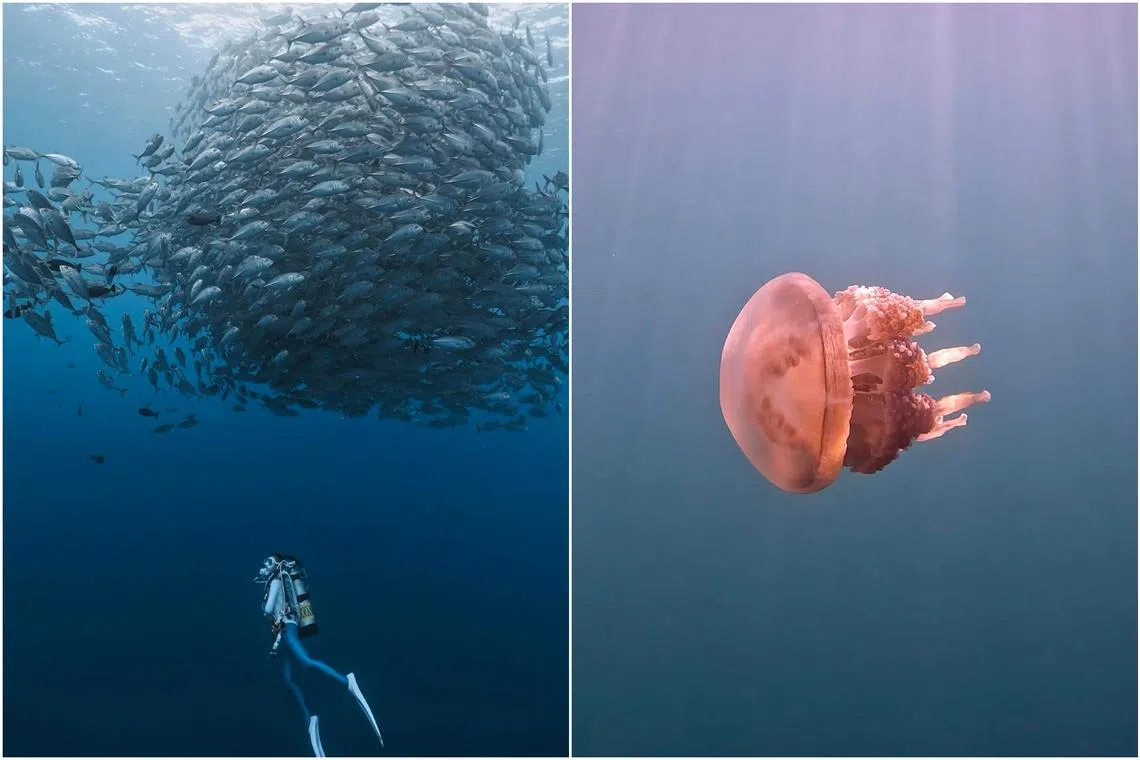
PALAU – The manta rays glide overhead, their dark bodies and tremendous wingspan for a moment blocking out the sunlight. Another swims towards us, mouth open, feeding in the plankton-rich waters of this island nation in the Philippine Sea.
The rays are not the only ones feeding. Reef sharks weave among schools of wrasse and snapper, the odd fish winding up in their jaws. A school of barracuda zips past. Within my field of vision, there are more fish than ocean.
This is the sort of scene that divers dream of witnessing – befitting the archipelago’s reputation as one of the world’s best dive spots, often mentioned in the same breath as the Maldives and Galapagos Islands for its marine biodiversity.
Yet tourism infrastructure in Palau, a young nation that gained independence in 1994, is more nascent – making it more appealing to intrepid explorer types.
Since 2024, non-stop flights from Taipei to capital city Koror by China Airlines have increased from two weekly to four to five. In October 2025, United Airlines launched a non-stop route from Tokyo to Koror.
In 2023, hospitality brand Four Seasons launched the Four Seasons Explorer in Palau, a luxury catamaran with only 11 cabins (from US$2,900 or S$3,700 a night for two guests in a cabin). It will complement an upcoming resort by the same brand, which The Straits Times understands is in the pipeline.
Both of them embody the country’s high-value, low-impact tourism strategy. This is an approach to tourism popularised by Bhutan, which mandates a Sustainable Development Fee of US$100 a night a person.
Palau has no such levy, but other expenses add up fast. With minimal public transport, travellers must either rent a car or rely on private taxis.
Hotels in Koror, where 85 per cent of the accommodation is located, range from $150 to $400 a night. And excursions, such as to key World War II historical sites or the Rock Islands Southern Lagoon, cost between US$75 and US$150 for a half- or full-day tour.
This precludes bargain hunters and allows a measured approach to growth, with goals such as increasing locally owned tourism-related businesses laid out in the country’s Sustainable Tourism Strategy 2025-2028.
Employment in Palau has increased by 5.1 per cent year on year, with the growth largely attributed to the tourism sector, based on a Jan 15 report by local newspaper Tia Belau.
Palau, known for its marine biodiversity, aims to draw tourism sustainably.
PHOTO: FOUR SEASONS EXPLORER PALAU
But the country knows growth should not come at the expense of its citizens. Besides being an economic driver, the strategy recognises that tourism should be environmentally sustainable, socially responsible and occur at a pace determined by Palauans.
Testament to this is Palau’s entry visa, a pledge every visitor must sign that is incorporated into its passport stamp.
“Children of Palau, I take this pledge as your guest to preserve and protect your beautiful and unique island home,” reads the first line, and I feel the weight of these words at immigration.

An aerial view of the Rock Islands in the Palau archipelago, which comprises around 340 coral and volcanic islands.
PHOTO: FOUR SEASONS EXPLORER PALAU

Luxury catamaran Four Seasons Explorer began cruising in Palau in 2023.
ST PHOTO: CLARA LOCK
Nowhere are these results more apparent than underwater, where thriving reefs teem with marine life.
I spot at least 20 reef sharks across five dives during my four days aboard the Four Seasons Explorer in January, their majestic presence indicating an ecosystem robust enough to support predators.
Healthy populations of fish such as tuna and barracuda are due partly to the success of the National Marine Sanctuary, which enacts a commercial fishing ban in about 80 per cent of Palau’s territorial waters, says resident marine biologist Elspeth Strike. Enforcement, however, remains an issue.
Staying on the Explorer offers a front-row seat to these splendid underwater views. Launched in the Maldives in 2002, it began plying Palau’s waters in 2023 and is billed as a floating hotel.

Plush communal spaces on the Four Seasons Explorer, which is billed as a floating hotel.
ST PHOTO: CLARA LOCK
Guests board via smaller boats and follow daily itineraries that include multiple dives as well as alternative activities such as snorkelling, historical tours and water sports.
During my stay, the crew pilots a route that takes Explorer guests to Kayangel, a pristine islet in the north of Pa lau, for the first time.
There is enough to keep non-divers entertained, but the vessel’s main clientele is divers and its main draw is offering the pinnacle of liveaboard luxury.

A tuna poke bowl.
ST PHOTO: CLARA LOCK
There are refined and delicious multi-course meals with influences from Vietnamese, Japanese and Western cuisines, and a large, plush bed to recuperate between dives. There are also staff who anticipate my every need, including chilled bottles of water at every turn, cold towels after each dive and a pot of after-sun gel placed in my room when I mention a sunburn.

One of 11 cabins on the Four Seasons Explorer.
ST PHOTO: CLARA LOCK
Married couple Debbie and Steve Parrott, both 73, have cruised nine times on the Explorer since 2006.
The Britons, both retired, return for the comfortable bed – “At our age, you need to get a good night’s sleep,” says Mrs Parrott – and the top-notch service. They rate this the best liveaboard they have been on. It is only my first, but I am inclined to agree.
Colonialism leaves both scars and legacy, and Palau’s rulers – Spain, Germany, Japan and the United States – have all made their mark.
During Germany’s occupation from 1899 to 1914, after it purchased Palau from Spain for its natural resources, the German government blasted and dredged a channel through the reef for faster passage of mined phosphate to Koror for export.
In World War II, while Palau was under Japanese administration, the channel served as a logistical supply route.

The German channel draws manta rays as well as a plethora of marine life to one of Palau’s most popular dive spots.
PHOTO: SAYAKA MORI
Today, the shallow waters of what is still known as the German channel draw manta rays, as well as a plethora of marine life, to one of Palau’s most popular dive spots, their presence a balm for the scars of the seabed.
The land, too, is a palimpsest. Peleliu Island, with a population of around 600 and gentle pace of life, belies its dark history.

Peleliu Island is known as the site of one of WWII’s fiercest battles.
ST PHOTO: CLARA LOCK
It is known as the site of one of WWII’s fiercest battles, where in 1944, US forces took on the Japanese occupiers in a bid to capture the Philippines and end the war.
They estimated a battle of three to four days, but it took more than two months of combat before the island was captured, resulting in one of the highest casualty rates of an amphibious assault in American military history. About half of all US troops involved were injured.
During our tour, we are reminded to stay on the paved road, as the island is still laced with mines. Norwegian People’s Aid, an organisation which provides post-conflict reconstruction assistance, has mapped and safely removed more than 25,000 pieces of ordnance since 2015, and more remain.
A monument to fallen US troops stands steps from a pristine beach, its sparkling water once laced with the blood of the Japanese and American armies. A Type 95 Ha-Go Light Tank used by the Japanese military remains in the same spot where it was attacked by US forces, now blanketed by an explosion of foliage and purple velvetberry flowers. In place of destruction, nature has taken root.

A Type 95 Ha-Go Light Tank used by the Japanese military remains in the same spot where it was attacked by US forces.
ST PHOTO: CLARA LOCK
Atop Bloody Nose Ridge, a network of caves used by the Japanese defensive cover that earned its nickname from the outsized number of resulting American casualties, the First Marine Division Association Memorial sits next to the Japanese Peleliu War Memorial Shrine. The flags of both nations flutter in the wind.
There are no winners in war, says Four Seasons Explorer’s activity manager Hassan Ali at a peace monument called The Promise, even as modern horrors in Ukraine, Gaza and Iran suggest that man is immune to the lessons of history.

Atop Bloody Nose Ridge, the First Marine Division Association Memorial sits next to the Japanese Peleliu War Memorial Shrine.
ST PHOTO: CLARA LOCK
Unlike many Asian nations, Palauans tend to view the Japanese not as war aggressors but benevolent administrators.
The Japanese governed Palau as part of the South Seas Mandate from 1914 to 1945, and during their reign established a judiciary, formal education for all children and economic development in the form of industries such as fishing, mining and agriculture.
And during WWII, Japanese military evacuated a significant portion of the Palauan population to less contested parts of the archipelago, minimising civilian battle casualties.

The Bai is a traditional Palauan community meeting house, where chiefs would historically gather.
PHOTO: FOUR SEASONS EXPLORER PALAU
I learn this from exhibits at Belau National Museum (admission: US$15 a person), where compact, old-school displays provide a comprehensive understanding of the nation’s history.
Its outdoor centrepiece is a Bai, a traditional Palauan community meeting house with an A-frame roof, where chiefs would historically gather. The airport’s new international terminal, opened in 2022, bears a similar design.
Today, there are Japanese influences throughout the capital. Eateries such as B’s Izakaya Yume palau serve respectable homestyle fare such as oyakodon (US$13.20), albeit shy of the value and quality found in Japan.
And infrastructure such as the Japan-Palau Friendship Bridge, completed in 2002 with grant aid after the original bridge connecting Koror to Babeldaob Island collapsed, illustrates diplomatic ties that propel Palau towards a more modern future.

At Belau Eco Glass, artists and visitors recycle glass bottles into homeware and accessories in yet another of the island’s waste reduction initiatives.
ST PHOTO: CLARA LOCK
At Belau Eco Glass, artists and visitors recycle glass bottles into homeware and accessories in yet another of the island’s waste reduction initiatives.
There are glass-blowing classes available (US$65 for a 30-minute workshop, book via facebook.com/BelauEcoGlass) or souvenirs from the on-site shop.
Beneath the surface, too, renewal is taking place. One of the country’s most iconic spots is Jellyfish Lake, where visitors can snorkel among thousands of stingless golden and moon jellyfish. It is among a handful of lakes worldwide where people can do so, with others located in remote parts of Indonesia and the Philippines.

A stingless moon jellyfish at Jellyfish Lake.
PHOTO: LUCA KOENIG
Out of Palau’s underwater marvels, this to me is its most surreal and beautiful – drifting among pulsing, globular jellyfish as they migrate across the lake with the sun.
The marine lake was formed about 12,000 years ago, when rising sea levels at the end of the last Ice Age flooded a landlocked basin, trapping a population of golden jellyfish inside. Isolated from the open ocean and largely free of predators, these jellyfish evolved to lose their sting, with venom too mild to harm humans.
But the jellyfish are not immune to harm and their population has waxed and waned precipitously over the decades. In 1998, the golden jellyfish population in the lake was all but wiped out, likely caused by increased water temperature and stagnation from climate phenomenon El Nino, as well as tourism pressure.
The population later recovered to pre-decline levels, peaking at 30 million in 2005 – the same year the lake was featured on American reality show Survivor (2000 to present). “You’re in millions of them, they’re all just coming at you,” said contestant Bobby Jon Drinkard on the show.
Today, there are between 500 and 100,000 jellyfish in the lake, based on a January survey by the non-profit Coral Reef Research Foundation. Each one is a precious sight, with numbers having recovered from a 2016 drought.
Without scores of jellies to swim into, I survey each one individually. Translucent, ethereal moon jellyfish propel themselves forward, pulsing like slow heartbeats. Illuminated by sunlight filtering through the water, they resemble delicate works of art.

A stingless golden jellyfish at Jellyfish Lake.
PHOTO: LUCA KOENIG
In larger, more well-developed golden jellyfish, I make out oral arms – fluffy-looking structures used to capture zooplankton that are fascinating to observe up close.
Yet it is these tiny invertebrates, no larger than my pinky fingernail, that hold the most significance for they represent a population on the mend. Just a year ago, there were no babies to be seen, says Four Seasons Explorer’s videographer Sayaka Mori.
Amid the threats of human activity and climate change, these juveniles are a reminder that when humans do their part in conservation, nature will find its way.
I fly from Singapore to Taipei on Scoot, and then from Taipei to Koror on China Airlines. The latter journey takes about four hours and costs around $500 for a one-way flight in June, based on checks by The Straits Times in April.
Other airlines that fly non-stop to Koror include United Airlines from Narita, Japan, and Qantas from Brisbane, Australia.
Public transport is limited in Palau and renting a car is the most efficient way to get around. My one-day rental of a Mazda 2 from IR Motors and Car Rental costs US$40. Reservations are recommended.
Alternatively, hotels may offer airport transfers and taxi services. I pay US$40 for a one-way airport transfer with a private driver (WhatsApp Ray on +680-779-1603).

Palau Central Hotel has clean, resort-style rooms, a small pool and lounge area, and a modest buffet breakfast.
ST PHOTO: CLARA LOCK
In Koror, I stay at Palau Central Hotel ($230 a night), which had clean, resort-style rooms, a small pool and lounge area, and a modest buffet breakfast.
Multiple operators offer tours to popular sites. A full-day snorkelling and island-hopping tour, for instance, costs US$125 an adult from Rock Island Tour Company.
If you are diving or snorkelling, use only sunscreen that is reef-safe, which means it is made without chemicals that are harmful to marine life. Brands such as Stream2Sea and Pura Vida Palau can be purchased from supermarkets and gift stores in Koror.
Take along seasickness pills for dive or snorkel excursions. The calmest season runs from December to March, but even in January, I find the waters fairly choppy.
Palau uses the US dollar, and while major establishments such as hotels take credit cards, it is useful to have cash on hand.
-
The writer was hosted on the Four Seasons Explorer.
-
Now Boarding is a series on destinations that are taking off. For more travel stories, go to str.sg/travel
