

BarcelonaIs the cult of the musical idol sidelining the music? Does a concert-goer get excited by the music and the way it is being performed on stage, or simply by being in front of their favorite artist or band? Do the stage elements hinder or amplify the songs? If the music is the most important thing, is it legitimate to put tickets on sale without visibility? Is live music better experienced individually or as a collective experience? Does it make any sense to follow a performance 30 meters from the stage while only looking at screens? Is it necessary to see the artist playing to enjoy a concert?
The Mercat de Música Viva de Vic opens on September 16 at the Teatre l’Atlàntida with a proposal that raises many of these questions. “We want it to be a space for thought and reflection on what live music is today,” says Joan Rial, one of the three directors of the Mercat, regarding Non concerto. Lucia del Greco, the stage director responsible for the show, does not want to give away many details, because the album the album Una lunghissima ombra (2025), by Andrea Laszlo de Simone, an Italian musician who decided some time ago that he would not perform concerts, is very important. “Non concerto is a kind of antithesis of everything a concert can be and at the same time everything that it really shouldn’t be or that the public doesn’t expect it to be. It is a title that helps us channel reflections on what live music is. And we have decided to enhance this lack of response with a title that only serves to generate more questions,” explained Del Greco at a meeting organized by the Mercat de Música Viva de Vic at the Antiga Fàbrica d’Estrella Damm in Barcelona. Sponsors are also part of live music. Some do it with more discretion, and others whose presence is almost one more scenic element during the concert.
The same day, the second edition of the Feroe Festival was presented, which will bring together concerts by Beth Orton, St. Paul & The Broken Bones, and Tiwayo at Poble Espanyol on November 13th. The festival director, Albert Puig, also shared reflections on live music, such as the need he feels to “recover the sensation of listening to music in good conditions” and the desire for an “ideal world in which artists understood that it is better to play in a place where the audience is effectively the audience that wants to see the artist”. As an example of the antithesis of this: performing concerts at festivals or major celebrations in front of spectators who are not even paying attention to the stage, such as the case of Ferran Palau at the 2024 Primavera Sound, who played for the people who had gone to save a spot for the Lana Del Rey concert that was starting five hours later. Surely a good remuneration makes the ordeal less painful for the artist, but is it worth it?
One of the questions that Lucia del Greco will raise at the Mercat de Música Viva de Vic has to do with a context in which “the music takes a back seat because the singer, the idol, is prioritized.” Everyone can contribute a personal experience. For example, the memory of having been able to see Elvis Costello at the Palau de la Música can take precedence over the tuning catastrophe that almost happened at the beginning of the concert. Or the admiration for Antònia Font or Aitana can forgive the sound problems at the Palau Sant Jordi.
In other cases, the prioritization of the idol not only pushes the music to the side, but also the musicians, who disappear from the stage. “The audience gets more excited when they believe the music is being played live,” says Jordi Casadesús, another of the market’s directors. And, furthermore, he recalls the notable ability to excite that a DJ has who works with recorded music and who can even spare themselves from intervening in what they are playing.

Rosalía’s Lux tour is quite a space for reflection in this regard. The singer, criticized during the Motomami tour for making the musicians invisible, now shows a chamber orchestra and combines it with pre-recorded sounds that make the sound of the orchestra itself grow, with moments of solo singing like in operatic arias, with piano, with synthetic rhythms and with a deluge of resources in a staging that prioritizes the idol while enhancing the emotion conveyed by the music. Regarding Rosalía, at the meeting at Can Damm it was also recalled that in a concert of the Lux tour, the artist forced a mistake with her voice to demonstrate that the technical perfection she was exhibiting was real and that the voice that was sounding was not a recording, as some critics had stated. Do we need the mistake to humanize the performance? Three decades ago, electronic music incorporated the digital error, the glitch, as a musical resource. Therefore, even the error could be planned. “We will open more answers than we will offer answers,” insists Del Greco.
In any case, despite the talent of the musicians, despite the logistics and the technical and technological sophistication, live music can become a very fragile space, where there are dozens of circumstances that can affect the artist, from an unexpected sea breeze that bothered Rubén Blades at the Porta Ferrada Festival, to the impertinence of some mobile phones that forced the conductor Omer Meir Wellber to interrupt one of the highlights of Mahler’s Fifth Symphony at the Palau de la Música. Sometimes fragility is extreme, like that of Miles Davis, who explained the anguish he suffered the day John Coltrane told him he had a dentist appointment to get a tooth implant. Davis thought that the secret to the magic of Coltrane’s sound playing the sax was that hole in his teeth, and he was not at ease until he heard him play again: the magic had nothing to do with the saxophonist’s dental health.

The impact of scenography
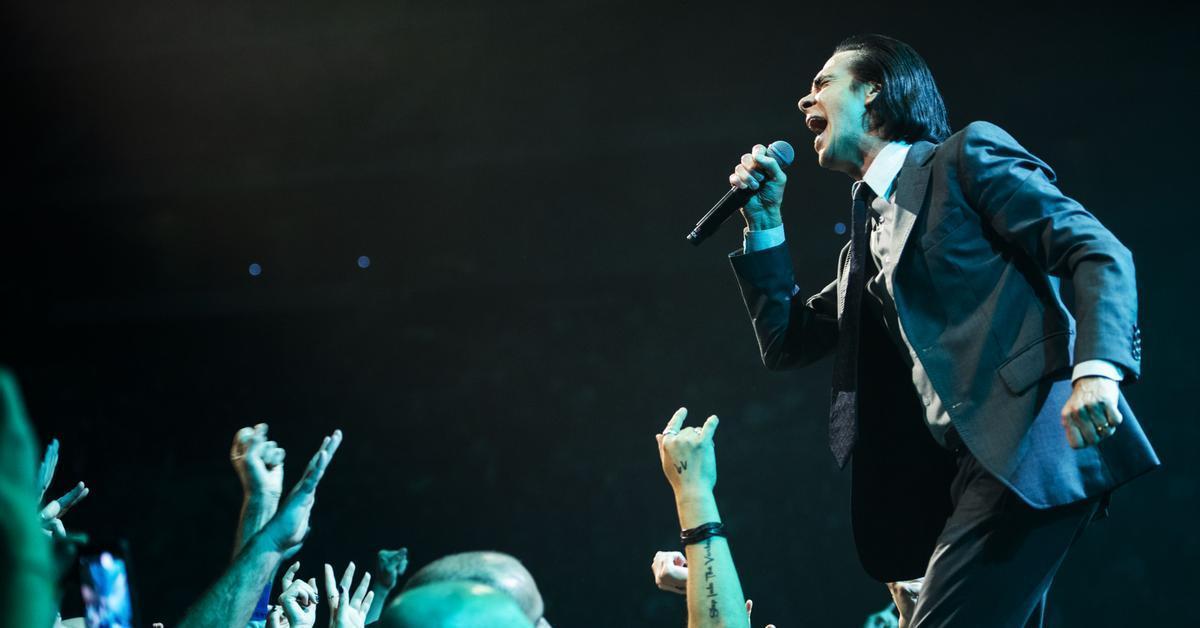
“There are artists for whom scenography works in their favor, but not for everyone. Music must be delivered to the spectator through a channel that is consistent with what the music itself wants to convey. I am as much in favor of a sophisticated staging as I am of what Justin Bieber did at Coachella, where he had enough with a computer to move the audience,” notes Del Greco. When Nick Cave lunges towards the audience (or when he put his foot on the monitor, back when they were still used), he makes a stage gesture that boosts the emotion of Red right hand, a simple gesture that becomes a high-speed channel for emotion, just like when the soprano Lise Davidsen stretches out her arm in the first act of Tristan und Isolde to reinforce the tragic dimension of what she is singing. Surely, the impact would be lesser if Cave and Davidsen sang like expressionless statues.
Opera, which as a total art form has been an open field for centuries for reflections on how live music should be, has demonstrated both the virtues and the vices of staging for non-amplified music. There is nothing more frustrating for a spectator than stage direction that places the singer at the back of the stage, a maneuver that especially punishes the furthest audience and widens the distance between those who pay for the cheapest tickets and those who pay for the most expensive ones.
The location of the audience is not a minor matter in live music. In some macro-concerts and festivals, tickets for the areas closest to the stage are more expensive: they are delimited by fences, like a luxury corral, and they do not reward the fans, but rather whoever can pay more. There have been grotesque cases, such as that of the 2025 Maleducats Festival: the rapper Santa Salut had to get off the stage and cross the emptiness of this premium zone to get closer to the fans who were behind the fences.
The price of tickets cannot be left out of the debate about what kind of live music we want. As Albert Puig says, the business is so juicy that the music industry has fostered an inflationary spiral of inflated fees due to “competition” between promoters in an unleashed auction. What sense does it make for a ticket to a Sting concert to cost more than 300 euros, 25% of the minimum interprofessional wage? Furthermore, the idea that a concert must be spectacular and must multiply the stimuli, as if there were not enough trust in the music and the performance, also raises costs that inevitably impact the price of the ticket.

Recovering the music lover’s spirit
In pop, sometimes the scenic free-for-all blocks the music, as happened in Katy Perry’s latest tour, a dramaturgical disaster in which the overdose of scenic stimuli was not a conduit but a dam for musical emotions. It had the same attention-dispersing effect as the chatter of some spectators at a festival. Precisely the opposite is what Albert Puig proposes at the Festival Feroe. “We want to recover the spirit of live music as something that is not overwhelming, neither in schedules nor in offerings, which does not involve watching the concert through screens and surrounded by influencers,” says Puig, appealing to the spirit of the music lover who discusses the performance passionately, and even critically, after the concert. This is the audience that Puig wants to reward with three concerts linked by a musical or emotional narrative, and with tickets at 48 euros. “People with an open mind who can see different things, because we are entering an era of monothematicism,” says Puig. It is surely the same audience that at a macro-festival tries to put together a route with a musical or emotional narrative and often has to give in due to scheduling conflicts that are weapons of mass frustration.
This artistic communion between musician and audience that the Festival Feroe pursues (designed for a capacity of 2,500 people) is not exclusive to small or medium formats. The magic of proximity that Cat Power at the Poble Espanyol, Roger Mas at the Teatre Grec,Remei de Ca la Fresca at the Apolo, Maria del Mar Bonet at L’Auditori or L’Arannà at the Festival Càntut achieved was as intense as the collective catharsis experienced by more than 50,000 people singing Run to the hills at the Iron Maiden concert at the Estadi Olímpic Lluís Companys or the 17,000 who accompanied Billie Eilish as if they were a choir on Happier than ever at the Palau Sant Jordi. The key to it all has more to do with whether the entire audience is focused on what is being transmitted from the stage, something more difficult to guarantee at a macro-festival or a major local festival.

It must be said that sometimes the emotional impact of live music has a lot to do with the audience’s expectations. At Bad Gyal’s concerts, a spectator may be satisfied if, beyond being at a show by their favorite artist, what they want is for the concert to convey the sensations they experience in a nightclub when her songs play; but there may be other spectators who are a bit disappointed if what they are looking for is a more dramatically consistent performance. Because live music is not reduced to seeing musicians reproducing songs on a stage exactly as they are recorded (or composed). In opera, it is accepted that one does not need to see the orchestra while it plays the prelude to the third act of Tristan und Isolde to be moved by what Wagner’s music proposes; in fact, the orchestra itself is in a pit, made invisible. But in the aria Vissi d’arte from Tosca, being able to see the soprano’s gesture and stage movement makes the emotion Puccini was pursuing more intense.
Finally, there are special cases, such as Bob Dylan’s latest concerts, which feed on idolatry (tickets at 90, 125, 175 or 215 euros at the Liceu) and at the same time sabotage it because the musician spends a good part of the performance practically hidden behind the keyboard, as if he wanted to communicate that music does not need to be seen. In his case, he compensates for the stage renunciation by modifying the songs enough and, therefore, challenging the memory that each spectator has of Dylan’s songbook, because live music should also be surprising. This is what happens with David Byrne, surely the artist who is contributing most to changing concerts with a device in which staging and music mutually enhance each other. One only needs to remember the memorable performance at Cruïlla 2026.
