


The recent death of the self-proclaimed King of Papaala, Noah Musingku, has prompted discussion over whether this famous, reclusive Bougainvillean was a visionary or a conman.
Musingku, who died last month in the autonomous Papua New Guinea region of Bougainville, was the mastermind behind the infamous U-Vistract finance scheme, in which many investors from the Pacific lost money.
The prevailing, somewhat comic image of a tiny King in a makeshift crown and British army regalia enhances the impression of a crackpot fraud, but people who knew Musingku from an early age claim he was someone with vision who tried to help others.
Noah Musingku
OCCRP / Aubrey Belford
Dennis Lokonai, an administrator with Bougainville’s Four Square Church and a former minister in the Autonomous Bougainville Government (ABG) until last year, studied alongside Noah Musingku through school and university and described him as creative and intelligent.
“He was a person who tried to invent new ways or new things. For example, I remember when we were in high school, he had a special handwriting which he developed by himself, kind of a sign writing like the Asian type of handwriting, like Chinese.”
At Unitech in the PNG city of Lae, Musingku became president of the Student Representative Council, showing his leadership qualities at an early stage. Lokonai said he saw how his friend was a generous Christian.
“In our university days, we used to receive a 13 kina allowance every fortnight. So while we, the other students, struggled to save money, Noah was able to set aside some tithe or offering, which he used to assist people in need or even contribute to the church.”
A former president of Bougainville, James Tanis, also studied with Musingku and echoed Lokonai’s points about him, his unique talents and deep faith, saying they remained friends.
“That’s why years later when I became President, I was able to visit him to encourage him to respect the [Bougainville] Peace Process. Which he did,” Tanis explained.
U-turn
In Port Moresby in the 1990s, Musingku developed the U-Vistract scheme, which promised large returns for investors and created his own currency, the Bougainville Kina.
U-Vistract is described as having started out as a Ponzi scheme that ended up more of a “millenarian religious cult” by Aubrey Belford, the Asia Pacific editor of the Organised Crime and Corruption Reporting Project (OCCRP).
“Right from the beginning, this scheme used a lot of the language and symbolism of evangelical Christianity, but that was secondary to the get-rich-quick promise,” Belford, who visited Musingku in his remote haven last year to interview him, told RNZ Pacific.
“I think Musingku’s main legacy is the thousands of people whose money he took who he left with nothing. Most people who got caught up in U-Vistract worked out sooner or later that they had been conned.”
Dennis Lokonai told RNZ Pacific that Musingku didn’t set out trying to scam people.
“Noah was a good person, he had a good initiative to start, but later things got complicated because of legal implications in regard to banking and all financial systems couldn’t allow him to operate something outside of the law.
“So that was why he was later termed as a conman, and all those things were said to him – but I think Noah had a good intention to start something good to help the people.
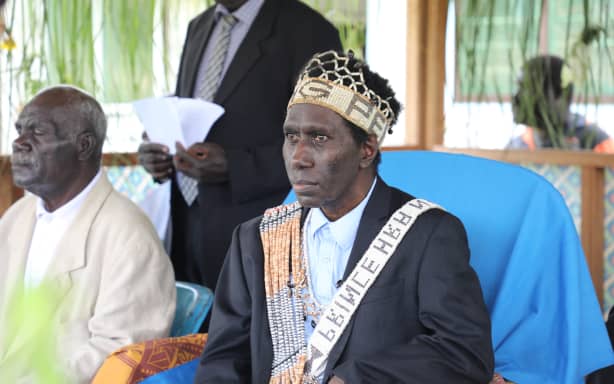
Noah Musingku
Anthony Kaybing / ABG
Crypto parallels
Musingku was quoted over the years denouncing the global financial system – much like the pioneers of cryptocurrency, he was trying to build a new system and an alternative currency.
Belford noted that Musingku’s scheme had some parallels with cryptocurrency, including that his currency was intended to replace the idea of government ‘fiat’ money.
“In fact, when he first started really pushing the currency and his International Bank of Me’ekamui he actually advertised that he accepted deposits in a whole number of digital currencies — which weren’t based on cryptography — that existed before Bitcoin.
“But whereas crypto is all about saying that a public bit of mathematics is the basis of a currency, Musingku went with an older idea that also has a fair bit of power among modern right-wing libertarians, that money should be based on gold.”
Lokonai said while he himself lost money invested in Musingku’s scheme, some early investors did well out of U-Vistract
“We witnessed a lot of people who were helped through that system when they actually withdrew their funds, which they they used to support themselves, build houses, ome built churches, some even bought cars through that money they got from that that system.”
The U-Vistract scheme was shut down by PNG authorities in 2000, after which, Musingku fled to Solomon Islands and then back to Bougainville.
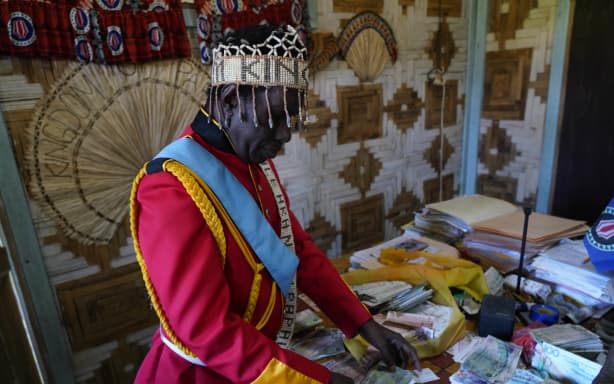
Noah Musingku died last month in the autonomous Papua New Guinea region of Bougainville.
OCCRP / Aubrey Belford
Becoming King
Forced to retreat to the interior of Bougainville to avoid the arm of the law, Musingku pivoted.
He proclaimed himself King David Pei II of the Kingdom of Papaala in 2004, and later returned to his home village of Tonu in South Bougainville to reign as a king with a group of armed loyalists protecting him.
“As Musingku’s scheme fell apart … the whole thing became more overtly about almost apocalyptic religiosity and grand promises about Bougainvillean independence,” Belford explained.
As Bougainville navigated the peace process with PNG, Musingku was not aloof to the process in the way that the Bougainville independence leader Francis Ona was.
Ona’s breakaway Me’ekamui-controlled territory in Bougainville had provided Musingku with refuge immediately after he fled PNG authorities, and before he set up his stronghold in Tonu.
Tanis said that Musingku displayed an openness to support Bougainville’s pursuit of independence, as it approached the 2019 referendum in which 97.7 percent of Bougainvilleans voted for independence from PNG
“I made a second visit to him, during the referendum preparations, to encourage him to allow his supporters to enrol and vote,” Tanis told RNZ Pacific.
“He listened to me again. I was able to talk to him because I had no issues against him personally. Most that hated him, are his own investors of U-Vistract.”
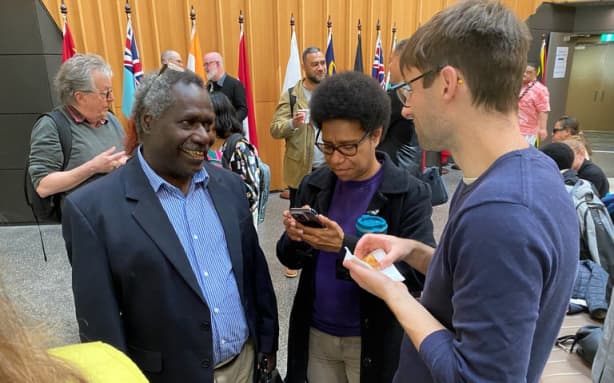
Former Bougainville president and External Relations Directorate international legate James Tanis speaks with delegates at ANU State of the Pacific conference in Canberra, pictured on 5 September 2024.
BenarNews / Stefan Armbruster
Musingku’s long-term followers and the few remaining U-Vistract investors still holding out hope for a return overlapped as his core base.
“So they were continuing to follow him up until his passing, because they were told that their money was still there and they would receive their money,” Lokonai explained.
He said that it’s not clear whether Musingku’s movement will continue now that he is dead, or if there is a successor.
Belford said although Musingku never got held to account for his investment misdeeds, he ended up as a prisoner of sorts anyway.
“He spent the rest of his life basically hemmed in, in his own dingy complex, giving sermons every week and sending out emails with the same promise that the big payout was going to come next week.
“And then when the payout didn’t happen, he came up with some reason why the bonanza would come the week after that. Rinse and repeat in the same small room behind his office with the same old laptop until he died.”
