


The Tongan government has launched its first national policy dedicated to helping deportees, or “returnees”, back to the kingdom reintegrate into society.
Many Tongan nationals deported to the island after spending decades overseas return to a country they barely know, faced with the daunting prospects of social isolation, and limited support.
But advocates are hoping the policy – Tonga National Returnees Reintegration Policy & Strategic Plan of Action 2026-2030 – will reduce reoffending and help people rebuild their lives.
The document was as unveiled on Wednesday in Nuku’alofa following a year of collaboration between government agencies, churches, non-government organisations and deportees themselves.
The process brought those groups together with a shared goal: developing a more coordinated response for people returning to Tonga.
from left, Dr. ‘Uhilamoelangi Fasi, Sinaitakala Tu’itahi, Hon. Sevenitini Toumo’ua, Hon. Fane Fituafe, Acting PM Hon. Dr Viliami Latu, HRH Crown Prince Tupouto’a ‘Ulukalala, HE Brek Batley, NZ Deputy High Commissioner to Tonga, HE Rosalind Dawson, ‘Akanesi Polotu Paunga, Prisons Commissioner Laini Manuofetoa, and Deputy Police Commissioner Tevita Vailea. Nuku’alofa. 15 July 2026. Photo: Matangi Tonga.
Matangi Tonga
“The vision … which basically is the heart of what the policy is about, and something that the various stakeholders came to agree to, is full reintegration and restoration of returnees’ life,” Katrina Ma’u Fatiaki, a member of ‘Dare to Dream’, said.
Dare to Dream is an organisation which has spent years championing the rehabilitation of returnees.
While not all returnees have criminal convictions, many of the people Dare to Dream works with, were deported after offending overseas.
Any person who has returned to their country of origin because of criminal deportation, visa overstaying and family reunification, is considered a returnee.
Fatiaki said more than 1000 Tongans had returned since 2000, with around 628 classified as criminal returnees.
“Majority of these returnees are young men aged 25 to 35, and so they’ve spent extended periods overseas. And so, there’s obviously cultural gaps, limited support, and that’s one of the reasons we have this policy,” she said.
Many deportees return to a country they barely know after spending most of their lives overseas, she added.
“Because they’ve been sent back because of criminal activities, they come back and their own homeland is almost like a foreign land. So the policy is about making them feel valued, so they know they are respected citizens of the country.”
Fatiaki said it was the lived experiences of returnees that guided and shaped the policy from the outset.
“Their testimonies have always been about the social isolation that they have faced.
“A lot of them that have been sent back, because of the isolation and the stigma, and one of the biggest challenges is for them to reintegrate back into the communities, and society at large,” she said.
Fatiaki explained a lack of employment opportunities and support services often contributed to people returning to crime.
“Often they turn back to criminal activities because the support systems are not there. That includes trying to find employment and also other support mechanisms.”
The policy’s strategic plan identifies eight priority areas: successful reintegration, health and wellbeing, faith-based support, social protection and accountability, risk management, human rights, community safety, and collaboration with international partners.
Fatiaki said the biggest strength was that it had been developed alongside those it was designed to support.
“The beauty about this policy is that it wasn’t created in isolation. It was created by the returnees for the returnees.”
During Wednesdya’s launch, attendees were encouraged to “welcome returnees back with compassion and support”, something Fatiaki believes reflects a wider societal desire to help returnees.
In attendance was Crown Prince Tupouto’a ‘Ulukalala, who did stress a concern that Tonga had limited resources to reintegrate the returnees, but agreed that society must welcome returnees’ with “open arms.”
Left as a baby
Dare to Dream representative Jay Latu knows very well the challenges of returning to a “foreign” land.
Born in Tonga, he moved to the United States as a one-year-old before being deported back to Tonga 45 years later.
“My own journey reflects the long and complex road that many of us have walked. I left the shores of Tonga all the way back in 1971 – I was just a baby. Living in a different country for 45 years … I spoke a foreign language, adapted to a foreign culture,” Latu told attendees.
“When you return after nearly half a century, it’s overwhelming … the foreign country you lived in is no longer yours. You feel like a stranger in your own ancestral land. You carry the heavy weight of social stigma, the pain of isolation, and the daunting challenge of starting a whole new life from scratch.”
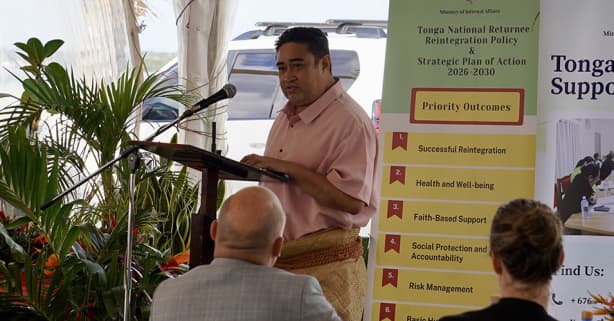
Jay Latu, pictured, spoke of his experience as a returnee
Matangi Tonga
Latu said returnees had a unique viewpoint that could aid the community and ensure growing issues, such as the prevalence of methamphetamine across Tongan communities, are battled by those who have experienced its impact overseas in foreign countries.
“We are not here to be a burden to Tonga, but a shield,” he said.
“Through this programme, we are building bridges to our younger generation, we want to work directly with them and the churches, schools, villages.”
“We are here to help,” he added.
