

One of the smallest countries in the world has set its sights on radically restricting—effectively banning—the global community’s access to nicotine.
On June 10, the Republic of Palau, an island nation in the Western Pacific with a population of 18,000, formally applied for a World Health Organization review of nicotine, under Article 2 of the 1971 UN Convention on Psychotropic Substances. This would have the potential to place nicotine under similar international drug restrictions to GHB, say, or methamphetamine—making the sale of non-medical nicotine products illegal.
The government of Palau, which banned vapes in 2023, argues that current efforts to protect people from combustible tobacco need to be sweepingly updated to include newer, safer products such as nicotine pouches and vapes.
“We may be a small nation, but the scale of a problem has never determined who acts on it,” said President Surangel S. Whipps, Jr. He urged governments around the world to follow suit in asking the United Nations “to finally treat nicotine like the toxic and addictive drug that it is.”
“Think of the consequences of prohibiting nicotine in international conventions just like cannabis, cocaine, heroin and so many other drugs.”
Ethan Nadelmann, founder and former director of the Drug Policy Alliance in the United States, said the initiative “may well be one of the most foolish in modern or even ancient history.”
“Think of the consequences of prohibiting nicotine in international conventions just like cannabis, cocaine, heroin and so many other drugs,” he told Filter. “All those drugs became far more popular after their criminalization than before, and far more dangerous.”
Prohibition generates vast illicit markets, corruption, violence and human-rights violations, he continued, “filling prisons with non-violent human beings whose only offense was to grow, possess, buy or sell a psychoactive substance that had long been legal.”
With nicotine, there’s additionally the critical harm reduction role of safer alternatives to smoking.
Smoking rates may be declining worldwide, but 1.3 billion people still use tobacco in risky forms, causing over 7 million deaths each year. Key to reducing this toll is the speed at which people who are unable or unwilling to quit nicotine transition to the safer products that over 100 million already use.
Nadelmann pointed to Sweden and New Zealand as countries that have “dramatically reduced cigarette smoking in recent decades without resorting to criminalization.”
“They claim it is an ‘initiative of the Republic of Palau,’ but it looks more like Palau is the willing puppet for a new billionaire-funded crusade.”
As part of its initiative, Palau’s government presented a scientific dossier and a website making the case against public access to nicotine. One of tobacco harm reduction’s most prominent voices labels this a “false operation.”
“They claim it is an ‘initiative of the Republic of Palau,’ but it looks more like Palau is the willing puppet for a new billionaire-funded crusade,” advocate Clive Bates, of Counterfactual Consulting, told Filter.
“The website is too slick, the lengthy science briefing was prepared in Europe, and an American activist group is involved,” he continued. “There is no disclosure about who is funding and organizing the campaign, but we can be pretty sure it isn’t the taxpayers of Palau with a population of 18k.”
It’s been reported that Palau’s application was put together by individuals who have been heavily involved in lobbying against safer nicotine products in Europe.
“What’s upsetting is that the anti-nicotine agenda being pushed on/by Palau … will do nothing to assist the people who are using deadly oral products.”
Just under 43 percent of Palau’s adult population legally and regularly consume gutka, a chewing tobacco mixed with betel (areca) nut. The highly carcinogenic product is banned in many countries. Curiously, the dossier fails to mention the use of gutka, which is far more prevalent in Palau than smoking.
“What’s upsetting is that the anti-nicotine agenda being pushed on/by Palau … will do nothing to assist the people who are using deadly oral products,” Nancy Loucas, executive coordinator of the Coalition of Asia Pacific Tobacco Harm Reduction Advocates (CAPHRA), told Filter.
Loucas added that denying people access to much less harmful products is contrary to basic human rights and the World Health Organization’s own harm reduction mandate. When Palau banned vaping, an option that has helped millions migrate from deadly forms of tobacco, it did so through according to the WHO’s MPOWER strategy. US billionaire Michael Bloomberg, a dedicated opponent of access to safer nicotine products, is a major funder of the WHO.
“Whether for money, for fame or other favors, there are countries willing to pawn their sovereignty and offer their place at the intergovernmental table to aggressive philanthro-colonialists, frustrated that billionaire money alone does not give them the standing and access of a nation state,” Bates commented.
Whether nicotine gets put on the UN’s scheduled list would depend upon a medical and scientific assessment by the WHO Expert Committee on Drug Dependence. That process would conclude in March 2028, subject to the votes of 53 member states.
“If the government of Palau’s proposal ultimately leads to a global prohibition of nicotine, and drug wars resembling those that have caused such devastation around much of the world in recent decades,” Nadelmann said, “then it will go down as a perpetrator of one of the most deadly war crimes in history.”
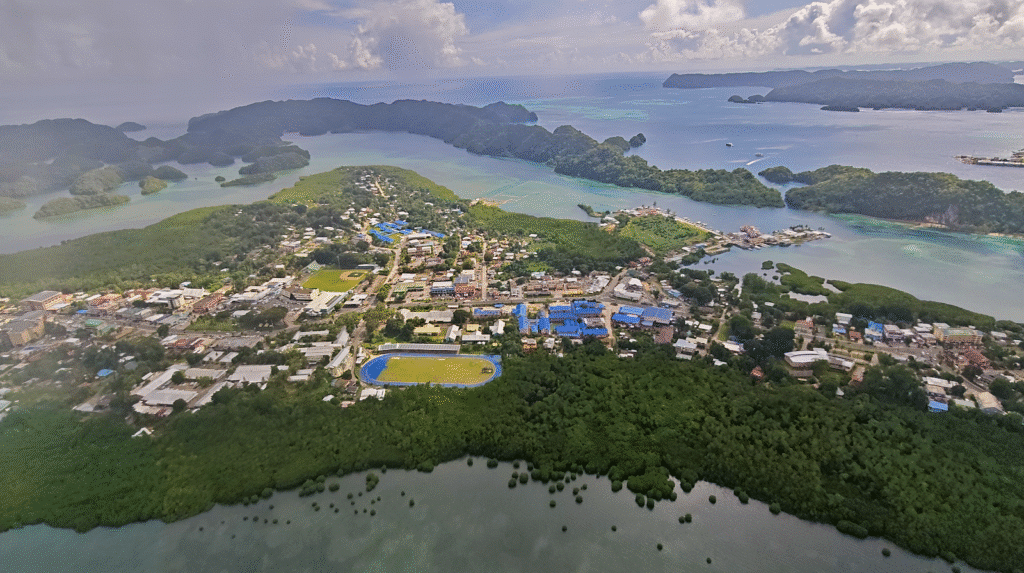
Photograph (cropped) of Koror, Palau, by Mandrusian via Wikimedia Commons/Creative Commons 4.0
The Influence Foundation, which operates Filter, previously received a restricted grant from the Drug Policy Alliance. Filter‘s Editorial Independence Policy applies.

#/media/File:Koror_from_Above.jpg)