


Dandhy Laksono
Photo: RNZ / Mark Papalii
An Indonesian filmmaker says the crackdown by authorities on his West Papua documentary in some parts of the country is a threat to democracy.
The Pesta Babi documentary looks at the social and environmental impacts of land seizures for big agri-business ventures in Papua – and the Indonesian military’s role in it.
Since March, the film has had screenings in New Zealand and Australia, and is now showing in Indonesia, where it has sparked public interest – not just through its treatment of the subject, but because authorities are trying to ban it.
‘Public order’
The film’s director Dandhy Laksono said that Pesta Babi was showing at around 1700 cinemas around Indonesia.
“We have recorded more than 30 incidents of the state apparatus stop the screening – mostly by military, and then they also using the civil servants – in the name of public order,” he explained.
Laksono said there has been no public disorder from the film in parts where it has shown.
“It’s ridiculous, and thanks to the audience they defend the film quiet hard, and they defend their rights to to watch and to absorb the information, about what actually happened in West Papua.
“I think compared to the subset of the public screening, the intervention or the intimidation is nothing in terms of numbers, but in terms of substance of democracy, that’s a real threat.”

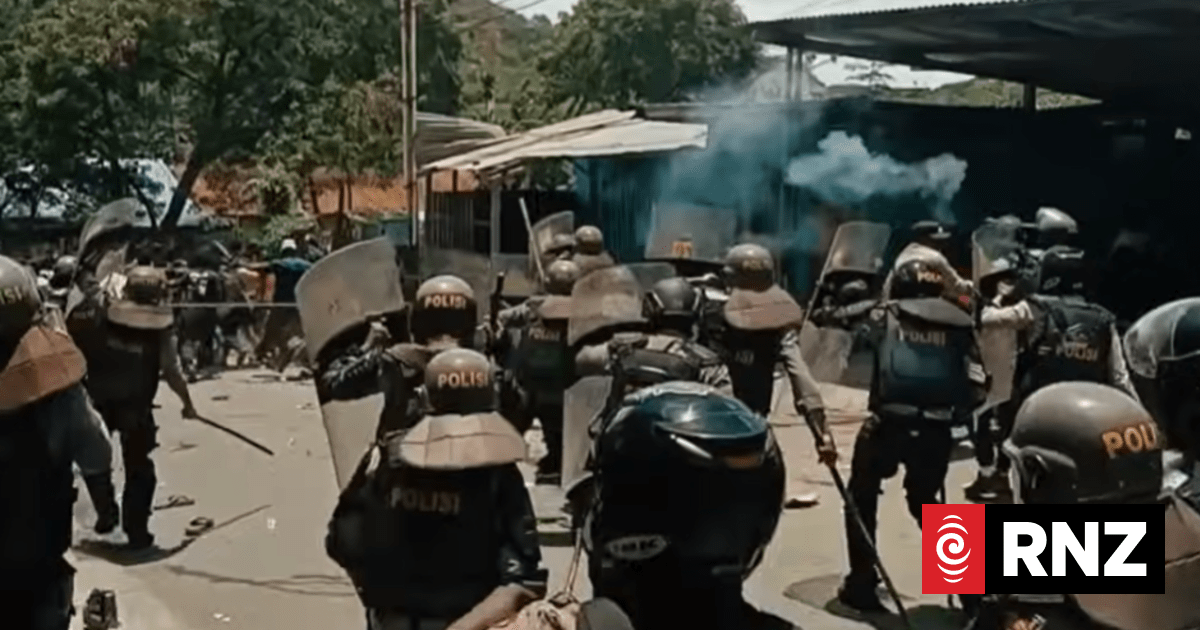
A screengrab from the film ‘Pesta Babi’ showing clashes between the Indonesian security forces and indigenous West Papuans.
Photo: Screengrab / Pest Babi
Interests disrupted
Laksono’s previous documentary film, The End Game, about efforts to undermine anti-corruption activities in Indonesia, also faced shutdowns, but only a handful. Pesta Babi has touched even more of a nerve.
“Because this film also talked directly about the military interest in West Papua, as well as the multinational corporation investment, so yeah, we assume that many interests is disrupted by this film.
The director said the reception of many Indonesians shows the film had also opened eyes.
“The most common thing is they (the audience) realise that the social media algorithm is never friendly for the Papuans, for the West Papuan issue, so they never have a chance to get the real situation in West Papua.
“And even the mainstream media, Jakarta-based mainstream media, never enough cover for West Papua, and of course, the international journalists cannot access the West Papua, so basically many people are blind from the current situation in West Papua.”
Relatable
The film has resonated with Indonesian audiences, Laksono added, because what is happening in West Papua is relatable across the republic.
“They comment about the proximity with their own problem in their own land, because the military now have more control under (Indonesian President) Prabowo’s administration and also the agrarian conflict with the land grabbing and environmental destruction for the investment.
“So basically what happens in West Papua now is basically a common phenomenon in other places in Indonesia, but of course in West Papua we have more in terms of scale and in terms of level of the damage – but the essence is same, so they feel the proximity.”
Laksono said the government had tended to use nationalism as a way to mischaracterise coverage of genuine West Papuan stories as a threat to the unitary Indonesian republic.
But he said more people were now seeing through this kind of propaganda and the bid to hide the human rights, environmental and social issues in Papua.
