


The limestone cliffs tower 200ft above the channel, their feet washed by aquamarine water and their heads styled in a lush coiffure of succulent plant life. A plastic bottle bobs against a rock at the bottom of the crags, mocking me with its jaunty dance. I paddle over, fish out the plastic intruder and drop it into my kayak.
“It’s so frustrating,” says my host Kiruu Kanai, gliding alongside me. “The trash washes in on the ocean currents, but by cleaning up, you’re honouring your Palau Pledge, so thank you.”
Kayaking is one of the best ways to experience Palau’s picturesque islands. Photograph by Bella Falk
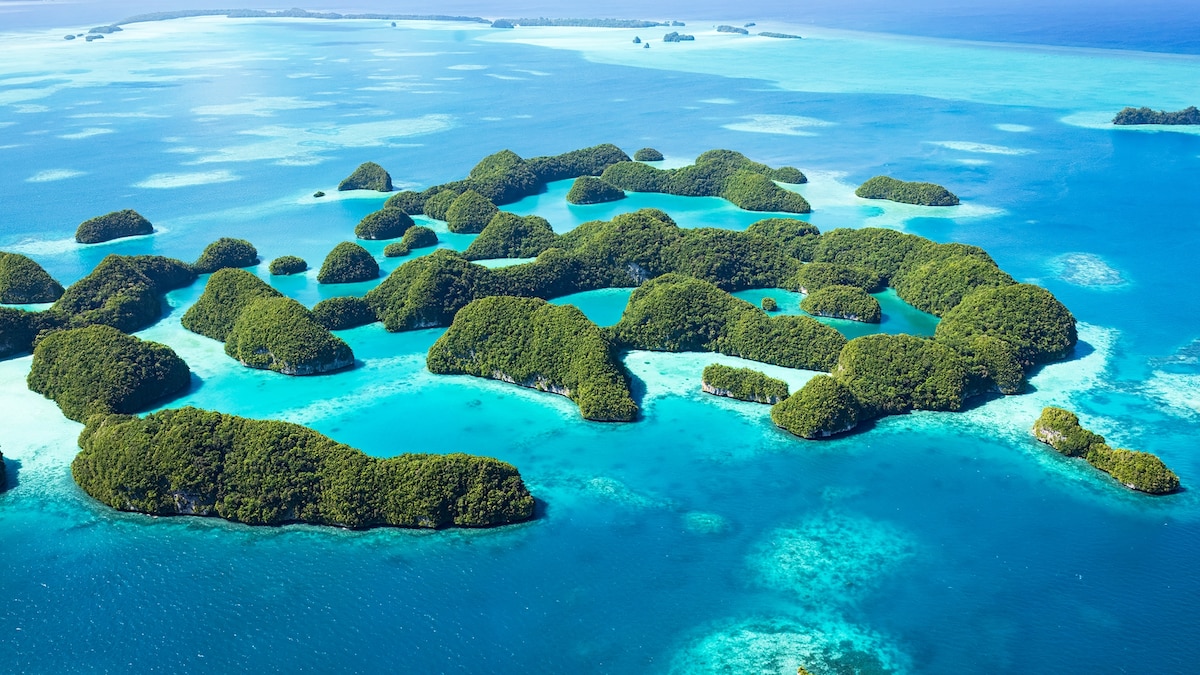
The Republic of Palau is the 17th-smallest country in the world, and is home to around 18,000 inhabitants. This idyllic archipelago of some 340 islands, most of them untouched by humans, floats almost unnoticed in the western Pacific, more than 500 miles from anywhere. It’s a pristine paradise of jungle-clad cays, sugar-white beaches, kaleidoscopic coral reefs and bath-warm waters humming with marine life. Safeguarding these treasures is enshrined in law. I’m not allowed in until I’ve signed the Palau Pledge, promising to ‘preserve and protect… act kindly and explore mindfully’ — the world’s first mandatory conservation declaration.
Arriving in this haven after a long journey is intoxicating. The next morning, as I step onto the verandah of my overwater bungalow at the Palau Pacific Resort, the white-capped noddies chilling on the balcony rail watch suspiciously as I inhale restorative lungfuls of clean air. But to really appreciate Palau’s biodiversity you need to dive in — literally — which means taking a boat out to the Rock Islands, a UNESCO World Heritage Site dotted with over 300 coral islands surrounded by a shallow lagoon. Prepped with snorkel and fins, I’m first over the side, dropping into a cloud of yellowtail fusiliers and zebra-striped sergeants that dart round me, disorientated by the sudden disturbance.

Women perform outside Bai ra RengaraIrrai, a chiefs’ meeting house in Ordomel village in Airai. Photograph by Palau Visitors Authority

The Badrulchau stone monoliths at the northernmost point of Babeldaob. Photograph by Palau Visitors Authority
After lunch we land on an empty beach, where Jackson Henry, my laid-back dive guide, leads me down a path shaded with strangler figs and tropical almond trees to a clearing enclosed by a collapsed stone wall.
“Early Palauans lived here in the 18th century,” he explains. From a jumble of shells and broken pottery he picks up half a spider conch and balances it on his hand, its spines jabbing skywards. “This was a weapon, like a knuckleduster. Imagine getting punched in the face with this.”
Nearby, Jackson shows me a memorial stone to Henry Wilson, an English naval captain shipwrecked in 1783. “His crew were the first Europeans to land in Palau. The villagers thought they were aliens, so they helped them. In exchange, Wilson gave them guns, which they used to defeat other tribes.”
Uncovering history and honouring heritage
Palau’s war stories don’t end there. From 1914 to 1944 the country was under Japanese occupation and became a key Pacific battleground in the Second World War. The southern island of Peleliu was worst hit: the site of intense fighting that lasted two months and claimed thousands of American and Japanese lives.
Self-proclaimed ‘history nerd’ Sean Kilcullen takes me on a haunting tour of the wreckage, showing me buckled tanks with wildflowers sprouting through rusted armour and claustrophobic tunnels where Japanese forces hid. A hollowed-out command centre with bullet holes peppering the staircase and vines snaking up the walls is the final stop.
“There’s still masses to be discovered,” Sean enthuses, picking up a brass shell casing from among the damp leaf litter. “Just hiking by myself I’ve found helmets, rifles, even unexploded grenades.”

Uai Skebong is skilled in the ancient art of weaving grass skirts from hibiscus bark. Photograph by Palau Visitors Authority

Sailing in a traditional ‘wa’a’, a wooden canoe hand-carved by local Palauans. Photograph by Josh Burkinshaw
Today, Palauans are as committed to preserving their history and heritage as their environment. On a tour of Airai state I meet Uai Skebong, who demonstrates how she weaves traditional grass skirts from hibiscus bark, worn by women to celebrate the birth of their first child.
“The ‘first birth ceremony’ is the most important event for a couple, like a wedding,” Uai explains. “It brings families together and celebrates motherhood.”
In Palau’s matriarchal society, women are both homemakers and leaders. They nurture and cook, but they also oversee finances and make decisions. Down the road we visit Bai ra Rengarairrai, a 200-year-old bai, or chiefs’ meeting house; an imposing thatched building brightly painted with faces, fish and roosters, where the (male) village chiefs hold meetings. “Only men can be chiefs,” my guide Velma Obak explains. “But women appoint the chiefs, and can fire them too.”
A Cessna flight on my last morning puts the tiny country into perspective: the islands I paddled and swam around are scattered on the sea like jelly sweets spilled on a blue tablecloth. From here, the plastic bottle I picked up seems small, but the importance of protecting this place isn’t. Paradise is fragile, and in Palau, everyone has a part to play in preserving it.

Palau is one of the Seven Wonders of the Underwater World. Photograph by PT Hirschfield
Three more activities to try in Palau
1. Go scuba diving
With more than 50 official dive sites, dozens of accessible shipwrecks, around 1,500 species of reef fish and visibility exceeding 200 feet, Palau is one of the Seven Wonders of the Underwater World and one of the world’s top scuba diving destinations.
2. Discover ancient history in Babeldaob
Palau’s largest island has fascinating historic sites, including ancient agricultural terraces, a nature hike to a ‘fountain of youth’, and time-worn standing stones that legend says were put there by demigods.
3. Try Palauan cuisine
Palauan menus are packed with seafood, from delicate land crab cooked with coconut milk to fragrant steamed clams. Try the staple vegetable, taro, in a leaf soup or pounded and dipped in caramelised coconut.
Plan your trip
To subscribe to National Geographic Traveller (UK) magazine click here (available in select countries only).
