

A 26-day deep sea expedition in the Cook Islands by a United States scientific agency has uncovered new information about marine life and seabed minerals within the country’s exclusive economic zone (EEZ).
New data about marine life unearthed in Cook Islands
The National Oceanic and Atmospheric Administration (NOAA) ship Okeanos Explorer returned to Rarotonga this week after carrying out research in the western Cook Islands where little to no prior data exists.
The expedition conducted 14 remotely operated vehicle dives, collecting more than 400 samples and sub-samples, exploring seamounts, abyssal plains and areas of the Manihiki Plateau.
Researchers aboard collected more than 23 biological specimens, some of which are believed to be new to science.
The information is being gathered at a time when the US administration has made no secret of its desire to explore the potential of minerals on the Cook Islands’ deep seabed.
Evaluating potential
US Geological Survey scientist Amanda Demopoulos said building an understanding of underwater life will help form a baseline that the local community can reference when making decisions about resources in their oceans.
But the ecologist pointed out the information can also impact the wider region, as the wider Pacific Islands grapples with whether to allow deep sea mining for valiuavble polymetallic nodules on the deep seabed.
“Countries have borders, but our ecosystems do not. By working together across international borders and boundaries, we can better understand how the full deep-sea ecosystem functions,” Demopoulos said.
The crew of the Okeanos Explorer and invited guests pose for a group photo upon her welcome to Rarotonga.
RNZ Pacific / Tiana Haxton
The expedition also confirmed the presence of extensive polymetallic nodule fields in parts of the Cook Islands ocean territory that scientists did not expect.
NOAA’s deputy assistant secretary Erik Noble said the findings provide important baseline data for future decisions about seabed resources.
“High-quality data is the essential first step towards evaluating resource potential. That baseline data collected on this cruise has given us concrete advancements in understanding deep-sea marine ecosystems.
“And yes, it confirmed the presence of rich polymetallic nodule fields, vast fields in this region, even in places where they were not expected, even from our own scientific team.”
Building relations
Noble said he wants to build on the expedition through further relations.
“The US is looking forward to long-term, lasting partnerships with nations that are actively committed to using world-class science to move forward’
“Specifically, using this foundation of data to build out a secure, responsible critical minerals industry for the future. The goal is to see this data translated into active economic development, strengthening global supply chains and creating real-world opportunities.”
He announced a new science fellow position will be established at NOAA though the US Embassy in New Zealand – with the person to be based in the Cook Islands to support and guide scientific and regulatory processes.
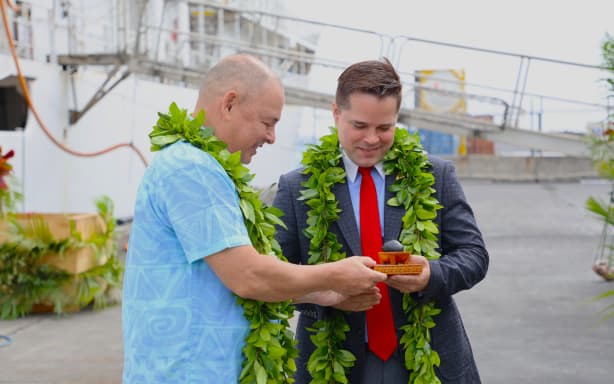
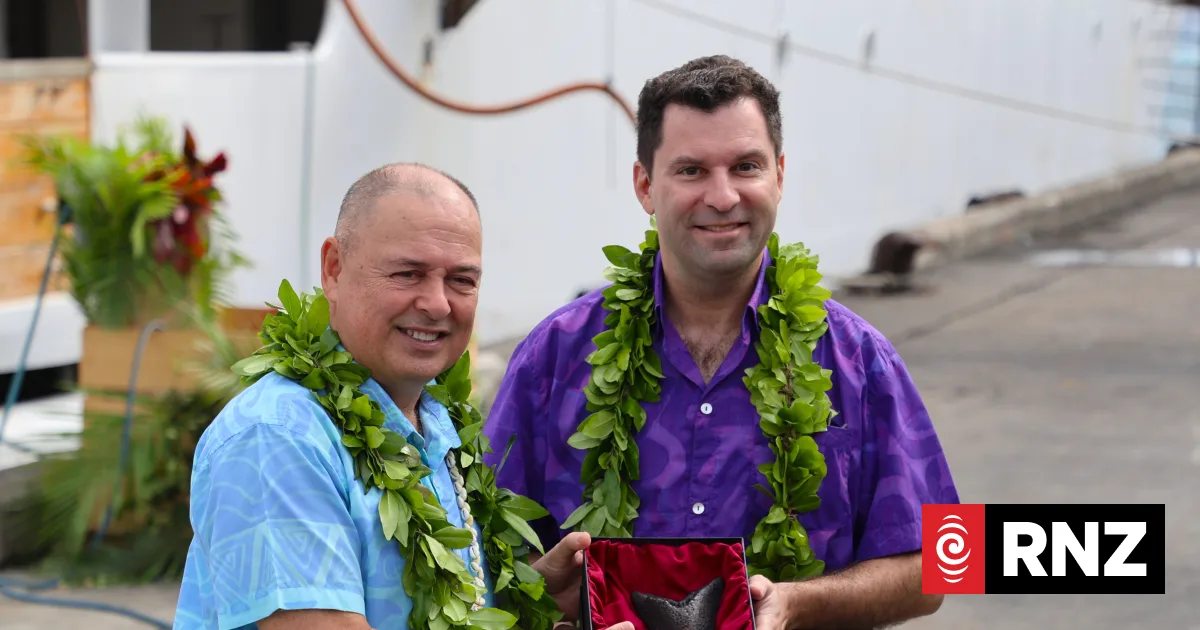
Gift exchange marking the end of the Okeanos Explorer’s 26-day expedition in the Cook Islands.
RNZ Pacific / Tiana Haxton
Cook Islands caretaker Prime Minister Mark Brown, fresh off a resounding victory in the country’s election last week, welcomed home the vessel and its crew.
“What has returned to these shores is more than a research vessel. It is knowledge,” he said.
Brown said the expedition showed how much remains unknown about the Cook Islands ocean.
He described it as a “humbling and inspiring” experience to sit alongside scientists as they sent an ROV, remotely operated vehicle, below the waves and watched its discoveries in real time on screen.
“It reminded me that, even as an ocean nation, there is still so much about our own waters that we are only beginning to understand, and that understanding matters.”
The new US Ambassador to the Cook Islands Jared Novelly said more than 60,0000 people around the world tuned in to the expedition’s ROV dives through live-streams.
“People around the world followed this expedition live. They watched scientists become genuinely excited about sand, rocks, and the occasional deep-sea creature that appeared surprised to be on camera. The discoveries were shared as they happened.”
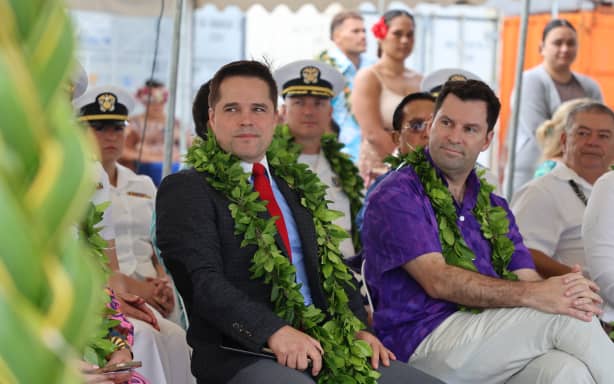
US Deputy Assistant Secretary Erik Noble and US Ambassador to the Cook Islands Jared Novelly.
RNZ Pacific / Tiana Haxton
Earlier expedition
The expedition builds on earlier work by the Okeanos Explorer that helped the Cook Islands establish its rights over a much larger area of seabed.
A Cook Islands public servant Joshua Mitchell said the vessel was instrumental in gathering evidence for the Cook Islands’ revised extended continental shelf submission to the United Nations.
In 2017, the Okeanos Explorer mapped unusual underwater ridges known as the Spurs, which extend from the Northern part of the Manihiki Plateau.
“The expedition was a resounding success. We sent the coordinates through to the Okeanos Explorer, and they mapped it thoroughly using sophisticated multibeam equipment. They even flew an ROV up and along the feature, broadcasting the high-definition footage in real time for all to see.”
“I’ll never forget sitting at my desk one day when Alan messages me and tells me to click on a link to follow the ROV expedition.
“What I saw unfold on my screen was just incredible: soft corals, invertebrates, and all manner of unusual sea creatures. The Spur was teeming with life, an amazingly diverse ecosystem some 4000 metres down in the deep.”
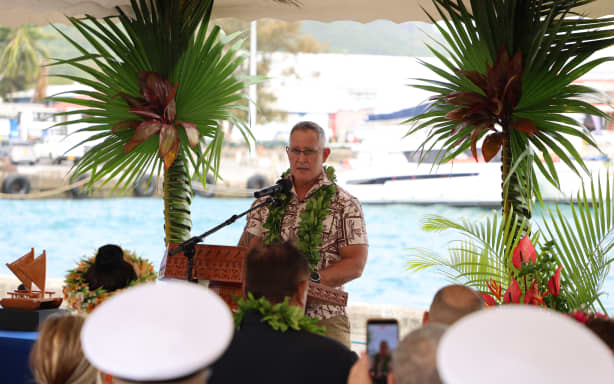
Long-service public servant Joshua Mitchell.
RNZ Pacific / Tiana Haxton
Mitchell said the information ultimately formed part of the Cook Islands revised submission to the UN Commission on the Limits of the Continental Shelf.
In 2025, the UN accepted the technical arguments and endorsed it’s claim, adding 396,900 square kilometres of extended continental shelf – and expanding the countrys total national jurisdiction to more than 2.3 million square kilometres.
Mitchell said this also makes the Cook Islands the first Pacific Island nation to finalise all of its maritime boundaries and extended continental shelves under the UN Convention on the Law of the Sea.
For him, the Okeanos Explorer returning to the Cook Islands for its most recent expedition is very special.
“She represents opportunity for people from two different nations working together for the betterment of both countries.
“She represents the importance of scientific knowledge to the ultimate expression of sovereignty in our maritime space, our Marae Moana, and she represents legacy from inspiring school kids in a classroom on a remote atoll to someday become marine scientists and researchers themselves.”
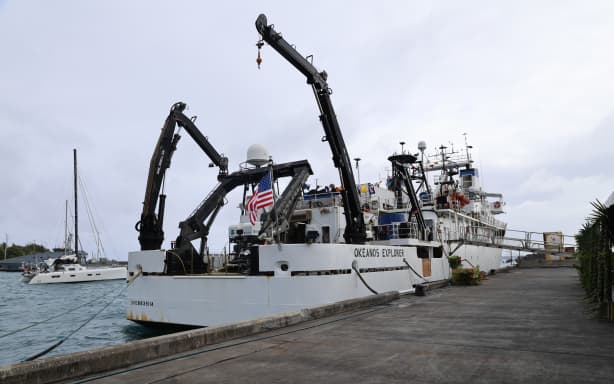
The NOAA’s Okeanos Explorer in Avatiu harbour, Rarotonga, Cook Islands.
RNZ Pacific / Tiana Haxton
Cook Islands Seabed Minerals Authority
The Cook Islands Seabed Minerals Authority commissioner Beverly Ataera said that having NOAA taking members of her team on board for the expedition has helped build local scientific capability.
“One of the things I particularly value about this expedition is that the Cook Islanders have not simply been observers… That capability that you shared with them will remain in the Cook Islands forever. This is how we build long-lasting capability.”
While there is significant concern in the Pacific Islands region about the potential environmental impact from deep sea mining, Ataera said the sort of knowledge gained in the NOAA expedition can only help better inform the debate.
She believes the value of the expedition lies not only in what it discovered, but what it allows the Cook Islands to do next.
“They help us to understand our ocean a little better. They help us to identify what we know and what we don’t know yet, and where we need to focus our efforts to learn a little more. And that matters enormously for us in the Cook Islands.
“If we are going to make good decisions about that ocean, those decisions must be grounded in good science and good information.”
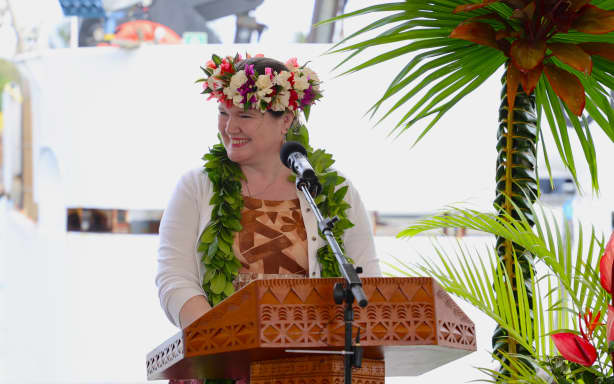
Cook Islands Seabed Minerals Authority Commissioner, Beverly Ataera.
RNZ Pacific / Tiana Haxton
Ataera concluded by reiterating that the information gathered must also be made accessible to Cook Islanders.
The expedition data, video logs and sample analysis will be processed and shared with the Cook Islands Government and wider scientific community.
