


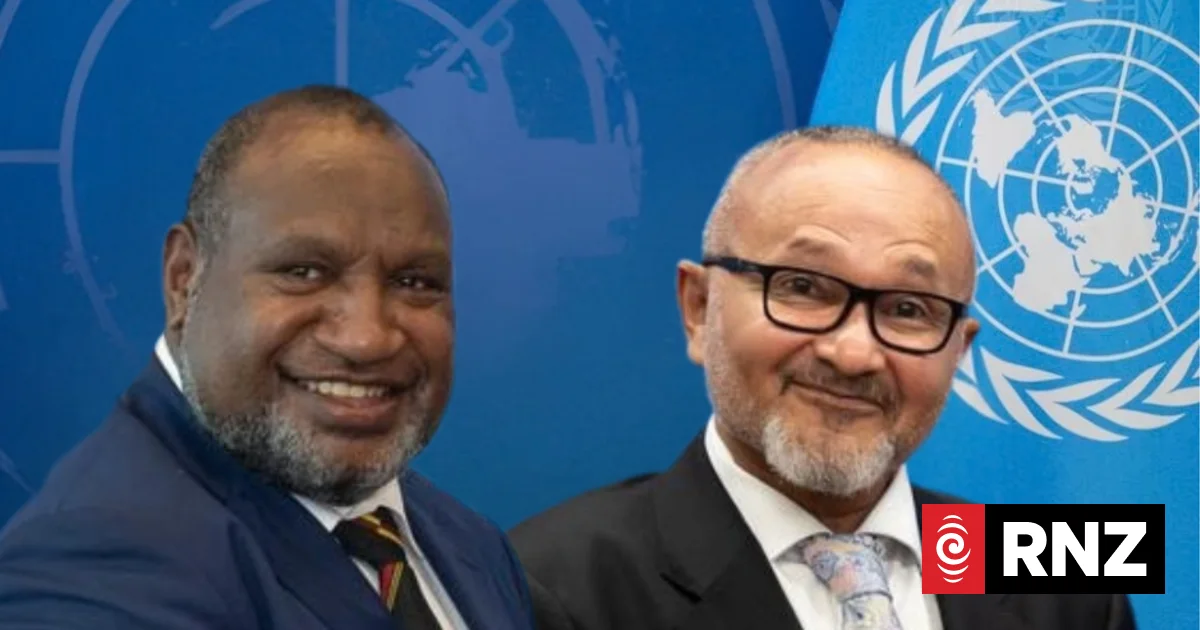
The leaders of Papua New Guinea and the Solomon Islands have issued a strong call to action to industrial nations and the international community ot act on the climate crisis.
Speaking at the United Nations General Assembly High-Level Plenary Meeting on Addressing the Existential Threats Posed by Sea-Level Rise, Papua New Guinea’s Prime Minister James Marape demanded industrial nations to stop the “empty promises” and cut their carbon emissions.
Papua New Guinea’s prime minister James Marape speaks at the UN General Assembly High-Level Plenary Meeting on Addressing the Existential Threats Posed by Sea-Level Rise, 24 September 2026.
PNG PM Media
Marape urged the biggest economies to do more to mitigate the impact of sea-level rise threats for PNG and Pacific small island states.
He expressed deep frustration with what he described as empty promises from industrialised nations.
He said that, while climate conversations have remained at the forefront of international diplomacy, actual mitigation from big polluters has been minimal.
“Stop your carbon emissions. We must secure our planet and our future,” Marape said.
“There is only one planet for all of us. Rich or poor, big or small, powerful or not powerful, it does not matter. If we destroy this planet, we pass a ruined world to our children. Sea-level rise is here amidst us, and we must act now. It is enough of talking,” he said.
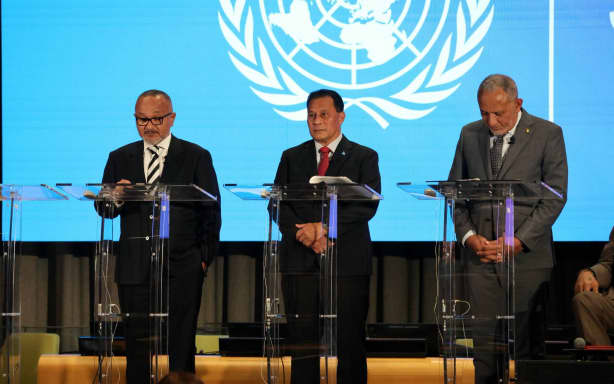
Solomon Islands Prime Minister Matthew Wale (left) urging climate action at the UN Secretary-General’s Climate Action Summit on ‘Just Transition’ at the Trusteeship Council in New York, 23 September 2026.
Solomon Islands PM office
Meanwhile, Solomon Islands Prime Minister Matthew Wale said the time for climate promises is over, urging real action from the international community.
Wale made the comments while addressing the UN Secretary-General’s Climate Action Summit on ‘Just Transition’ at the Trusteeship Council in New York.
He called for grant-based, predictable and accessible finance that turns climate commitments into resilience on the ground.
Wale said the Solomon Islands contributes less than 0.0015 percent of global greenhouse gas emissions, yet communities regularly face threats from rising seas, king tides, saltwater intrusion, cyclones, droughts and extreme rainfall.
“Solomon Islands did not cause this crisis, yet we bear its consequences every day,” the prime minister said.
According to Wale, vulnerable countries like his were being forced to make difficult choices between climate action and essential development priorities, including education, health, food and water security and infrastructure.
“Climate finance must be grant-based, predictable and accessible, aligned with national priorities and without adding to the debt burden of vulnerable countries,” he said.
“The time for promises is over. Commitments must become finance, and ambition must become resilience on the ground.”
