


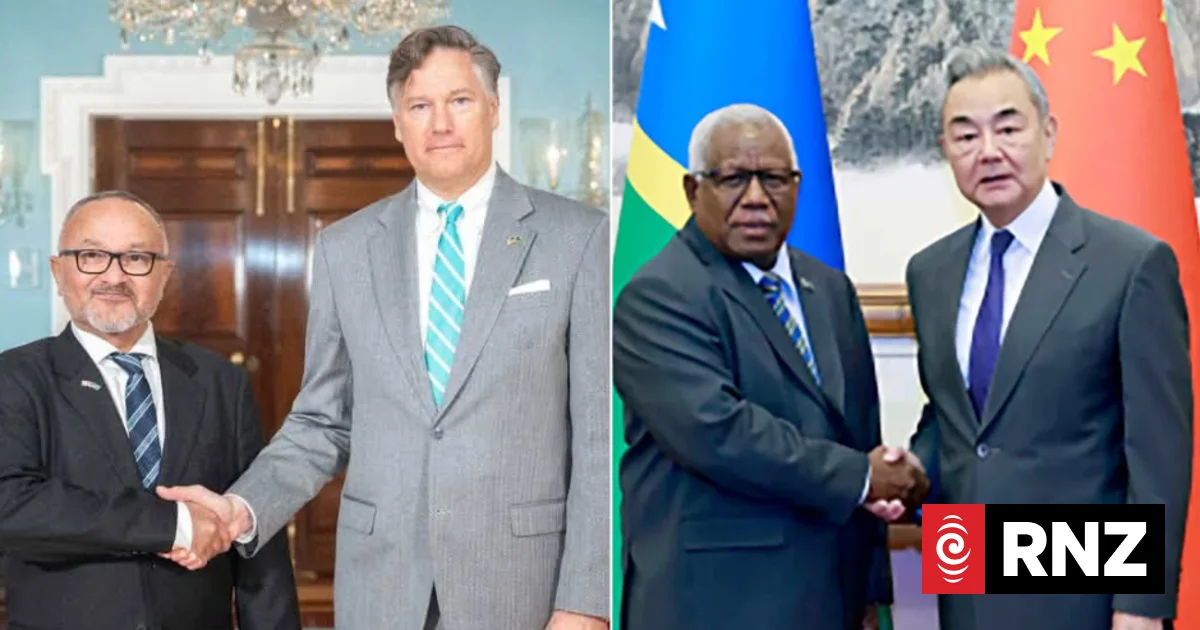
Two recent official trips by Solomon Islands’ leaders leave no clues as to where their preference currently leans: China or the West.
A visit by Solomons Prime Minister Matthew Wale to Washington DC wraps up this week, off the back of a visit by Foreign Minister Rick Houenipwela to Beijing last week.
Houenipwela met with China’s top diplomat Wang Yi, while Wale only met with the US’ second-top diplomat, Christopher Landau.
With China, its signed an agreement that frames negotiations for expanding trade and facilitating investment by Chinese firms in Solomon Islands.
The Chinese Embassy in Honiara described it as “a new chapter” in the relationship between the two countries, which went formal after Honiara ditched ties with Taiwan in 2019.
“This agreement will deepen cooperation in trade, investment, industrial and supply chain development, creating new opportunities for sustainable growth and common prosperity,” a statement read.
In the meantime, a Ship Rider Agreement will be signed in Honiara next week that allows the US Coast Guard into Solomon Islands waters, alongside local police.
Wale’s office said the agreement was expected to strengthen joint maritime enforcement and surveillance efforts.
“[Wale] highlighted the urgent need to enhance security across the Pacific region … he emphasised that the Pacific has become a growing transit route for illicit activities.”
Wale also walked away from his talks with Landau with a US$6 million sweetener to remove unexploded ordnances (UXO) left in the Solomons from World War II.
Meanwhile, Landau promised that the US Peace Corps, an agency facing massive budget and staffing cuts, would return to Solomons’ shores to help out with “community-based development, capacity building and cross-cultural exchange”.
The 2000 coup d’état in Solomon Islands and surrounding ethnic tensions forced the evacuation of active Peace Corps volunteers, suspending a programme that had seen more than 700 Americans serve in the country over nearly three decades.
Wale pronounced a “foreign policy reset” shortly after taking office two months ago, holding talks with Australia in his first overseas trip as prime minister, and speaking positively about the prospect of a regional security deal with Australia.
His government maintained its “commitment to strengthening relations with all international partners.”
