


By foreign affairs correspondent Stephen Dziedzic, ABC
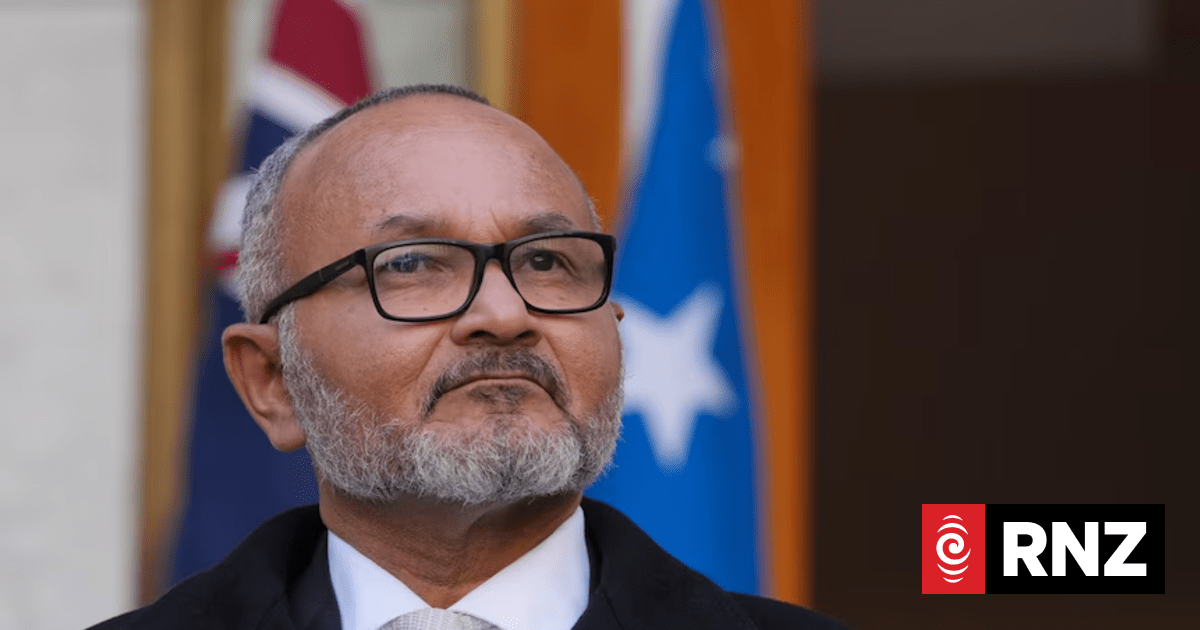
Matthew Wale (left) has agreed to start treaty negotiations with Australia.
Photo: ABC News / Adam Kennedy
In short:
- Australia and the Solomon Islands have agreed to begin negotiations on a new treaty.
- The new Solomon Islands prime minister, Matthew Wale, says he wants to “reset” the relationship with Australia.
What’s next?
- Wale has confirmed his government will review a security pact signed with China in 2022.
The new Solomon Islands prime minister has made a clear pivot towards Australia, agreeing to kickstart negotiations on a comprehensive treaty with Canberra and promising to “review” the Pacific nation’s contentious security agreement with China.
Matthew Wale declared he wanted to “reset” the relationship with Australia after sitting down for talks with Prime Minister Anthony Albanese in Parliament House.
Solomon Islands had been on the front line of strategic competition between Australia and China in the Pacific ever since it signed a sweeping pact with China in 2022.
Wale had been a fierce critic of that pact when it was signed, but has softened his tone in recent years.

Matthew Wale says he will “review” the security pact with China.
Photo: ABC News / Adam Kennedy
He told journalists in Canberra he would “review” the agreement now he was in power, although it was not clear how formal or informal that process would be.
“We are going to be reviewing [it] as we are reviewing other security agreements that we have with many other countries,” he said.
When asked whether he would stick by his pledge to make the agreement public, he made the extraordinary admission that he was not even able to get a copy until just before he left, more than two weeks since taking the top job.
“I’ve had to remove certain people from key positions. I haven’t been afforded a copy, even, of that agreement until a day before I left, so I haven’t had a good look at it,” he said.
Wale said he had been “praying and fasting” about what to do with the security agreement, but could not make it public immediately because it had a non-disclosure pact within it.
“I’ve had a look at it, I’ll be honest with you, but I haven’t had a good look at it … cabinet will need to have a look at these things,” he said.
“There is a non-disclosure clause in it, so I couldn’t show it to you right away.”
Push to curb China influence
In their joint statement, Wale and Albanese also reaffirmed that “Pacific peace and security is best led and handled by the Pacific”.
It is language often used by Australia as part of its push to curb China’s security ambitions in the region.
The two prime ministers said officials from both countries would now begin negotiations on a “comprehensive” new strategic treaty between the countries, which would bring “transformational change in the relationship” and see a “significant enhancement of the bilateral development assistance partnership between the two countries”.

Matthew Wale says he will “review” the security pact with China.
Photo: ABC News / Adam Kennedy
Australia has already struck a host of strategic agreements with Pacific nations in recent years, including a treaty with Papua New Guinea and sweeping pacts with Tuvalu and Nauru.
Some of those agreements have effectively given Australia veto rights over security decisions and limited Chinese investment in critical infrastructure.
Neither leader would be drawn on whether the treaty might cover similar ground.
Albanese said the two countries would “work through” those issues in negotiations.
“It will be one which identifies our mutual trust [and] respect for each other, the sovereignty of both of our nations as we go forward,” he said.
“We have said very clearly we want Australia to be the security partner of choice in our region.
“And we want the Pacific family to look after our security in this region.”
Wale was vague but said “the first reference point in these matters is within the region” and that it was “very important going forward”.
“That’s the direction we want to take,” he said.
Solomon Islands has also agreed to sign a long-stalled MOU on taking part in the Pacific Policing Initiative and push ahead more rapidly with the delayed $190 million policing agreement signed by Albanese and Wale’s predecessor, Jeremiah Manele.
Australia has also agreed to provide around $35 million to the Solomon Islands to help it deal with the impacts of Tropical Cyclone Maila and rising global oil prices.
Free education likely to be part of treaty negotiation
Pacific expert Tess Newton Cain, an adjunct associate professor at the Griffith Asia Institute, said that Mr Wale’s push for free education would “undoubtedly be top of his agenda when discussing enhanced bilateral assistance” during treaty negotiations.
“There will be an expectation within the Solomon Islands that a strategic relationship/treaty will include improved access to Australia for Solomon Islanders [beyond labour mobility] and this will almost certainly be a sticking point for Australia as it was when working with Vanuatu,” Dr Newton Cain said.
“The Nakamal Agreement [with Vanuatu] has taken a long time to negotiate because of Vanuatu’s concerns over sovereignty, and it would be surprising if similar concerns did not arise in the context of Solomon Islands. In fact, it would be a concern if they did not.”

Experts say Mr Wale is likely to ask for free education as part of the treaty negotiation. (ABC News: Adam Kennedy)
Photo: ABC News / Adam Kennedy
Dr Newton Cain said Wale’s reference to “praying and fasting” over the China security treaty reflects that it is something he wants to take seriously and give appropriate time and consideration to.
“He knows it is important to external partners, such as the PRC and Australia, but he doesn’t want it to become a problem when it comes to delivering on the domestic agenda, for example, by rupturing the coalition,” she said.
Connor Graham from the Lowy Institute said he thought Wale’s promise to “review” the 2022 security was “probably pretty standard procedure”.
“If you imagine coming in as a new government and there’s a secret security pact you’ve never been allowed to read, you’d probably be wanting to go over it,” Dr Graham said.
Dr Graham said he doubted Wale would be open to ripping up the agreement, but said he might contemplate modifications.
He said the new treaty negotiations were “a great sign for Canberra that the relationship reset is underway”, but warned Wale was not going to ditch China as a key development partner.
“Australia should be pleased with this opportunity to firm up the partnership with Solomon Islands and rebuild the mutual trust upon which lasting relationships are built,” he said.
-ABC
