

Luca Tu’avao Walton’s exhibition at Fibre Gallery draws on the nostalgia of island life.
“I think there’s something really special about having a first show as a Pasifika artist and being able to decide what that world looks like for yourself,” he said.
In the heart of Ōtautahi Christchurch, the Fibre Gallery is a hub committed to the visibility of Pacific artistry since it opened in 2022.
On 21 August, Walton – otherwise known as @lucidluca – transported crowds back to the islands with the opening of his first exhibition at Fibre Gallery, Between Tree and Tide.
The exhibition was not built around a traditional, grand artistic statement, he said.
Luca Tu’avao Walton reimagines the traditional gallery exhibition through a Pacific lens.
Luca Tu’avao Walton / Johnny Knopp
“The whole concept actually comes from a very specific childhood memory. I remember lying on a mat on the grass at my aunty Nau’s house with my cousins, underneath the shade of her great big mango tree,” Walton said.
“It would be late afternoon so there would be these dancing shadows cast across the mat and grass by the foliage above, the patterns of the mat pressed into my skin. There was the heat, the shade, the plants, the sound of people talking, the feeling of being completely comfortable and safe somewhere familiar.
“It’s such an ordinary memory, but it’s one that has stayed with me … the exhibition grew from wanting to recreate that feeling.” Walton said.
Walton previously told RNZ that the nostalgia of island life is central to his work, something that has made him particularly distinctive, and a key drawing point for the communities who engage with his mahi (work).
In turn, Walton has become increasingly popular across Pacific communities.
“The artworks are essentially my little dreamworld. I’m interested in creating images that feel idyllic and nostalgic but are still grounded in things I actually know and recognise,” Walton said.
“A lot of the women I draw look like people I know. They’re based on friends, family, women I’ve grown up around, or people who just feel familiar to me.”
Last year, one woman approached Walton, to say she had cancelled a plastic surgery because of the representation in his art work, instead embracing her “wide-set nose”.
“Our people are such yearners, such sentimental people, and we’re all family orientated.
“I feel there is a real hunger for work that feels familiar and is made with alofa and ‘ofa. People can tell when it’s made from within the culture, not just about it.”
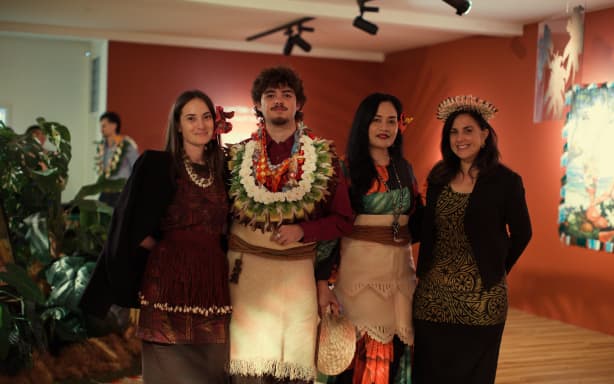
Luca Tu’avao Walton reimagines the traditional gallery exhibition through a Pacific lens.
Luca Tu’avao Walton / Johnny Knopp
He explained it as an unreal feeling to curate and witness the opening of his first exhibition, one that truly reflects and pays homage to his island upbringing.
“It still feels a little surreal to say as it felt like it was a long time coming. Most of my practice up until this point has existed outside of the traditional fine arts institution. I’ve worked primarily through illustration, digital art, children’s publishing, apparel, commissions, collaborations, public art and online communities,” Walton said.
“So this was the first time I had brought everything together into a physical exhibition and had to really think about what I wanted that experience to be.”
A Pacific approach
Walton’s exhibition is far from traditional – it reimagines the traditional exhibition through a Pacific lens.
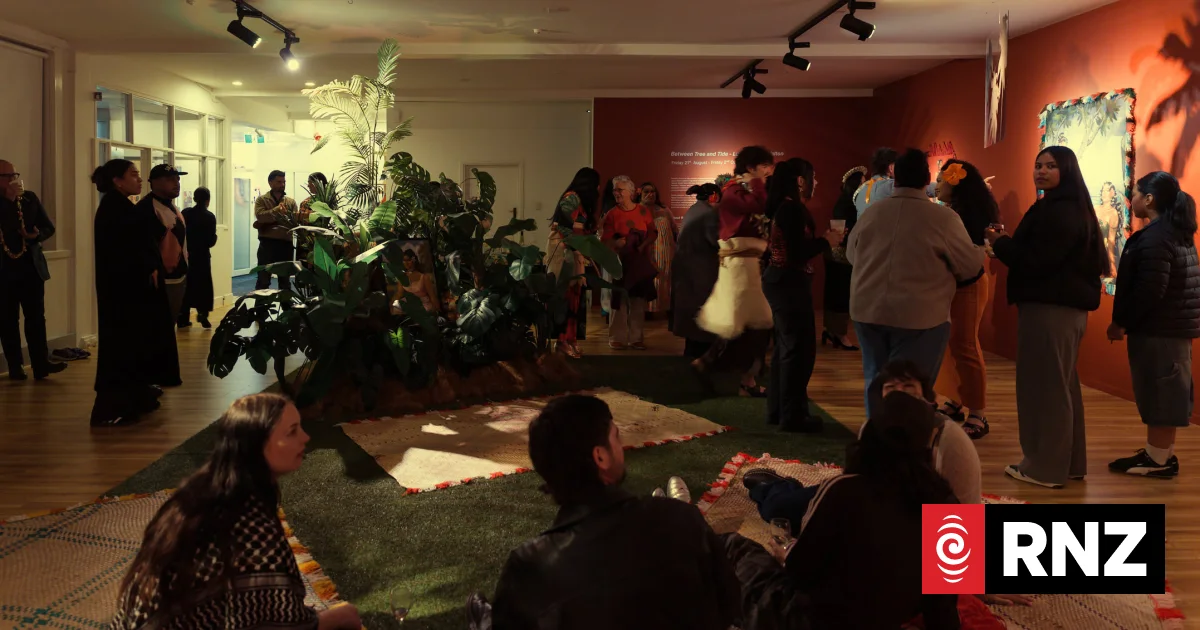
For example, visitors stepping into the gallery are met not by a traditional white-walled space, but by a tropical lawn, fala kulasi, mats adorned with yarn trim, Tongan music, and a warm room painted a deep red, designed to evoke feelings of home.
There were these sheets of clear acrylic, hand painted tree silhouettes of significance to my childhood, a lesi or papaya tree from my backyard by the water tank, some banana, lots of coconut trees, breadfruit,” Walton said.
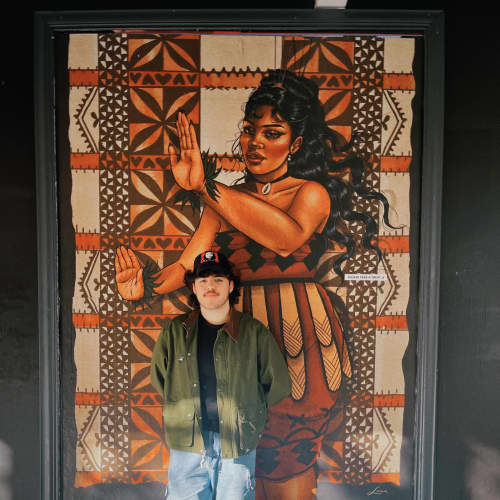
Luca and his mural
Luca Walton, Artist
“We put spotlights through them to cast shadows onto the lawn and around the art work, these were dreamt up early on as I knew this would bring even more immersion to this memory.”
“The fala kulasi were also the reason I started making the yarn frames around the artworks specifically for this exhibition. The colours from the artworks bleed out into the yarn, so the frames become part of the work rather than just something that contains it,” Walton said.
“I hand-cut and hand-knotted around 2,000 give or take individual pieces of yarn for every single work in the exhibition. That was an enormous amount of labour, but the labour itself was important.
“The yarn work is a tribute to the women back home who create traditional fibre textile art and make koloa, treasures, for their families. There is so much patience, skill, time and loveembedded in that kind of making. I wanted some of that to exist physically within the exhibition,” he added.
And alongside the traditional servings of wine and beers were servings of ‘otai and fresh fruit.
“That was important because hospitality is such a huge part of how I understand gathering. I didn’t want to recreate what I thought an art opening was supposed to be. I wanted the opening to feel familiar to me,” Walton said.
“I want people to get comfy on the floor. To gossip. To laugh. To stay.”
For the artist, whose work has largely existed online through a thriving he describes as his “digital village”, the exhibition exists as a physical love letter to whānau, the reoccuring themes of nostalgia and memory, and most importantly – wāhine.
“So much of what I am, the way I see beauty, the memories I have, the culture I carry and the way I make things comes from the women who came before me, and especially my mum,” he said.
“She, her sisters and my grandma are as much the artist as I am.”
The exhibition will run through until 2 October.
