


In June 2025, the PNG government removed tax from ten basic food items (rice, flour, tinned fish, tinned meat, chicken, noodles, biscuits, cooking oil, tea and coffee), with the aim of easing cost-of-living pressures on poorer households. To date, this policy has cost PNG almost half a billion kina in foregone revenue. In a new World Bank Working Paper we traced who benefited from this tax cut. Of every kina the government gave up, only about eight toea (there are 100 toea in a kina) reached the poorest 20% of households. Stores and wholesalers kept 36 toea. The richest 40% of households received almost 40 toea.
So why didn’t the poorest households benefit more? For three reasons. First, they largely grow their food rather than buy it. Second, the purchases they do make are mainly from informal (that is, unregistered) stores such as canteens and tuckerboxes, which do not charge tax. And third, they rarely shop at stores that face enough competition to force them to pass a tax cut on to customers.
We draw on four distinct sources of data to show this. First is monthly supermarket prices collected by the National Statistical Office (NSO) and the Bank of PNG, second is a census of prices in every formal supermarket in Port Moresby collected by a team from UPNG, third is weekly prices scraped from the two chains that sell food online, and fourth is a monthly, nationally representative phone survey of around 1,000 households implemented by Digicel in partnership with the World Bank.
We find that in Port Moresby supermarkets, prices of the basic food items subject to the tax cut fell almost immediately, relative to comparable foods that stayed taxed (Figure 1). This happened without heavy-handed enforcement requiring stores to cut prices. Why? We show this is primarily due to competition. In central Port Moresby, where the nearest rival supermarket is on average about 150 metres away, stores passed on the full tax cut immediately. Elsewhere in the city, supermarkets initially passed on about two-thirds. The pattern even holds within the same chains.
Figure 1: Prices of food items subject to the tax cut and comparison food items in Port Moresby supermarkets (May 2025 = 1)
In contrast, outside formal urban stores almost nothing changed. Formal stores are registered businesses, such as supermarkets, that charge tax; informal stores — canteens and tuckerboxes — sit outside the tax net. Our nationwide phone survey finds pass-through of over 80% in formal stores in urban areas, but little or no price change in informal stores anywhere, or in formal stores in rural areas.
Over the nineteen months the tax cuts are currently expected to be in place for, it will cost the PNG government around K600 million. Only around K50 million of that reaches the poorest 20% of households, whereas the richest 20% receive around K145 million and stores and wholesalers retain about K215 million (Figure 2). As a simple benchmark, paying the same K600 million as a cash transfer to every household in the country, with no targeting at all, would deliver K120 million to the poorest 20%. Alternatively, for the same money, the PNG government could scale up nationally the child grant program it piloted in 2025, which would provide a monthly cash payment to all families for the first five years of every child’s life.
Figure 2: Share of foregone tax revenue accruing to each household quintile and to stores, actual versus expert predictions
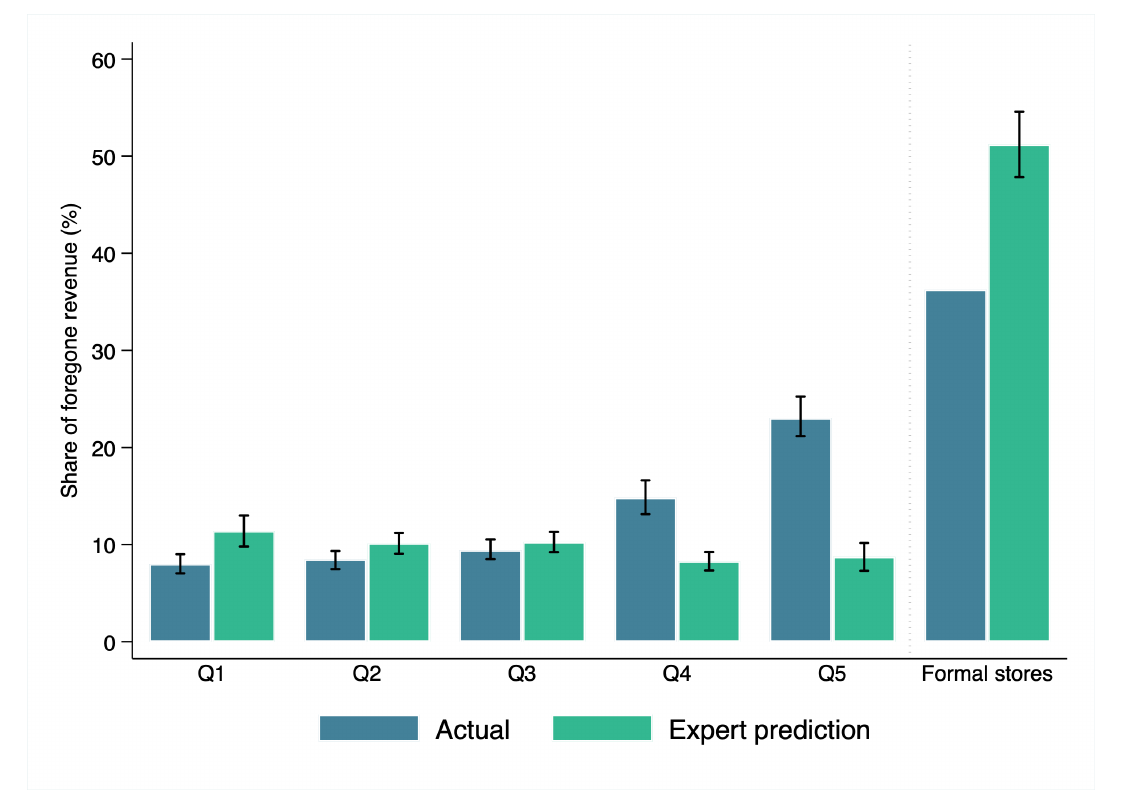
None of these results was anticipated by experts. Before the results were in, we asked 237 economists and policy specialists across the globe, including in PNG, to predict them. Experts thought stores would keep half the foregone revenue and the rest would be shared roughly evenly across households, with the poor doing slightly better (Figure 2). They underestimated how competitive Port Moresby’s supermarkets are and overestimated how far prices would move everywhere else.
Who benefits from this policy was also misunderstood by the general public. In the April 2026 round of the phone survey, we asked people to select which, from six policy options on the government’s agenda, would do the most to support poor and middle-class households. More than 70% of households ranked a tax cut on food first or second. But this support is shallow. In the following month’s survey, a randomly selected group of respondents were told that the price cuts were concentrated in the big urban supermarkets where richer households shop. Among these households’ support for the tax cuts fell sharply.
There are three takeaways for PNG policymakers, who must decide in the coming budget whether to extend the tax cut beyond the end of 2026.
First, the tax cut worked where it could. Prices fell in Port Moresby supermarkets without heavy-handed enforcement, which is more than what most experts expected. But it cannot reach most households who grow their own food and buy the rest from a canteen or tuckerbox, and that is a feature of PNG’s economy.
Second, the money would do far more for poor households as a cash transfer. Another year of the tax cut costs around K400 million and delivers roughly K32 million to the poorest fifth. Even providing the K400 million as a cash transfer to every household, with no targeting at all, would put about two and a half times as much money in the hands of the poor. The child grant the government has already piloted is the natural way this could be implemented.
Third, the politics are harder than the economics but easier than the headline popularity suggests. A slight majority of households would rather the money went elsewhere, and support for the tax cut falls once people learn who benefits. The government can make the case that the tax cut reached shoppers in urban supermarkets, who are mostly better off. A cash transfer can reach a rural family that grows its own food and buys a few essentials from a canteen — even one that is imperfectly targeted.
The World Bank Working Paper described in this article was co-authored by its authors together with Matias Strehl-Pessina, a PhD student at UC Santa Barbara, and Ruggero Doino and Darian Naidoo from the World Bank.
