

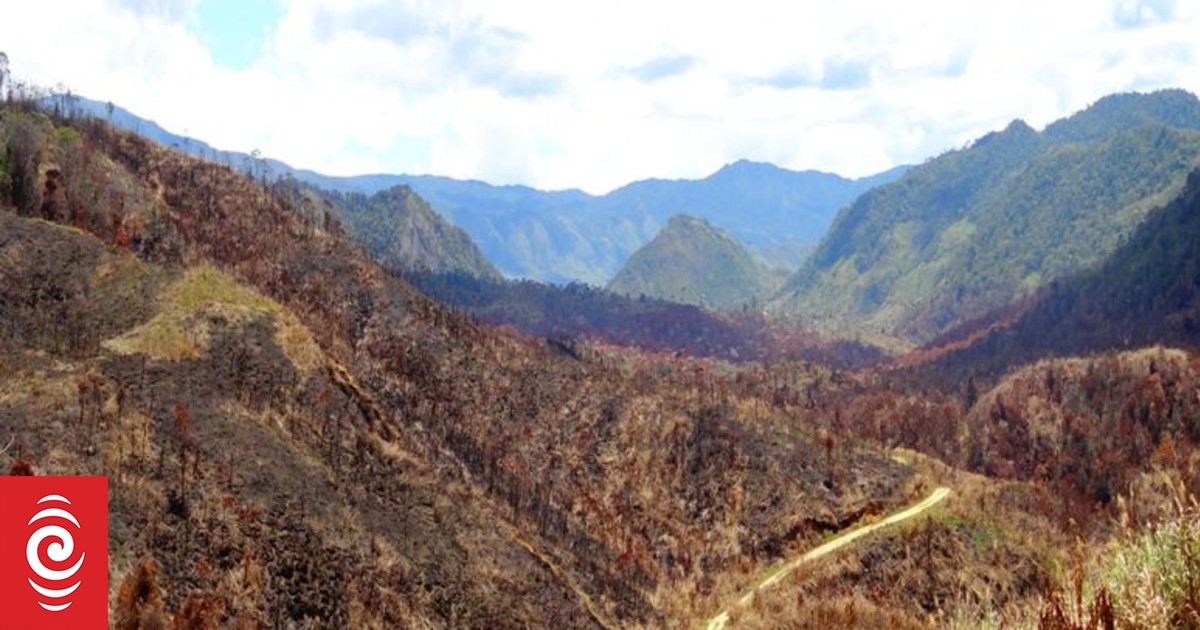
Yahoma, Kandep Valley, Enga Province, Papua New Guinea
Photo: Supplied
Papua New Guinea is being urged to prepare for El Niño – a cyclical weather event that develops over the Pacific and brings disruptive conditions.
Scientists have been advising that the Pacific region can expect a significant El Niño event in mid-2026 from this month.
An El Niño phase typically creates more than usual rainfall in the central Pacific Islands region, but less rainfall – and more drought – in the western Pacific incuding PNG.
East Sepik governor Allan Bird told fellow PNG MPs during last week’s Grievance Debate in parliament that it was not something to be taken lightly.
“I am using this opportunity to place the government on notice, and to request the Prime Minister and his front bench to start taking a serious look,” Bird said, adding that serious impacts can be expected.
“This is nature, and nature is giving us an indication that it’s coming, and it would be wise for us to taker note and for us to get ready for it when it does occur.”

Oil Palm damaged by drought, Ramu Valley, Papua New Guinea, September 2015.
Photo: Rebecca Robinson
Food security threat
An agricultural scientist and geographer and a specialist in PNG agriculture, Dr Mike Bourke of the Australian National University, warned that El Niño events could have signicant impacts on food sources in PNG.
He said previous events had brought weather impacts generally unexpected in parts of the region – including crippling drought and frost.
“That is to say, a lot of forest burning, a lot of deaths, and a lot of really things you just don’t expect, [for instance] forests where you get 4000 millimetres a year of rain and on fire, things that are just outside everyone’s experience,” he explained.
Dr Bourke said the worst El Niño phases had wiped out crops in various parts of PNG, leading to critical food shortages.
“So, back in 1997 we had an increase in the death rate in five different locations. The common denominator was not the food or the language they spoke or anything else. The common denominator was remoteness and no money, no way to buy your way out of trouble by buying food from other people or more likely imported rice.
Is PNG prepared?
The MP for North Bougainville Francesca Semoso said that fresh off the back of devastating Tropical Cyclone Maila, Bougainville’s people are bracing for some more devastating weather patterns.
She said people of her region were hearing this El Niño could be comparable to some of the worst PNG has had in living memory.
And Oro Province governor Gary Juffa said scientists were warning this El Niño could turn out to be possibly the worst in human history.
“So, how are we preparing for that? How are people going to be ready for that? They’re already facing the impact of climate change and global warming,” Juffa said in the Grievance Debate.
“They’re already talking about how the seasons are changing in such a way that they are starting to get confused as to when they would plant their crops and harvest them, etc.
“It’s happening: rising sea levels, coastal shores being washed away, islands and islets being affected, becoming saliated, so they cannot plant crops anymore.

Some PNG communities experiences starvation and malnutrition during drought in 2016
Photo: RNZI/ Courtesy of Sally Lloyd
“I would recommend that the government put significant effort and attention into preparing all provinces, so that all provinces can build disaster management centers.
Juffa said they are doing that in Oro Province and have allocated funds to build a provincial disaster management centere.
“But I want to encourage our government – we will need help to prepare for what’s going to be happening.”
The government said it plans to establish a National Emergency Authority for responding to natural disasters.
The US National Weather Service says it expects the El Niño to form this month, although there is still substantial uncertainty about how strong it will be.
