


PLEA:
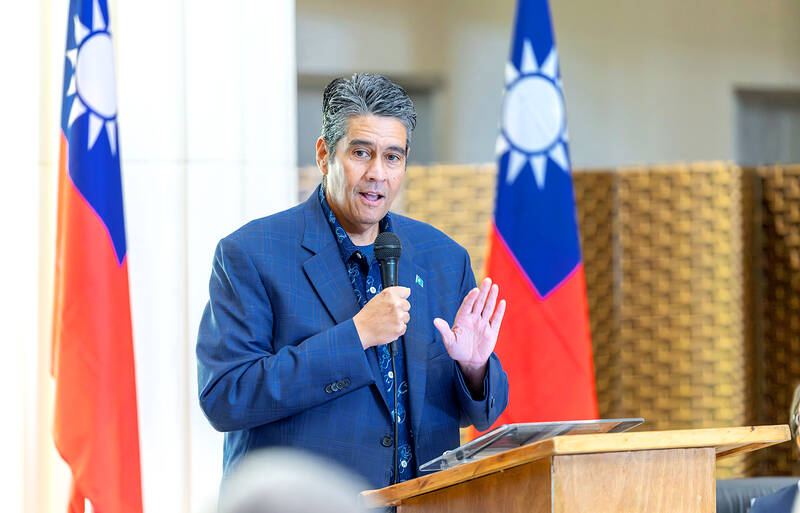
‘If Taiwan’s sovereignty is not recognized, then who are we to say that we’re sovereign? Might as well eliminate all small countries,’ the Palauan president said
Palauan President Surangel Whipps Jr expressed strong support for Taiwan during Vice President Hsiao Bi-khim’s (蕭美琴) visit to the Pacific ally, saying on Sunday that failure to recognize Taiwan’s sovereignty would call into question the sovereignty of all small countries.
“If Taiwan’s sovereignty is not recognized, then who are we to say that we’re sovereign? Might as well eliminate all small countries,” Whipps said at a welcoming dinner for Hsiao in Koror, Palau’s largest city.
“We have to stand up for freedom. We have to stand up for democracy, and we have to stand up for the rule of law,” said Whipps, whose country is one of Taiwan’s 12 official diplomatic allies worldwide and one of three in the Pacific.
Photo: Screen grab from the Presidential Office’s Flickr page
Taiwan is “a prosperous and growing nation” that has demonstrated leadership in healthcare, technology, aviation and other fields, and should be included in international discussions, he said.
“Taiwan needs to be a part of these discussions. They need to be a part of the UN, they need to be a part of WHO, they need to be a part of ICAO [International Civil Aviation Organization],” he said.
Whipps said he was asked about “the Taiwan question” during a visit to Japan last week, and had told Japanese media that Palau’s relationship with Taiwan is “strong and getting stronger.”
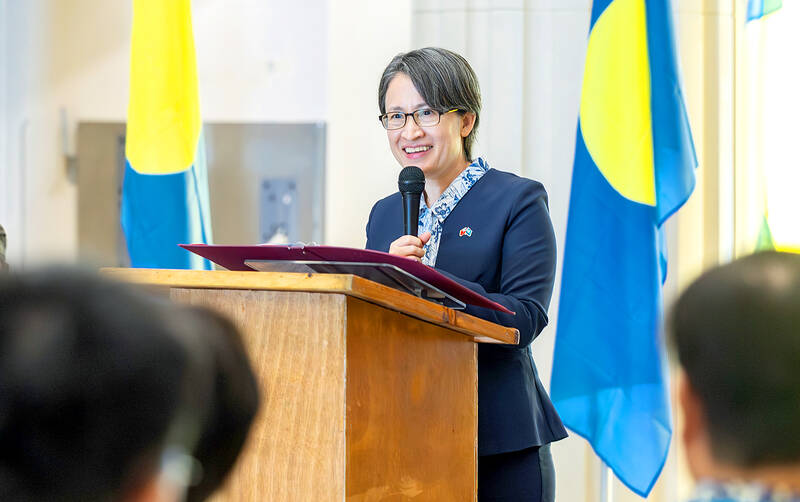
Photo: Screen grab from the Presidential Office’s Flickr page
That relationship, he said, is based on shared interests, support for a rules-based world order and “a free and open Indo-Pacific.”
Hsiao said President William Lai (賴清德) had given her three assignments for the Palau visit — to deepen friendship between the two peoples, encourage more Taiwanese tourists to visit Palau and visit projects that demonstrate bilateral cooperation.
“The Pacific Ocean doesn’t separate us. Instead, it connects us,” Hsiao said, adding that it connects the two countries’ cultures, peoples and ideas.
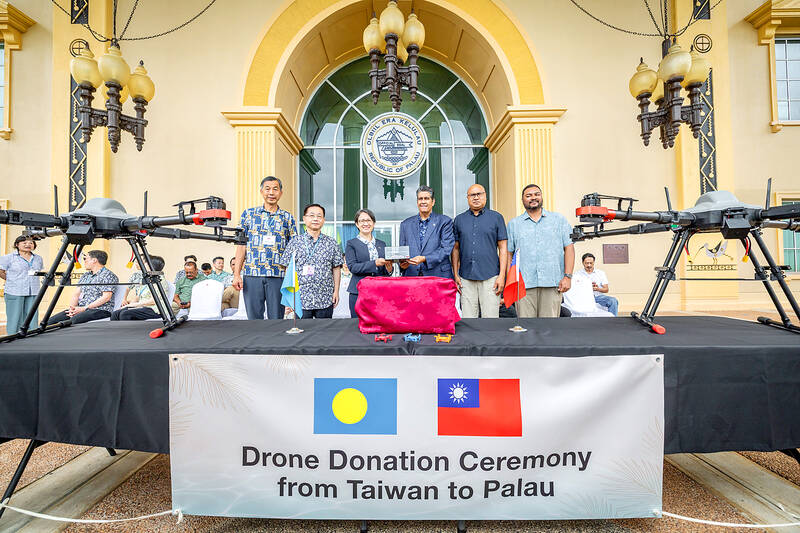
Photo: Screen grab from the Presidential Office’s Flickr page
Hsiao’s itinerary yesterday included an address to the Palauan National Congress in Ngerulmud, Palau’s capital, during which she said Taiwan is preparing to assign Investigation Bureau personnel to the Pacific ally to help it combat transnational crime, including fraud and cybercrime.
“As our societies become increasingly interconnected, new security challenges also emerge,” Hsiao said.
Fraud, cybercrime, money laundering, drug trafficking and other forms of transnational crime “threaten communities across the Pacific,” she said.
Taiwan is committed to being a “trusted partner” in improving law enforcement cooperation, and safeguarding the security and well-being of people in both countries, she said.
“To further deepen this cooperation, I am honored to announce that Taiwan’s Ministry of Justice Investigation Bureau is prepared to assign personnel to Palau to work closely with relevant authorities here and jointly address the growing challenges posed by cross-border crime,” Hsiao said.
Whipps welcomed the announcement, saying that the investigators from Taiwan would “work alongside our law enforcement.”
“We must be realistic: There are those who continue to attempt to bring drugs and organized crime into Palau, and the language barrier is a genuine obstacle,” he said, without elaborating on what he meant by “language barrier.”
“Your support is invaluable. This partnership makes Palau safer, and I am deeply grateful,” he said.
Last year, a US think tank said that China was using transnational criminal organizations to advance its political agenda in Palau.
Whipps himself has “pointed to crimes linked to China, including scamming, illegal casinos and cyberattacks,” the BBC reported in November last year.
Later in the afternoon, Hsiao and Whipps attended a ribbon-cutting ceremony for a Taiwan-backed cross-state road project in Ngchesar State, where she said roads built with Taiwan’s assistance now account for about 68 percent of Palau’s land transportation network.
The two also witnessed a donation ceremony in Koror for four Taiwan-made multifunctional drones, which Hsiao said could help Palau bolster its disaster response, medical logistics and maritime search-and-rescue capabilities.
