


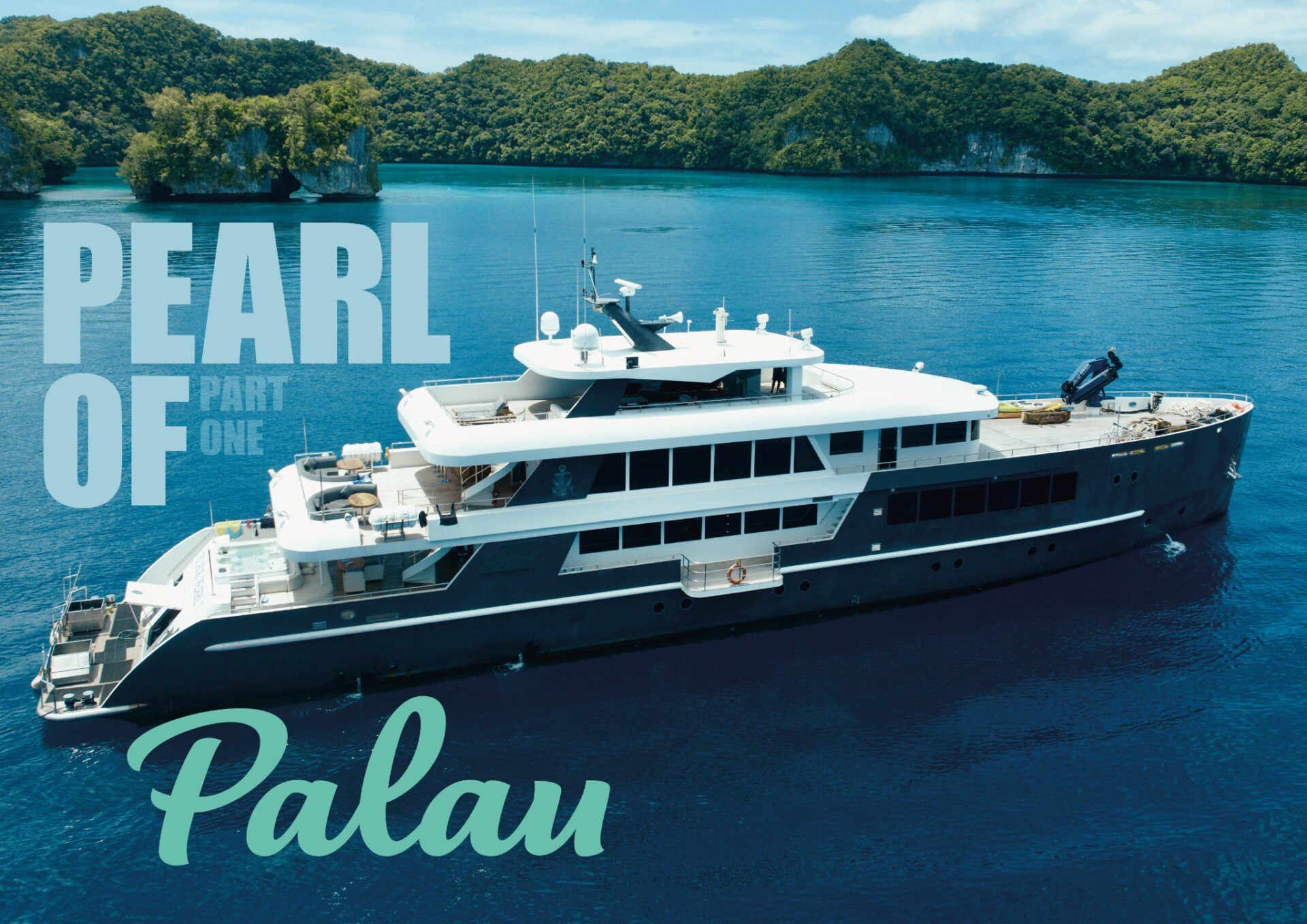
Adrian Stacey continues his liveaboard adventure
in Palau aboard the luxurious Black Pearl
The second half of my journey through Palau onboard the luxurious Black Pearl started in spectacular fashion. We returned to Blue Corner for an early morning dip and were rewarded with an epic dive.
This is one of those sites where you can dive repeatedly; each time, it will be different and quite often spectacular. We had a mid-strength current on this occasion, so on arrival at the plateau, we hooked onto the reef and waited for the show to start. It did not take long.
Along with the jacks, barracuda and snapper schools, we witnessed some interesting animal behaviour. First, a large Napoleon wrasse took exception to a grey reef shark getting too close and harried the shark out of the area.
Then later in the dive, two marble grouper had a stand-off, presumably over territory. The action kept coming for the entire dive, with plenty of sharks, turtles and schooling fish smothering the reef.
This was followed by a dive at the Virgin Blue Hole before the Black Pearl upped anchor and set off north towards the famous Jellyfish Lake.
The lake was once full of millions of golden jellyfish. Unfortunately, numbers have declined drastically since 2016, and now almost none are left; the exact reason is unclear, but some scientists believe drought and warmer temperatures may have played a part.
The government closed the lake to visitors for two years to give the jellies a chance to make a comeback, and the good news is the numbers seem to be on the rise again, although it is worth noting that are still only very few golden jellyfish in the lake.
The lake is about a ten-minute hike over a rainforest-covered ridge. No diving is allowed, only snorkelling. The recovering population of jellies seems to hang out in the middle of the lake, and I did manage to see one of these harmless creatures, but I spent most of my time around the mangroves on the lake’s edge.
There is a thriving ecosystem of colourful sponges, cardinalfish, anemones and other little critters. The final dive of the day was at Ulong Channel. This is another of Palau’s signature dive sites, which did not disappoint. A sloping plateau drops to around 17m, then a wall drops into the depths.
After carefully placing our reef hooks, we enjoyed a procession of grey reef and blacktip reef sharks going by. Also, at the drop-off were schools of fusiliers, big-eyed trevallies, barracuda and batfish. Plus, an eagle ray flies by.
After watching this show for around 20 minutes, we went to a channel that cuts through the reef. The channel is about 10m deep and is flanked by impress walls of hard coral; about halfway along this gouge in the reef is a colossal cabbage coral. It is the second largest in the world and is quite an impressive sight.
Our penultimate day of diving began with a site called Siaes Corner. This is another of Palau’s sites where it is handy to have a reef hook. Even if the current is not particularly strong, using a reef hook means no finning is required to maintain your position; both hands are free for photography.
Perhaps most importantly, the coral does not get damaged. The plateau starts at around 10m and drops to approximately 20m.
A plunging wall covered in soft coral then disappears into the depths. Along the wall at the drop-off were plenty of sharks and your usual schools of fish, including scad, sea bream, snapper, jacks and fusiliers.
Dive number two was at Sand Bar. While the site’s name did not sound particularly inspiring, this was an excellent and very fishy dive where we encountered large schools of red bigeyes, sea bream, and jacks and a swirling mass of barracuda plus several whitetip reef sharks.
Our last dive of the day was at the Chandelier Cave. I am not a keen cave diver, and in the briefing, when our guide, Gabriel, told us that the reef outside the cave was home to mandarinfish, I was tempted to dive with my macro lens instead of the wide-angle option.
WATCH THE VIDEO REVIEW
Gabriel urged me against this course of action, and once inside the caves, I was glad I heeded his advice.
The entrance to the caves is in a sheltered lagoon at the foot of a jungle-covered cliff and is just a few metres underwater. This is an easy and shallow dive, with the bottom of the deepest cave at only around 16m. Four large chambers are connected by wide underwater openings and boast impressive stalactite formations.
We were diving at low tide so that we could see them at their best. We moved from cave-to-cave surfacing in each one to look at the breathtaking formations and enjoy this unique experience. Underwater the stalactites were even more impressive and made for great photo opportunities.
Our final day of diving was focused on wrecks. Palau was an important base for Japanese operations in the Pacific region in World War Two. Many Japanese Navy and merchant boats were stationed here or visited to refuel and restock, including huge refuelling tankers, cargo ships and warships.
The ships of the Navy were known as Iro, while the merchant ships had the designation Maru. Palau’s rainforestcovered islands and shelter lagoons are still littered with the machines of war, and there are at least 60 wrecks in these waters, mainly shallow enough for recreational diving limits.
Most of the wrecks are Japanese ships and planes, but there are also a few American wrecks in the region.
The first wreck of the day was on the hulking remains of the Ijn Iro. This was a 144-metre-long oil tanker that was sunk in April of 1944 when a 1,000lb bomb smashed through its deck and exploded in the engine room.
The ship had been damaged by a torpedo attack a few days earlier and had been anchored near Koro for repairs. The vessel now rests upright on the sandy ocean floor at around 40m. The top of the mast reaches about 10m from the surface.


We began the dive by descending onto the deck at around 20m and making our way towards the bow. The first thing I noticed was the amount of coral growth. The forward gun emplacement was unrecognisable, such was the number of hard corals and sea whips growing from it.
The ship’s bow has a huge hole torn in it where a torpedo struck it. From the bow, we made our way to the stern past the bridge where schools of dusky batfish congregated.
At the stern, there was another gun emplacement, and after exploring this area of the wreck, we made our way to a huge mast to begin our ascent. Anemones and tomato clownfish have colonised the top of the mast and make for a spectacular end to the dive.
After breakfast, we headed out for the final dive of the trip. Our destination was the Teshio Maru. This was a 98-metre-long cargo ship was sunk in March 1944 as it tried to run away from an Allied air raid. The Teshio did not receive a direct hit, but its rudder was damaged in the air raid; unable to steer, the ship hit the reef and was abandoned.
It remained here for a couple of years before slipping off the reef, and the vessel now rests on its starboard side at around 24m. The top of the ship is only about 8m underwater.
This wreck is also covered in hard corals, plenty of whip corals, black corals and colourful sponges. Damsels, anthias, clown, banner, and glassfish reside on this massive wreck.
There is lots to explore on the Teshio, with well-lit swimthroughs and large compartments, making this a superb dive.
Did you know?
Palau can be dived year-round but the best time is during the dry season from October-May. Water temperature is usually warm at a range of 27-30°C and a 3mm wetsuit will suffice. Visibility often seems endless and can reach 50 metres.

After the dive, we made our way back to the Black Pearl, and as a bonus, we made an unscheduled stop at Jake’s Seaplane for a quick photo opportunity. This Japanese Imperial Navy seaplane is one of many plane wrecks in the region.


The wreck lays in about 10m of water on a hard coral reef and can be dived around in about five minutes, so after a few photos, I exited the water, and we made our way home. Once back at the Black Pearl, all our equipment was broken down, washed, and hung up for us.
There were no dives planned for after lunch, so all that remained was to enjoy our last day on the opulent Black Pearl, take a jacuzzi, socialise at the bar and lounge on the sun deck.
I really enjoyed the leisurely pace of the trip; the three dive-a-day (plus a night dive) schedule meant that we were never rushed and could enjoy impromptu excursions to secluded beaches or to stay and play with a pod of friendly dolphins when the opportunity arose.
For this, a lot of credit must go to the cruise directors and the crew. They were excellent throughout the trip. Always willing to help and always with a smile. They were keen to do that little bit extra to make the trip even more special.
As is the case with liveaboards, the food was plentiful and well prepared, and I could not have asked for a better vessel to sample the diving delights of Palau from.
Palau is an outstanding dive destination, and one of the things that impressed me the most was the variety of sites and the diversity of marine encounters.
There are plenty of coral-covered walls and action-packed plateaus, but there are also gently sloping reefs coved in hard coral and teeming with fish, caves, blue holes, and wrecks galore.
There is lots of big animal interaction with sharks on just about every dive, lots of turtles, grouper, tuna, Napoleon wrasse, manta and plenty of schooling snapper, bream, jacks, barracuda and more.
My week of diving was incredible and certainly lived up to my expectations, and I get the feeling that I did not even see Palau at its best!
Did you know?
There is a wealth of fascinating wrecks that scatter the waters of Palau. Liveaboard diving allows you to explore the incredibly varied World War Two wrecks, which range from sunken Japanese Zero planes to huge cargo ships which are carpeted in hard and soft corals.


Jake’s seaplane in the shallows
FAQ
Q1: What makes Palau one of the best liveaboard diving destinations?
Palau offers diverse diving with reefs, wrecks, blue holes, caves, and abundant marine life, including sharks, turtles, and barracuda.
Q2: What is special about Jellyfish Lake in Palau?
Jellyfish Lake is famous for its golden jellyfish population. Visitors can snorkel, but diving is prohibited to protect the delicate ecosystem.
Q3: Which wrecks can divers explore in Palau?
Palau’s waters host over 60 WWII wrecks, including the Ijn Iro oil tanker, Teshio Maru cargo ship, and Jake’s Seaplane—all covered in corals and marine life.
Q4: What is a reef hook and why is it used in Palau diving?
A reef hook helps divers stay in place in strong currents without finning or damaging coral, making it a common tool at sites like Blue Corner and Siaes Corner.
Q5: When is the best time to dive in Palau?
Palau can be dived year-round, but the best season is October–May, with warm water (27–30°C), calm seas, and visibility up to 50 metres.
This article was originally published in Scuba Diver UK #81
Subscribe today with promo code DIVE1 — enjoy 12 months for just £1!
