


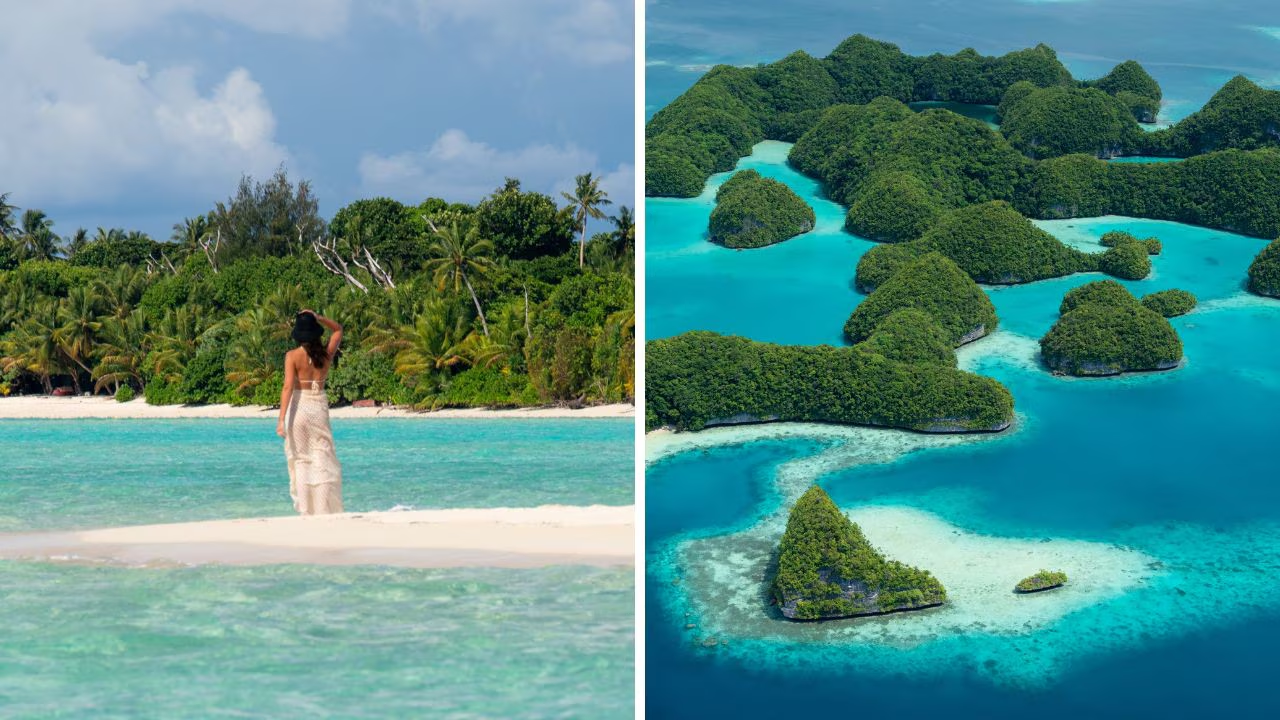
A tiny island nation in Micronesia is excited to be getting Aussies’ attention, but it doesn’t want to be the next Bali.
This year, Australia became Palau’s fastest-growing major tourism market.
The destination sits southwest of Guam and north of Indonesia – it’s located about 890km east of the Philippines and 400km north of Papua New Guinea.
The first ever non-stop flight between our two countries took off two years ago, and while the visitor numbers are still small, they are increasing quickly.
Just over 2000 Australians visited Palau in the first five months of the year, which was an increase of 87 per cent compared to the same period in 2025, and arrivals nearly doubled this May compared to last.
Palau Visitors Authority managing director Kadoi Ruluked told news.com.au he wants Australians to know Palau is no longer a hard to reach destination.
Now, he said, a six-hour flight from Brisbane can take you “to something increasingly rare; genuine untouched nature”.
“We’re one of the first nations in the world to declare our entire waters a shark sanctuary and our reefs are some of the healthiest on the planet,” he said.
The country wants to keep it that way. Palau has no intention of becoming a mass tourism destination like other Aussie favourites, Indonesia, Thailand or Fiji.
“What truly sets Palau apart is the Palau Pledge, every visitor signs it on arrival, a commitment stamped directly into their passport, promising to act in ecologically and culturally responsible way for the sake of our children and generations to come,” Mr Ruluked explained.
“No other destination in the region asks that of its visitors by law. That commitment is backed by a deliberate choice not to be a mass tourism destination.
“What’s untouched, stays untouched, giving travellers access to a natural world that’s becoming harder to find elsewhere. Combined with warm Palauan hospitality, that is what makes Palau truly special.”
The nation is made up of over 300 coral and volcanic islands and is most popular among older Australians.
About 30 per cent of Aussie visitors are aged 60 and over, and just over 20 per cent are aged in their 50s.
Mr Ruluked said they tend to be adventurous, conservation-minded visitors who value nature, outdoor activities and genuine cultural connection.
While Australian visitation is growing, the destination’s largest visitor markets continue to be China, North America, Taiwan, Japan and Europe.

Flight Centre Travel Group global leisure CEO James Kavanagh told news.com.au that Palau isn’t a competitor to Bali or Thailand for the mass-market family or budget traveller.
“It’s an alternative for a very specific niche: serious divers, marine life enthusiasts, and travellers who specifically want somewhere that’s relatively untouched and undiscovered,” he explained.
Travelling to Palau
A non-stop flight between Australia and Palau (Brisbane-Koror) was launched in May 2024, named the Palau Paradise Express and funded by the Australian Government.
It was first operated by Nauru Airlines before the contract was awarded to Qantas in December 2024.
Last year, the Australian Government extended its investment to ensure flights would continue until at least December 2026.
At the time, Republic of Palau President Surangel S. Whipps, Jr. said the flights had boosted the country’s economy through tourism and trade, and expanded its people’s education and workforce opportunities across the Pacific.
Mr Kavanagh said Australians used to be looking at a 20 to 30-plus hour trip to the islands before the Palau Paradise Express.
“Getting there so much faster, and at a much lower cost, has made a real difference, especially when you consider you can fly to Europe in roughly the same amount of time,” he said, adding that the Palau Government’s campaigning around visitation had also contributed to the increase in tourism.
Mr Kavanagh added that Palau will grow in popularity, but because its government has a specific intention behind how it wants to grow visitation, “it will probably never become truly mainstream”.
He said the best time for Aussies to visit is between November and April because dry, sunny weather gives ideal conditions for diving and snorkelling.
For first-time travellers to Palau, Mr Ruluked recommends joining a local tour.
“Beyond the UNESCO World Heritage-listed Rock Islands, one of my favourite experiences is the boat journey to Kayangel, Palau’s northernmost state and one of the least visited,” he said.
“If you’re lucky, spinner dolphins will escort you part of the way before you arrive into Kayangel’s untouched, turquoise waters.
“There are so many hidden gems to discover across our sixteen states, which is why we’ve created cultural tours including Experience Airai, Discover Ngaraard and Kingdom of the Northern Sky, each led by local guides
“I’d recommend visitors choose one of these experiences which bring Palau’s stories to life and provide a taste of the Palauan way, from our matriarchal society to the traditions that connect our island nation.”
Palau ranks second on ‘2026 Islands Hot List’
Expedia released its ‘2026 Island Hot List’ on Wednesday with Palau ranked second, only behind New Caledonia.
Accommodation searches made between September 22 last year and March 22 this year for travel in 2026 were up 60 per cent on the same period a year prior.
Expedia travel expert Sarah King said Palau “still feels like a bit of a secret” despite only being a six-hour flight away.
“Palau really hits the sweet spot for Aussies,” Ms King said. “From the iconic Rock Islands to the unforgettable experience of Jellyfish Lake, travellers can enjoy world-class scenery and adventure, with average accommodation rates of $300 per night.”
She said more savings can be made when booking a package with flights, hotel, car hire and activities together. Expedia’s own ‘Bundle & Save’ deal for an 8-night stay at Palau Royal Resort in November starts at $3538 per traveller with Qantas flights included.
“We expect Palau’s popularity may continue growing, especially among Australians who are looking beyond the usual hotspots for an island holiday,” Ms King added.
“Its mix of nature, adventure, relaxation and cultural experiences gives it broad appeal across families, couples and eco-conscious travellers alike.”
The hot list included New Caledonia (up 75 per cent), Palau (up 60 per cent), Vanuatu (up 45 per cent), Cebu in the Philippines (up 25 per cent), Langkawi in Malaysia (up 25 per cent), Jeju Island in South Korea (up 20 per cent), Fiji (up 15 per cent), Okinawa in Japan (up 15 per cent), the Whitsundays in Australia (up 10 per cent), and the Cook Islands (up 10 per cent).
While New Zealanders have long considered the Cook Islands a picturesque holiday spot, Australians are just starting to catch on.
And we make great guests, generally staying longer and spending more than our Kiwi counterparts.
“We’re still really unknown in Australia,” Graeme West, Cook Islands Tourism’s general manager of Australasia, told news.com.au while waiting to board a small flight from the stunning island of Aitutaki back to the main island of Rarotonga in May.
“It’s improved over the last few years as we do more marketing and now we’ve got daily flights out of Australia.”
Jetstar first launched flights four times a week from Sydney in June 2023 before adding a Brisbane service on the remaining three days in May 2026.
Meanwhile, Fiji is one of Australians’ top 10 most visited destinations.
The latest Australian Bureau of Statistics data, released last week for May, showed a 4.5 per cent increase in Aussies visiting in the last 12 months, compared to the year prior.
Indonesia, home to the wildly popular islands of Bali. was up 1.8 per cent, and Thailand, where you’ll find Phuket and Koh Samui, was down 2.5 per cent.
Japan, less known by Aussies as a typical island escape, was up 9.1 per cent.
