


Overview:
Every breath of air that enters the global stratosphere passes through a narrow atmospheric doorway — and that doorway sits directly above Palau.
For ten years, the Palau Atmospheric Observatory has stood watch over one of the most scientifically significant patches of sky on the planet. What began as two containers of instruments on the grounds of Palau Community College has grown into the largest scientific observatory in the rural western Pacific, generating data that reaches climate researchers from Germany to NASA and beyond.
At the observatory’s 10th anniversary ceremony, scientists and government leaders gathered to reflect on a decade of discovery — and the partnerships that made it possible.
Palau Atmospheric Observatory marks 10 years of transformative research as scientists confirm the western Pacific island sits above the world’s primary gateway to the global stratosphere
By L.N. Reklai]
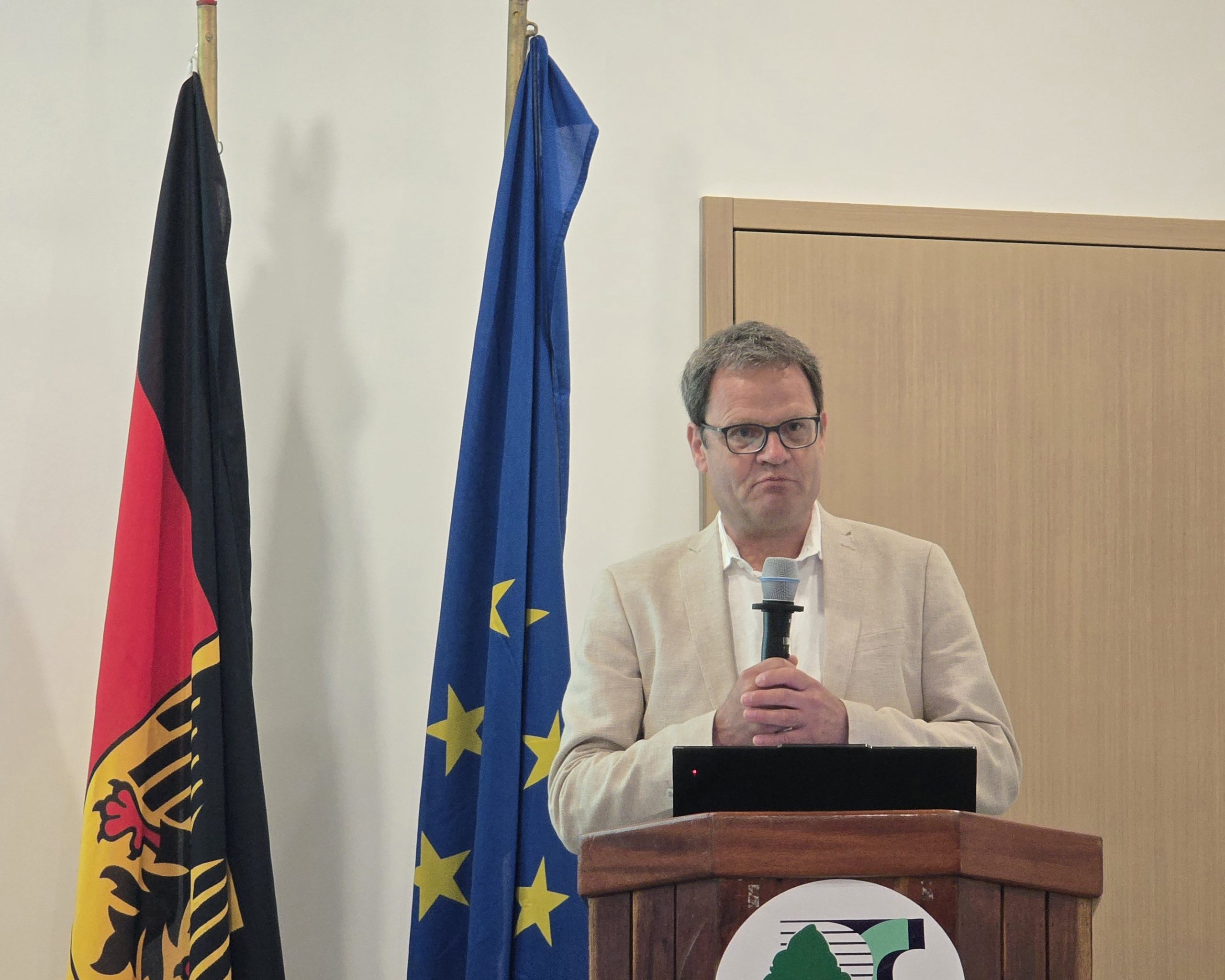
KOROR, Palau — “Nowhere is the air as clean as here,” said Dr. Markus Rex, addressing dignitaries, scientists and students gathered at the Palau Community College to mark the 10th anniversary of the Palau Atmospheric Observatory. “It is a benchmark site for understanding air chemistry in an undisturbed environment — and this region is the main source of air for the global stratosphere.”
Those words, delivered this week at a ceremony celebrating a decade of uninterrupted scientific measurement, captured the significance of a small island nation that punches far above its geographic size in the study of global climate.
The World’s Atmospheric Gateway
Rex, a leading atmospheric scientist at the Alfred Wegener Institute in Germany, explained that the ocean surface temperatures around Palau — consistently among the highest on the planet, regularly exceeding 28 degrees Celsius — drive a powerful vertical ascent of air that carries surface-level gases and aerosols all the way to the stratosphere, the atmospheric layer sitting roughly 17 kilometers above the Earth’s surface.
Using global tracking models, researchers have mapped the precise locations where air crosses the so-called tropopause — the boundary between the lower troposphere, where weather occurs, and the stratosphere. The highest concentration of those crossing points sits directly above the tropical western Pacific, with Palau at its center.
“Once the air crosses into the stratosphere in this region, it spreads globally,” Rex said. “A large fraction of the air over Germany has entered the stratosphere right above Palau.”
That makes the chemical composition of the air over Palau a matter of global consequence. Whatever gases, pollutants or aerosols enter the stratosphere here will eventually influence ozone concentrations, heat dynamics and UV protection for populations far beyond the Pacific.
Cleanest Air on Earth — and Why That Matters
Measurements taken at the observatory have confirmed that tropospheric ozone concentrations above Palau are the lowest recorded anywhere on Earth. The finding, Rex said, has fundamentally revised scientific understanding of atmospheric chemistry across the western Pacific.
Before the observatory’s decade of data, he said, global models predicted a substantially higher ozone presence in the region. “The Palau Observatory has already transformed our understanding of air composition in the western Pacific,” Rex said, describing how visualizations based on Palau data show a strikingly dark blue “hole” in global ozone maps precisely where earlier models showed none.
The low ozone environment has a cascading effect on atmospheric chemistry. With less ozone, there is also less of a key cleansing molecule — the hydroxyl radical, known as OH, which scientists call the ‘detergent of the atmospheric laundry machine.’ Without enough OH, gases emitted from the ocean, from ecosystems or from industrial sources linger far longer in the air.
Rex noted that the pollutant sulfur dioxide, which typically persists for about seven days in standard tropical conditions, can survive up to a month in the western Pacific. Another compound, dibromomethane, lasts nearly a year in this region compared to about two months elsewhere — meaning that both natural and human-made emissions here have an outsized influence on global atmospheric chemistry.
A Decade of Measurement — and Much More to Come
Dr. Katrin Müller, station manager and head of the observatory’s research program since its founding in 2015, described what has grown from a single container of instruments into the largest scientific observatory in the rural western Pacific and one of the largest in the tropics worldwide.
“We can call our observatory an oasis in the data desert,” Müller said. “Ten years of data are already great, but 20 years can really tell us about trends to come.”
The observatory’s instruments now include ozone-measuring weather balloons launched every two weeks, a green LiDAR laser that tracks aerosols and cloud particles after dark, sun photometers, infrared spectrometers, and a newly deployed PAMOS instrument monitoring fine particulate matter — pollution particles small enough to penetrate human lungs. A week of measurements at a clean-air agricultural site in Babeldaob recorded near-zero PM2.5 levels, a stark contrast to Manila and Taipei, where Müller showed comparison data.
The observatory’s 10-year ozone time series has already produced a key preliminary finding: unlike Southeast Asia, where tropospheric ozone levels have shown a positive — and troubling — upward trend, Palau so far shows no significant trend. Müller noted that spikes in 2016 and 2024 correlate with documented El Niño events, and model analysis confirms those temporary increases are driven by reduced convective activity over the island during those years.
Filling the Data Gap — and Putting Palau on the Map
The anniversary event also featured presentations by visiting scientists from NOAA and the University of Colorado Boulder. Dr. Alexandre Baron described his Balloon Baseline Stratospheric Aerosol Profile (B2SAP) project, which is now launching specialized payloads from Palau every three to four months to monitor the stratospheric aerosol layer — a thin but critical shield that moderates the amount of solar radiation reaching Earth’s surface.
“The deep tropics was one big data gap that existed before,” Baron said. “Palau sits right there, and it’s a pleasure to have been invited to bring measurements to the observatory.”
The Palau Atmospheric Observatory is now part of three international research networks: the Pandonia Global Network since 2022, the NASA-led Shadows Tropical Ozone Sun Network since 2024, and — as of just one month ago — the prestigious Network for the Detection of Atmospheric Composition Change (NDACC), which includes only a handful of similarly equipped observatories worldwide. Müller said the PAO is the only observatory of its kind in the deep tropics.
University of Bremen researchers Justus Notholt and Xiaoyu Sun, presenting via video, shared findings from the observatory’s measurements of carbon dioxide tied to El Niño cycles. Their data showed that even relatively modest El Niño events in recent years produced surprisingly high CO2 enhancements over Palau — a signal the team attributes to reduced plant uptake during dry conditions, amplified by ongoing global warming.
Looking Ahead
Looking forward, Müller outlined plans to expand collaboration with NASA, the National Center for Atmospheric Research and the Institute of Atmospheric Physics in Beijing. The team is also working to integrate the observatory’s balloon data with overpass measurements from the International Space Station’s SAGE III instrument, using Palau’s surface readings to validate and improve satellite ozone data that covers far wider areas of the globe.
Rex closed his remarks with gratitude to the people of Palau — and a reminder of what is at stake.
“The spirit of openness, support and collaboration that we have found here on Palau was a fantastic experience for us,” he said. “What we do here — we do it for Palau, and for the planet.”
The Palau Atmospheric Observatory is operated by the Alfred Wegener Institute in partnership with the Palau Community College, the Coral Reef Research Foundation, and CTSI, with support from the Government of Palau and the German Honorary Consul.
— 30 —
