


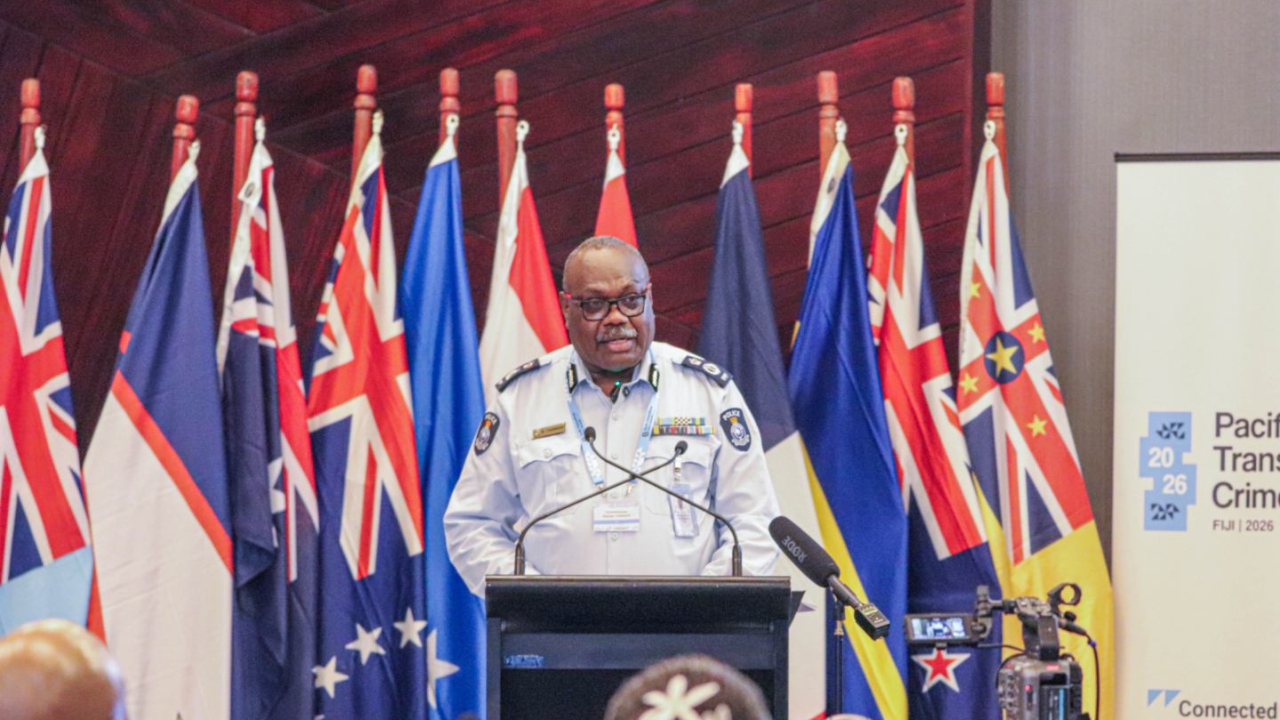
Police Commissioner Rusiate Tudravu. [Photo: BOSE VAVATAGA]
The Pacific is no longer just a transit point for illicit drugs and organised crime.
It is now becoming the destination itself, according to Police Commissioner Rusiate Tudravu.
Opening the inaugural Pacific Transnational Crime Summit, Tudravu warned that organised criminal networks are tightening their grip across the region.
He said Pacific nations are suffering the consequences of crimes largely driven by demand outside the region.
“We are not the highest consumers of illicit drugs, yet we are the most vulnerable to their impact, as we are caught in the transhipment route. The Pacific finds itself at a crossroad, literally caught in the middle of the transhipment routes to traffic illegal commodities, leaving a trail of devastation within the region while syndicates enjoy the profits of their crimes offshore. In the past, the Pacific was known as the transit; today, we are the destination.”
Tudravu compared the crisis to climate change. He said Pacific countries contribute little to the global drug trade, yet carry some of its heaviest impacts.
The Police Commissioner said the region sits directly along major trafficking routes. As a result, communities are facing rising drug harm, social instability and growing pressure on law enforcement.
He said criminal syndicates continue to profit offshore while Pacific countries deal with the damage left behind.
Tudravu warned against accepting the narrative that the Pacific is losing the battle against transnational crime.
He said Pacific police forces must prove the region is capable of fighting back.
We are not going to settle for the vulnerable tag, he told regional police chiefs and international partners gathered at the summit.
The meeting brings together law enforcement leaders from across the Pacific to strengthen regional responses to organised crime, drug trafficking and illicit trade.
Tudravu said cooperation through the Pacific Transnational Crime Network and the Pacific Transnational Crime Coordination Centre has already produced significant results since 2002.
However, he warned that criminal groups are evolving rapidly and regional responses must move faster.
He said the summit could not become another routine meeting without action and measurable outcomes.
Tudravu called for stronger intelligence sharing, cross-border investigations and coordinated prosecutions.
He said organised crime cannot be tackled in isolation.
The Commissioner also acknowledged the role of Australia and New Zealand in the regional fight.
He said demand within larger markets continues to drive the trafficking of illicit commodities through the Pacific.
Tudravu urged leaders attending the summit to return home with practical strategies capable of delivering visible results across the region.
