

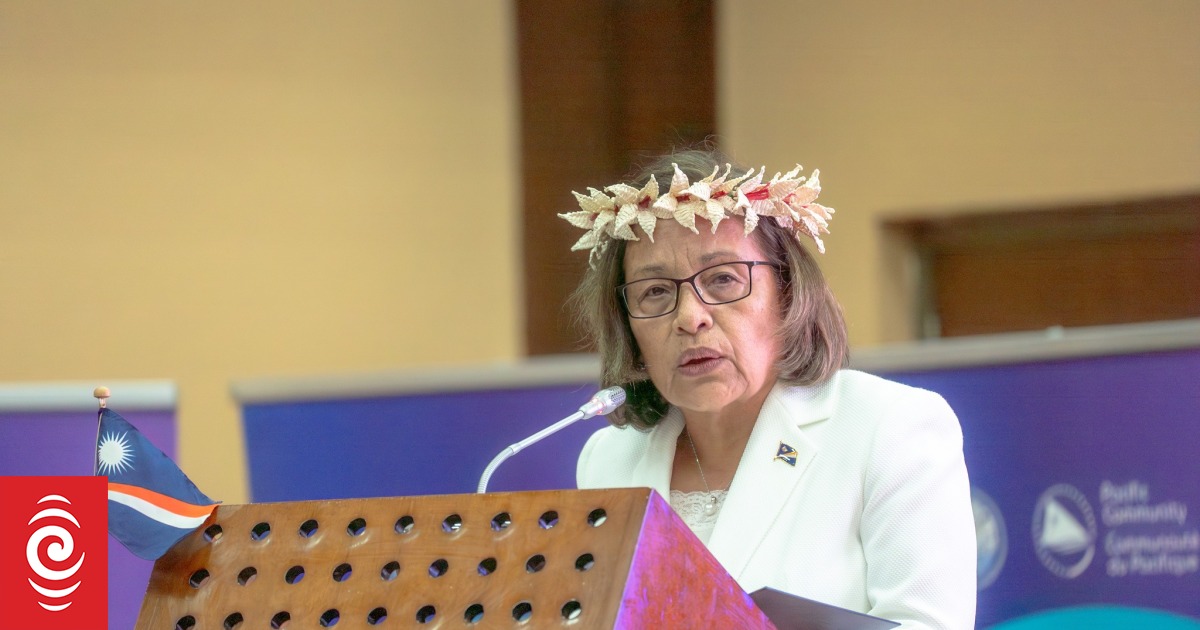
Marshall Islands President Dr Hilda Heine
Photo: Facebook / Pacific-Community-SPC
Marshall Islands President Dr Hilda Heine has told a high-level forum in Japan that island states need greater access to finance, and technology to better manage their oceans.
Heine is among a handful of Pacific leaders – including Cook Islands Prime Minister Mark Brown, Tuvalu Prime Minister Feleti Teo, and Palau’s President Surangel Whipps Jr – attending the two-day Island States Ocean Summit in Tokyo this week.
“For my country, the ocean is not simply a resource. It is our identity, our livelihood, our history, and our future,” Heine told heads of state, ministers, development partners and ocean leaders.
Heine highlighted the growing challenges facing island nations, including climate change, biodiversity loss, marine pollution and increasing pressures on ocean resources, the Office of the Marshall Islands President said in a news release.
The president stressed that while island states were leading efforts to protect and manage their oceans, “greater access to financing, technology, scientific data, and capacity-building remains critical.”
“As a large ocean state, sustainable ocean planning and management is not optional. It is essential,” she told delegates when delivering the Marshall Islands high-level statement at the summit.

Pacific Ocean map.
Photo: 123RF
According to the organisers, the summit will encourage island states to develop their national frameworks – the Sustainable Ocean Planning and Management (SOPM) – to balance ocean conservation with sustainable use.
Heine has thrown the Marshall Islands’ support behind the proposed SOPM Support Platform, and called for “a demand-driven, country-led mechanism that strengthens capacity and partnerships while remaining responsive to national priorities”.
Speaking at a plenary session on climate resilience at the conference, Tuvalu PM Teo focused his message on the urgent need to strengthen the connection between climate action and ocean management.
Tuvalu remains one of the world’s most vulnerable nations to climate change and sea-level rise.
“Climate change is our reality. It is no longer a projection or mere speculation. It is a daily occurrence and a lived reality,” Teo said.
Teo noted that the impacts of the climate crisis are already being experienced across Tuvalu, including coastal erosion, coral bleaching, changing fish migration patterns and increasing threats to livelihoods and food security.
“For Tuvalu, Sustainable Ocean Planning and Management should not be a planning exercise only, but a survival framework,” he said.
Whipps told the summit that the ocean is changing faster than island states can adapt.
He warned that international ocean and climate governance is not delivering for those who are most vulnerable.
“We need action that matches the urgency,” the Palauan leader said, adding that “integrated ocean management is achievable, but it requires sustained investment and legal architecture”.
Sign up for Ngā Pitopito Kōrero, a daily newsletter curated by our editors and delivered straight to your inbox every weekday.
