


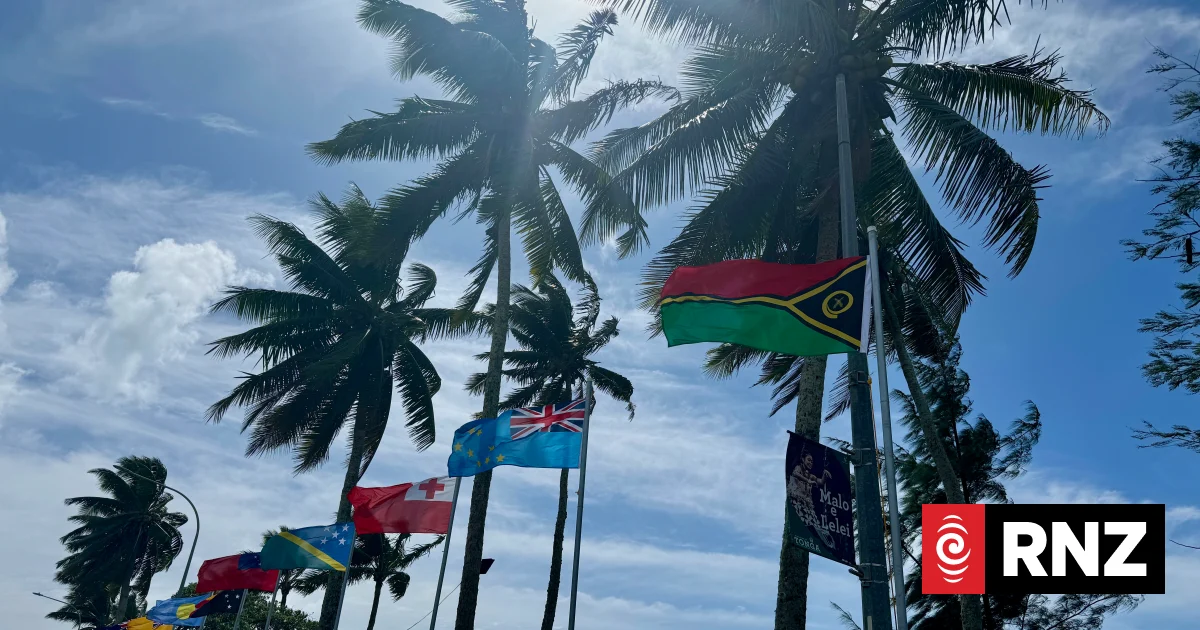
A proposal from the Solomon Islands government for a regional security treaty is being considered by the Pacific Islands Forum (PIF) foreign ministers in Suva on Friday, RNZ Pacific understands.
The treaty proposal forms a key agenda item at the day-long annual meeting – the outcomes of which help determine what will be discussed at the Forum leaders’ meeting in Palau at the end of the month.
Solomon Islands Prime Minister Matthew Wale, who is also PIF chair, began promoting the concept of a regional security agreement soon after he was elected leader by his country’s parliament in May.
The idea gained pace in early June after the new Wale visited his Australian counterpart Anthony Albanese in Canberra.
In an address he delivered at the PIF headquarters in Suva last month, Wale highlighted the need for the region to consider “bold ideas that strengthen our collective security and provide greater certainty for future generations”.
He also told ABC there was “a growing consensus” among leaders he had spoken with of “gaps that such an architecture would help plug”.
However, political experts warn a collective security treaty could change regional decision-making processes and norms by introducing mandatory consultation.
Currently, decision making and policy processes on regional security through the Forum are guided by principles enshrined in regional declarations like Biketawa, Boe, and the Ocean of Peace.
Solomon Islands Prime Minister and Pacific Islands Forum chair Matthew Wale.
Pacific Islands Forum
This regional cooperation is not underpinned by an international legal agreement, except in certain instances like nuclear issues, which are covered by the Treaty of Rarotonga, and fisheries surveillance under the Niue Treaty.
The PIF, through its 2050 Strategy for the Blue Pacific Continent, describes this type of political cooperation as the “Pacific Way”. It involves “consensus-based decision making, whilst respecting sovereignty and the principle of non-interference in national affairs”.
Converting political commitments into obligations
According to RNZ Pacific sources, those pushing for the Solomons security treaty intend to codify the existing regional security legal and policy framework, including the three declarations mentioned above.
Codification would involve setting rules that govern regional security cooperation.
Massey University Centre for Defence and Security Studies associate professor Anna Powles said the existing Forum architecture and declarations and agreements, like Biketawa, preserve sovereignty and substantial national discretion.
“The proposed treaty would convert political commitments into obligations under international law, which poses a series of questions from what obligations it creates, whether decisions remain consensual, and whether it regulates existing bilateral security partnerships.”
Powles emphasised the need for governments to carefully consider what was being put on the table through the proposed agreement.
This included which decisions governments were agreeing to share, the obligations they were committing to, and whether the proposed treaty could restrict their ability to respond to national circumstances.

Pacific leaders pose for an official “family photo” at the 54th Pacific Islands Forum Leaders’ Meeting in Honiara, Solomon Islands. 11 September 2025.
RNZ Pacific / Caleb Fotheringham
“Depending on what the Wale proposal contains and seeks to do, a treaty in the current geopolitical climate could risk narrowing the Pacific concept of security from the Boe Declaration, which recognises climate change as the existential threat.
“There will be concern in parts of the region that the proposed treaty could become another geopolitical instrument through which certain states seek to limit their competitors.”
Wording to be ‘critical’
Regarding shifts in the policy and decision-making processes, Powles said the wording of the treaty would be critical.
“A formal collective security treaty could change regional decision-making and consensus by introducing mandatory consultation,” she said.
“Governments might be legally required to notify and consult other members about an emerging security threat, or a proposed security arrangement with an external power.”
The key question would then be who or what country would be given a formal role in determining whether an issue constituted a regional security concern, she said.
“The treaty would need to establish how collective action is authorised. If consensus is retained, every member would continue to have an effective veto.
“Members could be required to notify or consult the region before entering bilateral security agreements involving foreign police, military personnel [and] bases, or strategic infrastructure.”
Powles also suggested a stronger version of the treaty may be needed to achieve this, which would have the potential to “significantly reduce individual governments’ freedom of action” and “probably be the treaty’s most politically contested feature”.
“The key distinction is between consensus over adopting the treaty and decision-making after it enters into force, or if the treaty simply consolidates existing declarations, preserves consensus and makes participation in regional responses voluntary. Its principal effect would be to give existing commitments a more durable legal form.”
‘Competing priorities’ around regional security
Pacific historian and Auckland University of Technology lecturer Marco de Jong highlighted the potential trade-offs around a regional security treaty.
“There are a range of competing priorities when it comes to the formulation of a treaty.
“On the one hand, it may be to codify long-standing norms and principles, which have guided regional security cooperation thus far.
“Alternatively, it might be to embed, and serve as a chapeau for, the emerging regional security architecture, which is predominantly being driven by Australia,” he said.
“Another option is that it might seek to elevate the types of confidence-building or transparency mechanisms, and strategic-trust mechanisms, which have been in bilateral agreements to the regional level.”
De Jong said those scenarios meant vastly different things for the region.
“All three of those potential purposes are in tension when it comes to genuine, Pacific-led regional security.”
RNZ Pacific
Both De Jong and Powles urged careful consideration and discussion on the treaty proposal.
“For instance, what problem does a treaty solve that existing declarations cannot,” Powles asked.
“Which provisions or obligations would be legally binding? How will the tradition and spirit of consensus be upheld? Who will pay for the operationalisation of the treaty? Where does oversight sit? Will the Pacific Islands Forum have oversight? How will disputes be resolved, and can a state withdraw?”
Following Friday’s meeting, regional leaders are due to gather in Palau for the week-long PIF Leaders’ Meeting beginning 30 August.
This is expected to be one of the Forum’s largest leaders’ summits, with dialogue partners set to attend – a departure from last year where then-host Solomon Islands excluded dialogue partners.
