

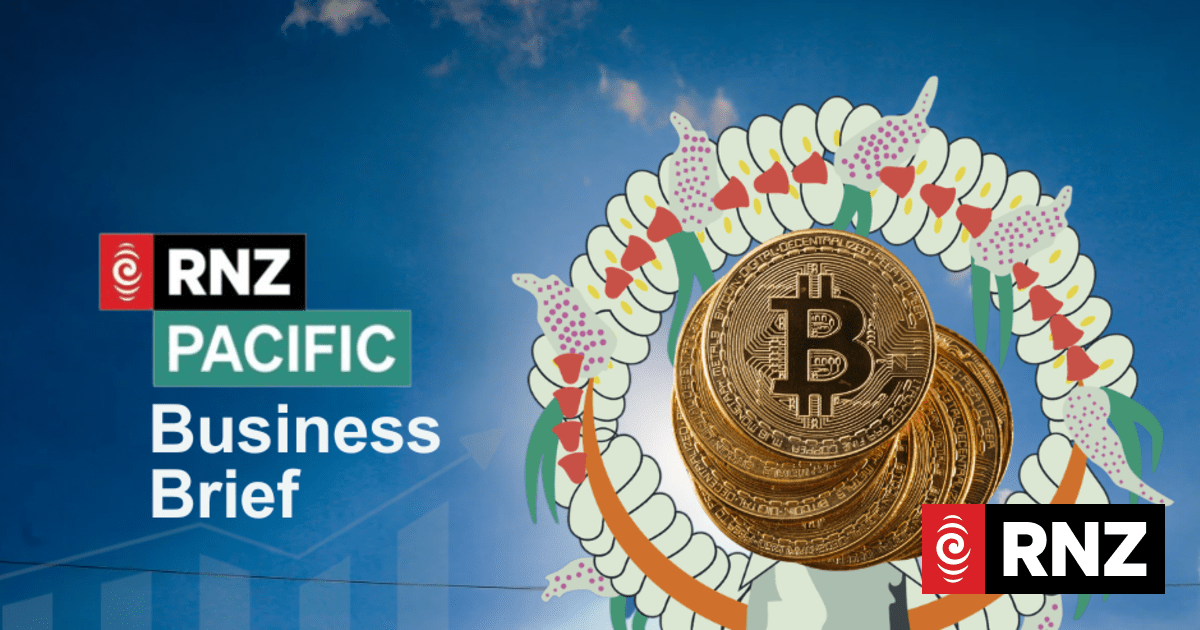
The Pacific Business Brief tracks the capital, trade and trends shaping the regional economy.
Photo: RNZ Pacific
The Northern Marianas get a new digital token, and James Marape tries to woo Chinese giants for infrastructure investment.
Here are the weekly highlights in the Pacific economy.
In this edition:
- Northern Marianas’ cryptocurrency plans for disaster recovery
- Papua New Guinea PM’s diplomatic mission to China
The crypto storm
A former secretary of finance in the Commonwealth of the Northern Mariana Islands (CNMI) has become the US territory’s chief proponent of cryptocurrency.
In the wake of Severe Typhoon Sinlaku, David Atalig says he has a guaranteed revenue stream for recovery and disaster spending: from a digital tokens trading profits.
Atalig runs the new Marianas Foundation, and is also a part of $MARI, soon to be launched by Atlanta-based blockchain server Nebula Defi and custodians Zone Global Marianas.
“We started this project about eight months ago, and the same concept and the purpose was for a community benefit programme,” Atalig told RNZ Pacific.
“With the recent typhoon, we just shifted our goal to say we can be a part of something to help the CNMI basically recover.”
The for-profit firms have an audacious goal to generate $100 million in revenue from trading the $MARI token in three months from June. For that time, Atalig said his foundation will receive more than two percent of that revenue. From then on, its two percent in perpetuity.
The crypto world has captured the imaginations of Pacific governments everywhere. Fiji and Vanuatu are exploring opportunities around a central bank digital currency, Palau is developing a stablecoin programme for cross border transactions, and aid agencies such as Oxfam are hooking up storm-hit communities with digital wallet apps.
In November, the Marshall Islands announced a universal basic income (UBI) system via a stablecoin called USDM1. Finance Minister David Paul told RNZ Pacific at the time that it could reach far out communities where cash shipments were scarce and access to banks was minimal
This, Atalig believed, would eventually become a key selling point for locals on the outer reaches of the Mariana Archipelago. Nevertheless, he said he is not marketing the token to local people to buy into right now – but he would not say no.
“It’s a privately run project. It has support from from government officials, but it’s not backed by the CNMI government,” he said.
“We’re not looking at this as something that changes the local people’s way of utilising their funds, we’re just trying to be an alternative.”
A report in Marianas Variety last week by Gregorie Michael Towai criticised the project as yet another means of foreign exploitation dressed up in humanitarian clothing.
“The more the token is used locally, the more value is extracted outward. That is not a recovery model. That is an extraction model,” it read.
“The CNMI has seen this pattern before. External entities arrive with capital, technology, and promises of transformation. They position themselves as partners. They align with local leadership. They frame their presence as opportunity. And over time, the balance of benefit shifts outward, leaving the community with less control than it began with.”
But Atalig said it was nonsense.
“We’re all doing this for business purposes, but it was just part of our ecosystem. Nebula Defi are our experts in the field and they are also strong on on compliance.”
The project launches on 2 June.
Marape in Guangdong
China’s Guangdong Province recently rolled out the red carpet for Papua New Guinea Prime Minister James Marape.
China remains PNG’s largest trading partner, and Guangdong is China’s industrial powerhouse. The Observatory of Economic Complexity, PNG spends $1.33 billion on Chinese goods: but China spends $3.26 billion in the other direction. Natural resources dominate the exports list in both directions.
The Chinese Embassy in PNG said that the country has “now emerged as the bridge for PNG and Pacific into China”.

PNG Prime Minister James Marape was treated by Guangdong officials for his birthday during his trip to China.
Photo: Chinese Embassy in PNG
Pleas made by PNG to China included a “build-and-operate” plan for PNG’s aging water infrastructure, “long-term partnerships” for ports, and greater investment into the resources sector.
Trade Minister Richard Maru said that they were extending “an olive branch” to Chinese capital.
“We will offer incentives under the economic zone. So if you invest in agriculture, we will offer incentives. If you are in downstream processing, we offer incentives.” Maru told a meeting of business folk.”
Special Economic Zones are not uncommon in the Pacific. The government negotiates with the private sector to carve out locations where, if a business sets up, they benefit from certain tax and regulatory exemptions.
Marape also had meetings with two resources giants: China Minmetals, which operates the Ramu nickel-cobalt project in Madang Province, and Guangdong Rising, which is invested in the Frieda River copper-gold project in Sepik.
Other meetings included with electric car company BYD, and the inventor of Juncao, a nutrient rich grass on which mushrooms grow faster.
